rile*books

Search books

Search books by title, author, publisher, keywords...

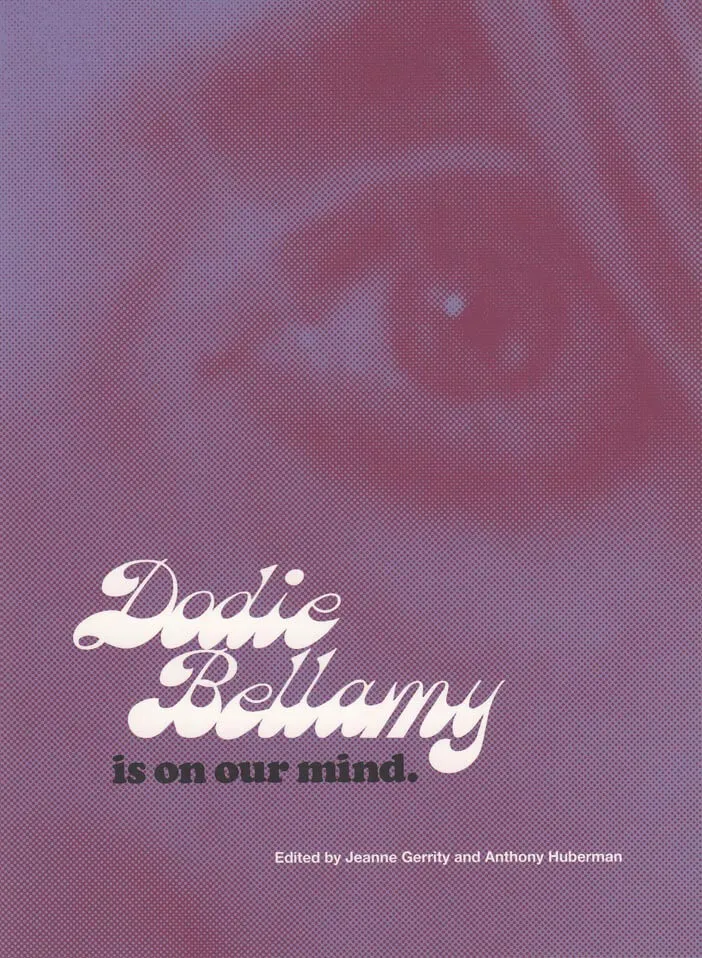
Cover of Dodie Bellamy Is on Our Mind

Semiotext(e)

Dodie Bellamy Is on Our Mind

Anthony Huberman ed., Jeanne Gerrity ed.

€25.00

Examining the genre-bending writing of Dodie Bellamy, whose work has focused on sexuality, politics, feminism, narrative experimentation, and all things queer.

Dodie Bellamy Is on Our Mind is the first major publication to address Bellamy's prolific career as a genre-bending writer. Megan Milks made several trips to San Francisco in order to spend time with Bellamy and craft a provocative and fascinating profile of the writer. Originally delivered as a lecture at the Wattis Institute, Andrew Durbin's text takes the form of a personal essay, expertly weaving anecdotes of his own encounters with Bellamy's writing with insights into broader themes in her work. Academic Kaye Mitchell takes a close look at the role of shame and its relationship to femininity in particular texts by Bellamy. And Bellamy and her late husband Kevin Killian offer deeply personal, emotionally wrenching ruminations on topics from the mundane (drawing) to the profound (mortality). These texts, alongside archival photos and a complete bibliography make, this book an important compendium on Bellamy.

Dodie Bellamy (b. 1951, in North Hammond, Indiana) has lived and worked in San Francisco since 1978. A vital contributor to the Bay Area's avant-garde literary scene, Bellamy is a novelist and poet whose work has focused on sexuality, politics, feminism, narrative experimentation, and all things queer. In her words, she champions “the vulnerable, the fractured, the disenfranchised, the fucked-up.”

Language: English

recommendations

Cover of Resentment: A Comedy

Semiotext(e)

Resentment: A Comedy

Gary Indiana

Fiction €18.00

In a novel capturing an era that seems at once familiar and grotesque, a New York writer lands in Los Angeles in 1994.

Originally published in 1997, Resentment was the first in Gary Indiana's now-classic trilogy (followed in 1999 by Three Month Fever: The Andrew Cunanan Story and in 2003 by Depraved Indifference) chronicling the more-or-less permanent state of “depraved indifference” that characterized American life at the millennium's end.

In Resentment, Seth, a New York–based writer arrives in Los Angeles (where he has history and friends) in mid-August, 1994, to observe what will become the marathon parricide trial of the wealthy, athletic, and troubled Martinez brothers, broadcast live every day on Court TV. Still reeling from the end of his obsessive courtship of a young SoHo artist/waiter, Seth moves between a room at the Chateau Marmont and a Mount Washington shack owned by his old cab-driving, ex-Marxist friend, Jack, while he writes a profile of Teddy Wade—one of the era's hottest young actors, who has “dared” to star as a gay character in a new Hollywood film. Studded throughout with scathing satirical portraits of media figures, other writers, and the Martinez trial teams, Resentment captures an era that seems, two decades later, at once grotesque, familiar, and a precursor to our own.

Introduction by Patrick McGrath
Afterword by Chris Kraus

Cover of Artless: Stories 2019-2023

Semiotext(e)

Artless: Stories 2019-2023

Natasha Stagg

Fiction €17.00

Composed of stories, fragmentary essays, and even press releases Stagg has been commissioned to write, Artless captures the media landscape lived and generated in New York during the past half decade. Since the 2016 publication of her debut novel Surveys, Stagg has positioned herself as an in-demand expert on, and critic of, the psychic experience of self-mythology within the cruelly optimistic metaverse of infinite branding. Part voyeur and part participant, Stagg continues her exploration of the branded identity and its elusive, bottomless desire for authenticity.

Natasha Stagg is the author of a novel, Surveys, and a collection, Sleeveless: Fashion, Image, Media, New York 2011-2019. Her essays have appeared in the books Excellences and Perfections, Link in Bio: Art After Social Media, You Had To Be There: Rape Jokes, Intersubjectivity Vol. II: Scripting the Human, and 9th Berlin Biennale for Contemporary Art: The Present in Drag, among others.

Cover of The Pain Journal

Semiotext(e)

The Pain Journal

Bob Flanagan

Biography €21.00

"The Pain Journal" is the last finished work by Los Angeles writer and artist Bob Flanagan and is the extraordinary chronicle of the final year of his life before his death from cystic fibrosis at the age of 43. Flanagan created performances with Sheree Rose that shocked and inspired audiences as he combined text, video, and live performance to create a highly personal exploration of childhood, sex, illness, and mortality.

Cover of Ripcord

Semiotext(e)

Ripcord

Nate Lippens

Fiction €17.00

A novel about escape and connection, class, sex, and queer intimacy in the American Midwest. 

The oldest story: an insider pretends to be an outsider and receives praise for his empathy and imagination and intelligence. Maybe some asshole even says bravery. An outsider pretends to be an insider, is exposed as a fraud, a liar, and burned to the ground. 

In Ripcord, Nate Lippens continues his meditations on escape and connection, class, sex, and intimacy. Stuck in Milwaukee, the narrator cobbles together a living by bartending and catering weddings, enmeshed in a semiaffair with a younger, married man. Cruising apps while tallying his youthful romantic failures, he fantasizes about disappearance but finds both solace and frustration in his friendships with Charlie, an aging punk who was prominent in the 1990s Chicago queercore scene, and Greer, a painter who never broke through but continues making work.

Cover of Love Me Tender

Semiotext(e)

Love Me Tender

Constance Debré

LGBTQI+ €18.00

A novel of lesbian identity and motherhood, and the societal pressures that place them in opposition. 

The daughter of an illustrious French family whose members include a former Prime Minister, a model, and a journalist, Constance Debré abandoned her marriage and legal career in 2015 to write full-time and begin a relationship with a woman. Her transformation from affluent career woman to broke single lesbian was chronicled in her 2018 novel Play boy, praised by Virginie Despentes for its writing that is at once "flippant and consumed by anxiety."  

In Love Me Tender, Debré goes on to further describe the consequences of that life-changing decision. Her husband, Laurent, seeks to permanently separate her from their eight-year old child. Vilified in divorce court by her ex, she loses custody of her son and is allowed to see him only once every two weeks for a supervised hour. Deprived of her child, Debré gives up her two-bedroom apartment and bounces between borrowed apartments, hotel rooms, and a studio the size of a cell. She involves herself in brief affairs with numerous women who vary in age, body type, language, and lifestyle. But the closer she gets to them, the more distant she feels. Apart from cigarettes and sex, her life is completely ascetic: a regime of intense reading and writing, interrupted only by sleep and athletic swimming. She shuns any place where she might observe children, avoiding playgrounds and parks "as if they were cluster bombs ready to explode, riddling her body with pieces of shrapnel."  

Writing graphically about sex, rupture, longing, and despair in the first person, Debré's work is often compared with the punk-era writings of Guillaume Dustan and Herve Guibert, whose work she has championed. As she says of Guibert: "I love him because he says I and he's a pornographer. That seems to be essential when you write. Otherwise you don't say anything." But in Love Me Tender, Debré speaks courageously of love in its many forms, reframing what it means to be a mother beyond conventional expectations.

Cover of Raven Chacon: A Worm’s Eye View From a Bird’s Beak

Sternberg Press

Raven Chacon: A Worm’s Eye View From a Bird’s Beak

Stefanie Hessler, Katya García-Antón and 1 more

Monograph €29.00

A career-spanning catalogue featuring excerpts from Raven Chacon’s scores, musical prompts, and drawings interspersed with full-color documentation and descriptive texts of installations, sculptures, and performances. Raven Chacon is a composer and artist creating musical experiences that explore relationships among land, space, and people.

In an experimental practice that cuts across the boundaries of visual art, performance, and music, Chacon breaks open musical traditions and activates spaces of performance where the histories of the lands the United States has encroached upon can be contemplated, questioned, and reimagined. In 2022, Raven Chacon became the first Native American to win the Pulitzer Prize for Music, and was awarded a prestigious MacArthur “genius” fellowship in 2023.

Texts by Raven Chacon, Lou Cornum, Aruna D'Souza, Candice Hopkins, Anthony Huberman, Ingir Bål Nango, Marja Bål Nango, Dylan Robinson & Patrick Nickleson, Eric-Paul Riege, Sigbjørn Skåden, Ánde Somby.

Foreword by Katya García-Antón and Stefanie Hessler.

Cover of The Letters of Mina Harker

Semiotext(e)

The Letters of Mina Harker

Dodie Bellamy

Fantasy €18.00

In Dodie Bellamy's imagined "sequel" to Bram Stoker's fin de siècle masterpiece Dracula, Van Helsing's plain Jane secretarial adjunct, Mina Harker, is recast as a sexual, independent woman living in San Francisco in the 1980s. The vampire Mina Harker, who possesses the body of author Dodie Bellamy, confesses the most intimate details of her relationships with four vastly different men through past letters. Simultaneously, a plague is let loose in San Francisco-the plague of AIDS.

Bigger-than-life, half goddess, half Bette Davis, Mina sends letter after letter to friends and co-conspirators, holding her reader captive through a display of illusion and longing. Juggling quivering vulnerability on one hand and gossip on the other, Mina spoofs and consumes and spews back up demented reembodiments of trash media and high theory alike. It's all fodder for her ravenous libido and "a messy ambiguous place where pathology meets pleasure." Sensuous and captivating, The Letters of Mina Harker describes one woman's struggles finding the right words to explain her desires and fears without confining herself to one identity.

Cover of Cunt Norton

Les Figues Press

Cunt Norton

Dodie Bellamy

Fiction €20.00

In Cunt Norton, the sequel to her unforgettable CUNT UPS, Dodie Bellamy "cunts" The Norton Anthology of Poetry (1975 edition), setting her text-ravenous cut-ups loose to devour the canonical voices of English literature.

The texts that emerge from this sexual-linguistic encounter are monstrous, beautiful, unashamed: 33 erotic love poems ("the greatest fuck poem in the English language," according to Ariana Reines) that lust after the very aesthetic they resist. "These patriarchal voices that threatened to erase me—of course I love them as well," Bellamy writes. Even as Cunt Norton dismembers the history of English poetry, "cunting" Chaucer and Shakespeare, Emerson and Lowell, it simultaneously allows new sexual members to arise and fill in the gaps, transforming the secret into the explicit, the classically beautiful into the wonderfully grotesque. Bellamy's cunted texts breathe life into literary "masters" with joy, honesty, hilarity, and insatiable passion.