rile*books

Search books

Search books by title, author, publisher, keywords...

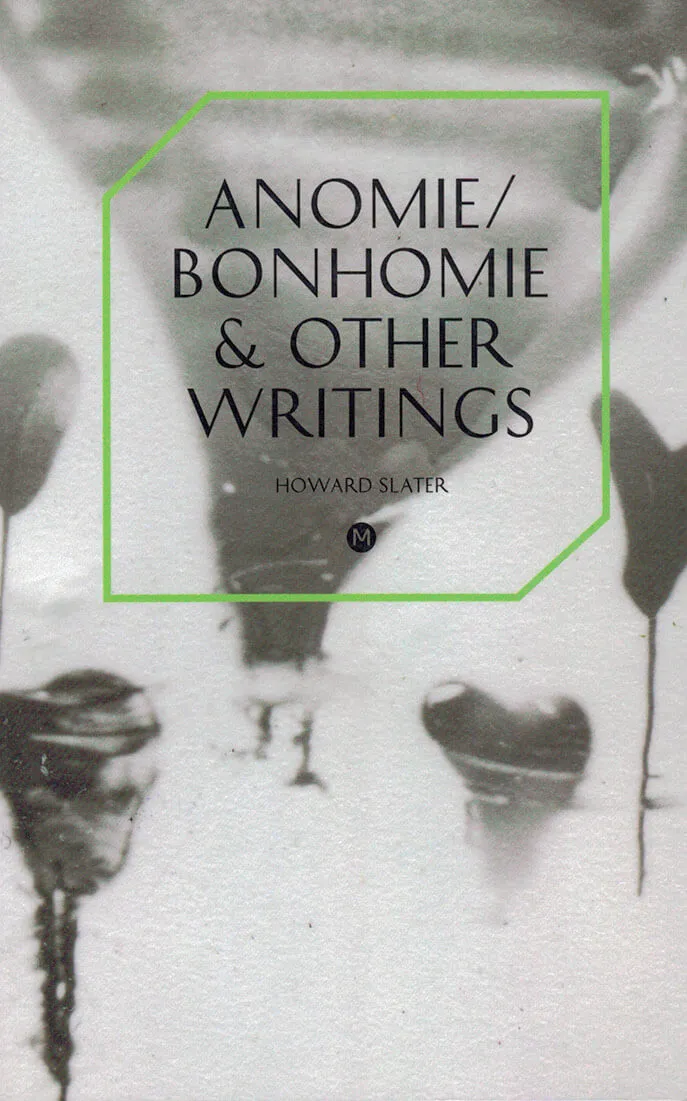
Cover of Anomie/ Bonhomie & other writings

Mute

Anomie/ Bonhomie & other writings

Howard Slater

€10.00

In this collection of writings, Howard Slater improvises around what Walter Benjamin could have meant by the phrase 'affective classes'. This 'messianic shard' and its possible implications leads Slater to develop a therapeutic micro-politics by way of a mourning for the Workers' Movement and a grappling with the 'becomings of capital'.

The essay 'Anomie/Bonhomie' is the keystone of this book which also features tributary texts and poems drawn from the past ten years. These supplementary texts approach such themes as exodus, species-being, surrealist precedents, poetic language and the possibilities for collective 'affective' practices to combat capitalism's colonisation of the psyche.

Language: English

recommendations

Cover of Art et production

Éditions Sans Soleil

Art et production

Boris Arvatov

Non-fiction €19.00

Art et production de Boris Arvatov fait partie des classiques oubliés des avant-gardes qui se sont épanouies durant la Révolution russe. Publié à Moscou en 1926, il vient porter le fer dans les débats qui agitent l’école constructiviste : que doit être le statut de l’art après la révolution, ses liens avec les techniques industrielles de reproduction, avec la critique de la vie quotidienne, comment doit-il entrer dans l’usine ? Autant d’interrogations radicales, témoignages d’une séquence politico-sociale bouillonnante. Une nouvelle conception de l’art émerge, qui laissera une empreinte indélibile sur une tradition de critiques matérialistes de la culture, de Walter Benjamin à Peter Bürger, en passant par Fredric Jameson, celle qui posera la question de l’articulation entre pratique artistique et logiques propres à la sphère de la production. Un document exceptionnel enrichi d’illustrations, paraissant en français pour la première fois, une porte prviliégiée sur un moment-clé de la modernité exthétique du XXe siècle. 

Boris Arvatov (1896–1940) est un artiste et critique d’art russe. Il est notamment connu comme théoricien du productivisme, un mouvement d’avant-garde post-révolutionnaire lié au constructivisme. 

Cover of Cyclamen

Tenement Press

Cyclamen

Alix Chauvet

Poetry €25.00

A debut collection from the poet, artist and designer, a suite of unfaithful translations/transversions of works drawn from Baudelaire’s Les Fleurs du mal / Flowers of Evil, a bunch of flowers in decay, pressed and frayed, ‘a flock of pockmarked words.’

Through these creative ‘translations’ of Charles Baudelaire, Alix Chauvet—artist, designer, poet—refuses fidelity in favour of flirtation: her ‘flowers of evil’ line Amsterdam’s canals, drink from the same rainclouds as Rachel Ruysch’s bewitching bouquets, sprout through peat, and are tended by a distinctly feminist and nomadic sensibility. Chauvet—akin to Olive Moore, Sean Bonney and Lisa Robertson—takes the nineteenth-century French decadent as a contemporary accomplice for aesthetic and linguistic misbehaviour. Walter Benjamin once wrote of Baudelaire that he is ‘der geheime Architekt der Moderne,’ and in Chauvet’s hands, those foundations are made porous, unbuilt into cast shadows, into ribbons, into veins streaming across the page. Accompanied by scans of the French poems and Chauvet’s shadow photography, what Cyclamen ultimately offers us is a regenerative rewilding of the English language: a wondrous terrain ringed by vines of unruly syntax and dotted with the fruit of words refusing domestication by any single tongue. Mia You

Alix Chauvet is a Swiss-French poet and graphic designer based in Amsterdam, taking pleasure in the possibilities of translation. She received her BA in Graphic Design from the Gerrit Rietveld Academie (Amsterdam, 2020), and has since been working independently and in collaboration with contemporary artists. Investigating the relationships between language and body, intimacy and collectivity, past and contemporary, her hybrid practice covers a wide range of visual and linguistic experiments from artist’s book design to experimental translation. Her method is rooted in decelerating the creative process through the use of analogue and unprofitable techniques such as cut-outs, letterpress, linocut, handwriting and painting. Chauvet’s poetic approach follows the same logic, prioritising English over her mother tongue as a way to revise language with both critical detachment and a degree of identification. Her poems have appeared in literary magazines such as Blackbox Manifold, and Cyclamen is her debut collection.

Cover of The Mirror of Simple Souls

Winter Editions

The Mirror of Simple Souls

Leah Flax Barber

Poetry €20.00

In her first book of poems, Leah Flax Barber revives an actress figure of the commedia dell'arte to consider her own destiny as a soon-to-be historical subject. Taking its title from Marguerite Porete's fourteenth-century Beguine classic, The Mirror of Simple Souls embodies the metaphysical thorniness of the book-as-object through sources as wide-ranging as Renaissance theater, Low German and Old French mystical texts, Kate Bush lyrics, and the melancholy dialectics of Walter Benjamin. In Flax Barber's stark, brutally compressed poems, the performance of writing is charged with the eros and anxiety of coming after: "Will it all be destroyed? / Definitely / I will hear it on my radio / In the 22nd century."

The Mirror of Simple Souls, a series of repeated beginnings and endings, is a form of speech act which, through a Freudian Durcharbeiten, or working through, brings about a new beginning. And, in its movement from this Freudian "working through" to a Hegelian Aufhebung, lets us begin, again, at the beginning, at the end. —CYNTHIA CRUZ

The spare poems of The Mirror of Simple Souls evoke and then draw back into shimmer. Herein, a performance that suffuses the horizon with beautiful absurdity: a shirt sewn with mirrors that reflect a strange and evanescing world-at-large, “an I where the nay was.” Drawing from film, mystical texts, commedia dell'arte, the reader finds that there “is paraphernalia of life / all over.” This paraphernalia is a kind of “segue music” for the endlessly indeterminate. The old adage claims that we can’t step into the same river twice, but Leah Flax Barber creates an evocative, provocative current through which each step is at once past, present, and future. —ELIZABETH ROBINSON

Leah Flax Barber is a daring and brilliant new poet. Her voice is restless and coiled and sprung as we discover "The demonic finalist / Of material culture / Is love / There is paraphernalia of life / All over / A woman.” There is also a take-no-prisoners attitude throughout this startling and powerful book. These poems are vital and necessary and perform “The wounded chance / To think in public.” This book will move you, scare you, and blow you away. —PETER GIZZI

Leah Flax Barber's first book reads like a journey, a kind of anabasis, passing back through the myth and history which are its own antecedents. It manifests, in the encounter, a saturnalian world: ludic, dark and sensuous, strange and vibrant with thought. I was delighted to travel with it. —CLAIRE DeVOOGD

Cover of Appendix Project

Prototype Publishing

Appendix Project

Kate Zambreno

Essays €16.00

Written in the course of the year following the publication of Book of Mutter, and inspired by the lectures of Roland Barthes, Anne Carson, and Jorge Luis Borges, Appendix Project collects eleven talks and essays. These surprising and moving performances, underscored by the sleeplessness of the first year of their child’s life, contain their dazzling thinking through the work of On Kawara, Roland Barthes, W.G. Sebald, Bhanu Kapil, Walter Benjamin, Theresa Hak Kyung Cha, Marguerite Duras, Marlene Dumas, Louise Bourgeois, Doris Salcedo, Jenny Holzer, and more.

Cover of Wanting Something Completely Different – 111 Vignettes of Left-Wing Figures, Themes, Films, and Writers

Rab-Rab Press

Wanting Something Completely Different – 111 Vignettes of Left-Wing Figures, Themes, Films, and Writers

Jairus Banaji

Non-fiction €20.00

A collection (montage) of biographies and themes written by Jairus Banaji.
Wanting Something Completely Different discusses a range of political figures, themes, directors and writers in a series of brief, evocative descriptions ('vignettes') aimed at laying out a vision of a modern, cosmopolitan left that can think creatively about the world we live in. The political figures include both thinkers and activists from a wide range of backgrounds—from Frantz Fanon and the Palestinian novelist Ghassan Kanafani to the theologian Dietrich Bonhoeffer and the murdered Russian journalist Anna Politkovskaya. The themes range equally widely from the death of Walter Benjamin (reconstructed here from a remarkable documentary on the same theme) and the slaying of Pasolini to the work of British Marxist Perry Anderson, or the corrupt nature of India's leading corporate groups, or the outstanding contributions of Italian and U.S. Black feminists to feminist theory. And under the rubrics which discuss film and literature, there is the same striving for diversity and depth.

The vignettes collected in this Rab-Rab book first circulated on Facebook over some seven years or more and are reproduced here with a new introduction and extensive bibliographical references and notes.

Jairus Banaji is a historian and revolutionary Marxist activist. He received the Isaac and Tamara Deutscher Memorial Prize in 2011. His academic work has ranged widely across sources and languages, with major books on Late Antiquity and commercial capitalism as well as numerous papers and articles.

Cover of Butterflies Come Out At Night

1080 Press

Butterflies Come Out At Night

Alex Patrick Dyck

Poetry €35.00

A fullness of the erotic that pervades the entirety of the book to its edges, where a continual corruption of our often unexpressed desires overflows into forms both lyrical and traditional. "Butterflies Come Out At Night" continuously asks where the "you" stands, and if desire can empower one to reach a fullness of self. No othering, but flowing seamless from source to rapid source. The book explores this encompassing and embracing body of care and power through poetry, collage, enchantments, and spells and keeps an aura that constantly shifts where the erotic nature of both writer and reader bloom through out the reading.

Cover of Agitated Air: Poems After Ibn Arabi

Tenement Press

Agitated Air: Poems After Ibn Arabi

Robin Moger, Yasmine Seale

Poetry €24.00

Born in Murcia in 1165, Ibn Arabi was a prolific Muslim philosopher and poet. He travelled extensively before settling in Damascus, where he died in 1240. Tarjuman al-Ashwaq, or The Interpreter of Desires, is a cycle of sixty-one Arabic poems. They speak of loss and bewilderment, a spiritual and sensual yearning for the divine, and a hunger for communion in which near and far collapse.

Agitated Air is a correspondence in poems between Istanbul and Cape Town, following the wake of The Interpreter of Desires. Collaborating at a distance, Yasmine Seale and Robin Moger work in close counterpoint, making separate translations of each poem, exchanging them, then writing new poems in response to what they receive. The process continues until they are exhausted, and then a new chain begins.

Translated and re-translated, these poems fray and eddy and, their themes of intimacy across distance made various, sing back and forth, circling and never landing. Absence and approach, knowing and unknowing, failure and repetition: Ibn Arabi’s cycle of ecstatic love shimmers with turbulence. Seale and Moger move into and against these contending drifts, finding in the play of dissatisfaction and endurance a prompt for new poetry. 

Cover of Licorice Candies

Scrambler Books

Licorice Candies

Cecilia Pavón, Jacob Steinberg

Poetry €16.00

Licorice Candies collects short stories and poems written during the author’s most experimental and frenzied phase. The backdrop shifts from barren plazas in Buenos Aires to basement parties in Berlin. “I wished that, by continually moving horizontally, in a straight line, my body would touch Germany…that you could reach Berlin from Buenos Aires in a second without any planes that all the coolest cities in the world were each a continuation of the next: Lima, Buenos Aires, Berlin.” The medium through which these desires manifest is the Internet. The Internet—a ubiquitous force that becomes the notebook for the author’s poetry: typo-ridden love letters the grammarless confessions of a polyglot a geography that bends to the author’s will, making everything closer, more intimate.

Translated from Spanish by Jacob Steinberg