rile*books

Search books

Search books by title, author, publisher, keywords...

Explore

Categories
Visit
Collections
Publishers
Back in stock
Any books
Cover of Alternative Pedagogical Spaces – From Utopia to Institutionalization

Sternberg Press

Alternative Pedagogical Spaces – From Utopia to Institutionalization

Anna Colin

€12.00

A critical exploration of the values and qualities inherent in independent educational organizations and the hurdles in the way of remaining "alternative" with the passing of time.

Grounded in empirical research, Alternative Pedagogical Spaces: From Utopia to Institutionalization is a critical inquiry into the establishment, development, and transformation of alternative pedagogical and social spaces. Written by Anna Colin, a former director and co-founder of Open School East, an independent art school and community space founded in London in 2013, this essay-length book explores the instituting factors, organizational life cycles, and alignments and misalignments between values and practices that permeate such a project. The essay delves into the qualities and prerequisites for what Colin calls "multi-public educational organizations." It also scrutinizes the hurdles associated with the effort to remain alternative, including processes of habituation, temptation or pressure to scale up, ethos-bending fundraising exercises, and long tenure, as well as the plain desire for stability and sustainability.

Alternative Pedagogical Spaces proposes where to look for a reconceptualization of waiting, slowness, and longevity, and asks how these ideas may benefit cultural practice and the design of future institutions (or the redesign of existing ones). Overriding the common assumption that success equals longevity, the author searches for institutional models that resist chrononormativity, drawing from social movements, psychotherapy, biology, and permaculture.

Paperback ┊ Language: English

recommendations

Cover of I Want

Sternberg Press

I Want

Pauline Boudry/ Renate Lorenz

I Want reviews the eponymous duo's double-projection film installation examining issues of gender, sexuality and performativity—and inspired by the words of punk poetess Kathy Acker and convicted whistle-blower Chelsea Manning. This publication documents the major film installation I Want (2015) by collaborative artists Pauline Boudry and Renate Lorenz, which was presented at their 2015 solo exhibitions at Kunsthalle Zürich and Nottingham Contemporary.

The double-projection film installation is based on a script that borrows texts from American punk-poet Kathy Acker (1947-1997), as well as chats and materials by convicted whistle-blower Chelsea Manning that speak of her reasons for revealing nearly one million secret military and diplomatic documents through WikiLeaks, at the same time exposing her transgender identity to her superiors.

Through poetic gestures of appropriation and recombination, Boudry and Lorenz examine issues around gender, sexuality, the performance of identity, and the nature of collaboration. Alongside generous color documentation, written contributions by Gregg Bordowitz, Laura Guy, Dean Spade, and Craig Willse unpack and reflect upon both the historical context and contemporary significance of this multivalent work.

Cover of Film X Autochthonous Struggles Today

Sternberg Press

Film X Autochthonous Struggles Today

Nicole Brenez, Jonathan Larcher and 2 more

First global exploration of contemporary forms of filmmaking from political and cultural self-determination movements of Autochthonous communities and peoples.

Film X Autochthonous Struggles Today brings together for the first time filmmakers, activists, film curators, and scholars who share a common interest in filmmaking practices that emerge from and participate in the various situations of struggle that the Autochthonous/Indigenous/Native/Aboriginal/First Nations peoples and communities are involved in worldwide.

Starting with the Edison Studio's 1894 short films Buffalo Dance and Sioux Ghost Dance, representations of Autochthonous peoples have been part of cinema right from its inception. The vast majority of these representations, however, have not been produced by nor for Autochthonous peoples. In the wake of political and cultural self-determination movements of the 1960s and 1970s, and with the gradual democratization and accessibility of the tools of moving-image making, Autochthonous communities have displaced and renewed cinema's forms and means of production, increasingly reclaiming their right for self-representation by way of film and video.

Along with the vibrant forms of moving images arising from within the communities, close to their existential political concerns, filmmaking has also become a potent tool in Autochthonous struggles. This book answers the need to take a global look at the diverse ways of filmmaking that fight for land rights and against environmental injustice (Brazil, Morocco, Taiwan, USA), that resist neocolonial domination, economic and political exploitation (Japan, Philippines), that offer a counterpoint during low intensity or drawn-out armed conflicts (Colombia, Mexico), that invent strategies of counter information and representation (Australia, Canada, Russia, Samoa), and that strive for visibility.

Contributions by Myrla Baldonado, Mayaw Biho, Nadir Bouhmouch, Ricardo Matos Cabo, Carolina Canguçu, Amaranta Cesar, Karrabing Film Collective, Rupert Cox, Nicolas Défossé, Etienne De France, Sophie Gergaud, John Gianvito, David Harper, Aurélie Journée-Duez, Blackhouse Lowe, Caroline San Martin, Laura Langa Martínez, Isael Maxakali, Sueli Maxakali, Dan Taulapapa Mcmullin, Chie Mikami, Francisco Vázquez Mota, Omar Moujane, Marie Pierre-Bouthier, Perrine Poupin, Ariel Arango Prada, Beatriz Rodovalho, Roberto Romero, Jonathan Sims, Mercedes Vicente, Jamahke Welsh.

Cover of The German Library Pyongyang

Sternberg Press

The German Library Pyongyang

Sara Sejin Chang

From December 11, 2015, until April 10, 2016, the German Library in Guangzhou, China, became The German Library Pyongyang, a reimagining of an initiative of the Goethe-Institut that originally operated in North Korea between 2004 and 2009. This temporary intervention by Sara van der Heide is an imaginary transformation of the current geography of the German Library in Guangzhou. Van der Heide’s project is a contemporary version of the Goethe-Institut’s original library initiative in North Korea, devised as a vessel to discuss national cultural policy in a post-Cold War and postcolonial era that looks critically toward the parallel histories of Germany and the two Koreas. The German Library Pyongyang offers a space for critical questions, but it also functions as a context for transcending thinking that is prescribed by the lines of the nation-state, language, and geography. The several artistic, linguistic, and graphic interventions in the library merge with the continuing activities of the German learning center in Guangzhou, and all institutional printed matter in Chinese is replaced by Korean.

This publication brings together the four original exhibition booklets in German, Korean, English, and Chinese. An additional reader is included with critical reflections as well as documentation of the exhibition and the organized seminar.

Design by Dongyoung Lee
English/German/Korean/Chinese

Cover of Tell Them I Said No

Sternberg Press

Tell Them I Said No

Martin Herbert

Essays €18.00

This collection of essays by Martin Herbert considers various artists who have withdrawn from the art world or adopted an antagonistic position toward its mechanisms (essays on Lutz Bacher, Stanley Brouwn, Christopher D'Arcangelo, Trisha Donnelly, David Hammons, Agnes Martin, Cady Noland, Laurie Parsons, Charlotte Posenenske, and Albert York).

A large part of the artist's role in today's professionalized art system is being present. Providing a counterargument to this concept of self-marketing, Herbert examines the nature of retreat, whether in protest, as a deliberate conceptual act, or out of necessity. By illuminating these motives, Tell Them I Said No offers a unique perspective on where and how the needs of the artist and the needs of the art world diverge.

2nd edition (2025).

Cover of Gender and Postsecularity in Visual Culture and Knowledge Production

Sternberg Press

Gender and Postsecularity in Visual Culture and Knowledge Production

Boka En, Sabine Grenz and 2 more

Non-fiction €21.00

A collection exploring the intersections of gender and religion in post-secular knowledge production and visual culture.

Over the last three decades, religious practices and belongings have gained increased visibility across the globe, turning secularity and its relationship with religion into subjects of intense interdisciplinary and international debate. Previously marginalized in gender studies, the secular and the religious now attract growing interest in academic and activist feminism, prompting a critical reflection on secularity's emancipatory potential. This publication aims to foster this interest by providing a platform for interdisciplinary and transregional discussions on the complex dynamics of secularity, religiosity, and gender, as well as new approaches to explore these relationships.
 The contributions examine the entanglements and boundaries of religions and secularities in everyday life, art, culture, and knowledge production. By presenting relevant case studies, this book underscores an understanding of religion as both a category of knowledge and a marker of identity.

Cover of HUH why didn't I know this?

Self-Published

HUH why didn't I know this?

Egon Schoelynck

Performance €13.00

“Sometimes I find myself explaining to someone at 2 a.m. what a subsidy is. Or how train tickets become cheaper if you have the increased allowance – and what that is exactly. Or in which months you should email a cultural centre if you want to sell a performance. Then those people often say: “Huh, why didn’t I know this?” And: ‘Why isn’t all this just explained somewhere in simple words?’

So I started writing it myself. Because I had to figure these things out myself as a new creator, I can speak from experience. I know better than Kunstenpunt or Cultuurloket what a starting creator struggles with, because I’ve only been doing this for a few years myself. I can explain it better because some things in practice are quite different from the theory.”

Egon Schoelynck (he/him, 1996) is a Sunday child and theatre maker. His work is political-ish and can be found in black boxes, on paving stones and in collective collaborations. His artistic practice was supported by detheatermaker (’22-’25), where he explored, among other things, how to run a soap opera in a café without actors. Together with Runa Robbroeckx and Lennert De Vroey, he created KAK, an ecological shitshow (2025). He also solves global problems with punk songs and children’s instruments, under the name Middle Class Babypunk.

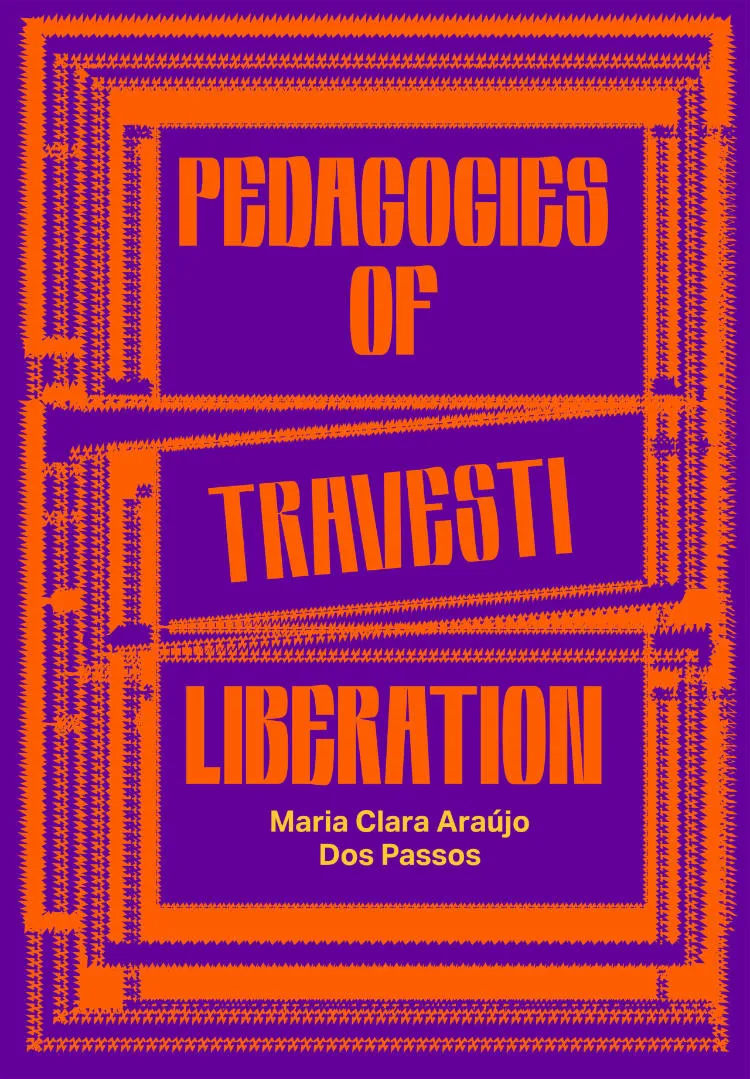
Cover of Pedagogies of Travesti Liberation

Archive Books

Pedagogies of Travesti Liberation

Maria Clara Araújo dos Passos

Essays €15.00

Maria Clara Araújo dos Passos examines the interplay of education, identity, and liberation in Brazil's travesti community.

In Pedagogies of Travesti Liberation, Maria Clara Araújo dos Passos critiques traditional pedagogical frameworks that marginalize gender nonconforming narratives and highlights the effects of systemic discrimination on travestis' psychosocial well-being. The book advocates for inclusive educational practices and emphasizes the need for affirmative curricula.
Newly translated from Portuguese, this work contributes towards connecting political struggles globally and navigating the complexities of translation—particularly of the term "travesti"—across various geographical and political contexts, featuring a conversation between Araújo dos Passos and translator Natália Affonso.

Maria Clara Araújo dos Passos (born 1996 in Recife) is a Brazilian Afro-transfeminist educator and sociologist, and an activist for LGBT rights.

Cover of Biting the Hand – Traces of Resistance in the Art & Language diaspora

Rab-Rab Press

Biting the Hand – Traces of Resistance in the Art & Language diaspora

Paul Wood

Non-fiction €30.00

Extensive survey of the politically outward-looking Conceptualism emerging from Art & Language in the UK. Especially considering its critique of the norms of Modernist art practices in contemporary art, particularly practices of art education.

Edited, compiled and introduced by Paul Wood, Biting the Hand: Traces of Resistance in the Art & Language diaspora is about a dissident formation of artists active in the UK in the 1970s and 80s.

The book tells the story of artists engaging with a critique of then-contemporary modernist art education, who have embarked on a series of theoretical investigations which became increasingly politicised under the pressures of an evolving social crisis. Increased racism, unemployment and attacks on the organised working class all raised questions about how a critical art might respond.

By the late 1970s, these radical artists, mostly in the orbit of the Art & Language group, were producing posters and leaflets for a wide range of left-wing causes, as well as analyses of the politics of art and design education and the role of cultural ideology in maintaining consensus. In the 1980s, as Thatcherism tightened its grip, those involved went their separate ways into areas as diverse as media work, trade unionism, health and education.

Biting the Hand has three parts: a retrospective introduction setting the formation in its historical context, and two annotated documentary sections presenting examples of the work as both text and image, written and edited by Paul Wood.

It also includes a foreword by Sezgin Boynik, publisher, and an afterword by Ann Stephen, curator and art historian, further expanding on the book's subject.

For many years Paul Wood worked for the Art History Department of the Open University. His publications from that period include Conceptual Art (2000), Western Art and the Wider World (2013), and the four-volume anthology Art in Theory (1990-2020), co-edited with Charles Harrison and others.

Edited, compiled and introduced by Paul Wood.
Foreword by Sezgin Boynik; afterword by Ann Stephen.