rile*books

Search books

Search books by title, author, publisher, keywords...

Cover of Allies

Sinister Wisdom

Allies

Sinister Wisdom

€13.00

Sinister Wisdom 52: Allies adresses what lesbians what from our allies. We say we're a community dedicated to changing conditions and attitudes around race, class, age, ability, size, appearance. As allies, how are we making that happen?

Special Features

Interviews of Andrea Calderón,
Lynne Scott, Lisa Rudman,
Melanie Kaye/Kantrowitz,
Kit Yuen Quan, Mattie Richardson,
Hadas Weiss, Akiba Onada-Sikwoia,
Gloria Anzalduá, and Barbara Smith

Creative Work By

Rachael Rosen
Judith K. Witherow
Lisa Huebner
Caryatis Cardea
Jamie Lee Evans
Neta C. Crawford
Aspen
Sadie Green

and More!

Language: English

recommendations

Cover of Celebrating the Michigan Womyn's Music Festival

Sinister Wisdom

Celebrating the Michigan Womyn's Music Festival

Sinister Wisdom

Sinister Wisdom 103: Celebrating the Michigan Womyn's Music Festival honors the forty-year legacy of the Michigan Womyn’s Music Festival (1976–2015). Sinister Wisdom 103: Celebrating the Michigan Womyn's Music Festival celebrates this embodiment of radical feminist separatist collaboration, transformational self-defined autonomous spaces, a commitment to sisterhood and matriarchal culture, and a musical city sprung from the earth for one week in the woods.

A collective of five womyn each with a deep connection to Fest operated by consensus to create this issue. Striving to represent a range of womyn’s voices, values, traditions, and experiences of Fest, the collective highlighted what Fest has meant to generations of womyn, documented its chronology, and bore witness to the power of this community. Sinister Wisdom 103: Celebrating the Michigan Womyn's Music Festival includes womyn from multiple races, geographies, sexualities, generations, and gender and other social identities. Just as Fest brought together womyn from various backgrounds, our collection includes a range of artistic experience, from seasoned authors and photographers to those womyn new to publishing.
Sinister Wisdom 103: Celebrating the Michigan Womyn's Music Festival remembers the transformations, possibilities, and hopes for spaces cultivating the ongoing empowerment of womyn.

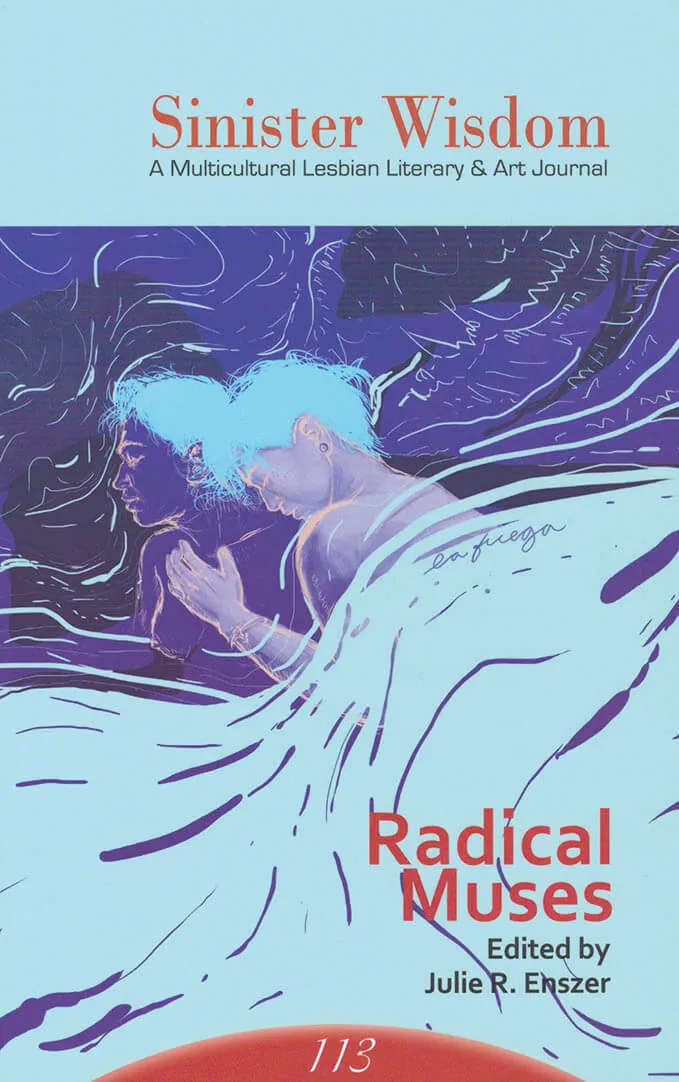
Cover of Radical Muses (Sinister Wisdom nr. 113)

Sinister Wisdom

Radical Muses (Sinister Wisdom nr. 113)

Julie R. Enszer

Sinister Wisdom 113: Radical Muses features an eclectic array of contemporary poetry, prose, and art by lesbians from around the world, including new work by: Andrea Assaf, Tara Shea Burke, Cheryl Clarke, Marina Chirkova, Estela González, Barbara Haas, Nancy E. Lake, Vi Khi Nao, H. Ní Aódagaín and much more!

Cover of  Viscose 08: SOUND

Viscose Journal

Viscose 08: SOUND

Jeppe Ugelvig, Bill Kouligas and 2 more

The eighth issue of Viscose examines the myriad of music and sound cultures of fashion. Entirely untethered from materiality and image, sound is the proof that fashion operates just as vividly in the purely atmospheric. From the artfully curated musical narratives of the runway to the ambient sonic environment of shops, fashion both emits sounds and seeks to associate itself with it for its own advancement. 

Music in particular asserts fashion’s existential relationship to time: it aesthetically time-keeps fashion media and confirms sartorial novelty by mirroring it rhythmically. To a public consciousness, the intimate relationship between fashion and music is obvious and at times even understood as one and the same. Sound glues material such as clothes to wider zeitgeists and mediated lifestyles, and as such, to cultural memory itself. As Mary E. Davis has illuminated, the alliance is profoundly historic: as far back as 1672, fashion periodicals have covered clothes and music as equally essential components of an elegant, fashionable lifestyle. 

Music, in fact, surrounds fashion: it enwraps makers, mediators, and consumers alike in ephemeral, yet intensely meaningful, signifiers of taste. Countless designers have come to fashion through musical subcultures, and labors in ateliers to particular playlists. Indeed, style most often has a soundtrack of its own, or dances to a specific tune.  Fashion emits sounds before and after the musical. The clicking of heels, the rustling of a sweater, the hissing of a zipper. The ambient humming of a sewing machine; the conclusive “beep” from a store cashier. 

For the 8th issue of Viscose, we set out to examine the sonic landscapes of fashion in a most expansive manner. In billing our issue “sound” we seek to gesture to more visually obscure and materially ephemeral interplays between fashion and the auditory—in wardrobes and shops, on the body and in the nightclub. With music culture at the center of our inquiry, we hope to seek beyond and towards the more ephemeral sounds the clothing and fashion emits, records, and appropriates. We are pursuing the possibility of rendering fashion in entirely sonic terms, and how this translates into written words, in a print magazine. 

Cover of Parapraxis 06: Resistance

Parapraxis

Parapraxis 06: Resistance

Periodicals €25.00

In 1911, Sigmund Freud addressed his followers gathered at Nuremberg, where he restated the import of his practice: “the task of psychoanalysis lies not at all in the discovering of complexes, but in the dissolving of resistances.” A formal antipode to political resistance, psychoanalytic resistance dams up desire and obstructs traumatic knowledge. It is conservative, allergic to change, and aims for the kind of frictionless normativity against which the unconscious drives rail. Meanwhile, we associate political resistance with change itself, with a blockade that pushes for revolution—rather than a blockage that censors its very possibility. If we read Freud as urging his followers to help their patients move through their resistance, psychoanalysis is a project on the side of material and political reality by bringing patients out of isolation and into social struggles. However, psychoanalysis is often glossed in reverse: as a project of isolated relief for the stubborn individual.

Should psychoanalysis only succeed at rendering patients compliant in their cure? Is psychoanalysis a tool for nullifying political resistance? If so, Freud’s edict for the aim of psychoanalysis is now but an epitaph. It would be easy, then, to give up the ghost, to let psychoanalysis go. But why should psychoanalysis retreat from collective symptoms back into the consulting room for individual treatment—away from strikes, riots, and uprisings, and toward complacency and normativity, if not quite literally marriage and babies? Why should the clinic not dare to be in and of the world?

Feeling restless. Hunger tactics. Laughing in the face of fascism. Breaking through. Diagnosing revolution. Madness in the Maghreb. Essays by Fady Joudah, Jamieson Webster, Dylan Saba, Yasmin El-Rifae, Ussama Makdisi, Mary Turfah, Hannah Proctor, and more.

In Memory of Joshua Clover (1962-2025).

Cover of Cassell's Encyclopedia of Queer Myth, Symbol and Spirit

Cutt Press

Cassell's Encyclopedia of Queer Myth, Symbol and Spirit

Randy P. Conner, David Hatfield Sparks and 1 more

Bootleg edition by Cutt Press. 

Foreword by Gloria Anzaldua.

Drawing on religion, mythology, folklore, anthropology, history and the arts, this encyclopoedia is a collection of queer spirit. It contains articles on the world's spiritual traditions; entries on deities, symbols, spiritual teachers, spiritually focused artists; and related subjects.

Did you know that in medieval French folklore a person might change sex by passing under a rainbow? Or that same-sex unions have been celebrated by peoples of the ancient Mediterranean, Africa, China, and indigenous America? Or that Sappho, da Vinci, Emily Dickinson, Nijinsky, Benjamin Britten, Mishima, Adrienne Rich, Audre Lorde, Keith Haring, Boy George, and Derek Jarman number among those who have explored the spiritual dimension of gender and sexuality in their works? While the terms many of us employ today to identify ourselves – ‘queer’, ‘lesbian’, ‘gay’, ‘bisexual’, ‘transgendered’ – differ markedly from those of peoples of other times and places, we are nevertheless the bearers of a rich spiritual history that has been ignored or suppressed, a history encoded in sacred texts as well as in works of art, music, dance and other media. Drawing upon religion, mythology, folklore, anthropology, history and the arts, the Encyclopedia is a cornucopia of queer spirituality, containing over 1,500 alphabetically arranged entries from Aakulujjuusi to Zeus.

Cover of Issue 9: John Akomfrah

Plaster Magazine

Issue 9: John Akomfrah

John Akomfrah

This special, limited-edition issue of Plaster celebrates Akomfrah’s commission for the British Pavilion at the 60th International Art Exhibition, La Biennale di Venezia. The linen presentation box contains: an essay by Akomfrah’s long-time friend and collaborator, the BAFTA-winning film curator June Givanni; an interview with Akomfrah by Harriet Lloyd-Smith; original portraits by photographer Siam Coy and a fold-out poster featuring an exclusive still from Akomfrah’s film installation, Listening All Night To The Rain, now screening in the British Pavilion at the Venice Biennale.

With creative direction by Constantine // Spence and design by Emma Ralph.

Cover of On The Rag

Casual Encountersz

On The Rag

Various

Periodicals €14.00

Casual Encountersz presents On The Rag, America’s Greatest Tabloid. Blending art and literature with sex, slime and sleaze, On The Rag emerges from LA's underground reading series Casual Encountersz to create a new media platform where the Ivory Tower and the gutter collide. On The Rag is a literary journal, gossip mag and conceptual art project all in one. Get off the apps…And get On The Rag!