Books
Books
in random order

From Palestine to "Xinjiang": Forced Labour and Capitalist rule
For a long time, Israel and the West, led by Europe and the United States, have used hasbara and neoliberal discourses to hide their colonial plunder of Palestine, while today China and Russia are also whitewashing their own imperialist practices by aligning themselves with authoritarin government and projecting an image of leading resistence to western hegemony.
This publication analyzes the structural similarities and differences between forced labor and capital exploitation of Palestinians and Uyghurs from left-wing perspective. The author hopes to dispel the myth of campism and call for inter-racial/-ethnic/-national proletarian solidarity against oppression of colonization, capital and totalitarianism.

Blackout
Spring 2020. During lockdown in a mountain village with his partner and young child, Yann Chateigné Tytelman becomes haunted by the presence of his dead father. Provoked by memories of him, of their laconic relationship and of the class antagonisms that emerged between them – the father was a manual labourer while his son ‘turned his back’ and entered the art world – Chateigné Tytelman starts writing letters, piles of them, which have as their subject that most mystical, most incomprehensible of phenomena: silence.
Condensed into a series of short fragments, Blackout interweaves the letter to the father with the observations of an art theorist who surveys with precision the occurrences and experiences of silence in painting, music, literature and philosophy.

Psalmist Kaput
Through the harsh noise of reality, a signal appears. At first faint, but slowly, as we approach, it grows louder, more defined. Aerial photographs depict odd structures and garbled sounds, blurred images of decaying media, alien architecture. It calls out your name.
Psalmist Kaput lures the reader into a misama of fragmented speech, disembodied voices, deteriortating thresholds, and lo-res nightmares. Fusing text and image, it is a work undefinable and wholly its own.
Enter the exclusion zone, witness its monuments, and if you're able, find your way back out again. "Soon we will all be submerged."

Fanta For The Ghosts
fanta for the ghosts by Elisabeth Molin
120mm x 210mm
edition of 500
Co-published with OneThousandBooks and Elisabeth Molin

Death Sentence
This long awaited reprint of a book about which John Hollander wrote: “A masterful version of one of the most remarkable novels in any language since World War II,” is the story of the narrator’s relations with two women, one terminally ill, the other found motionless by him in a darkened room after a bomb explosion has separated them. “Through more than 40 years, the French writer Maurice Blanchot has produced an astonishing body of fiction and criticism,” writes Gilbert Sorrentino in the New York Review of Books, and John Updike in The New Yorker: “Blanchot’s prose gives an impression, like Henry James, of carrying meanings so fragile they might crumble in transit.”
Translated from the French by Lydia Davis.
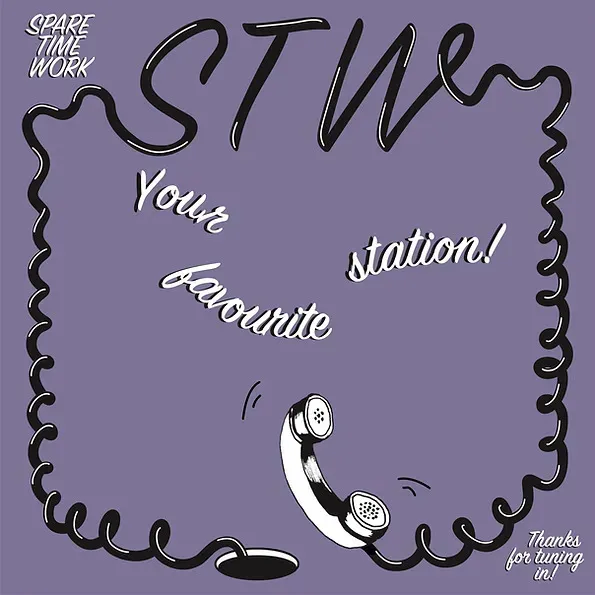
STW, your favourite station!
STW, your favourite station! functioneert als een radioprogramma. Een boek dat lyrisch proza uitzendt van We make stuff up for a living (een CV medley) tot COMPUTER_SONG, een ceremoniële quiz met Adult Hood & Young als protagonisten, een grillige anekdote van iemand die zich ergert aan een Call Service, en meer! Thanks for tuning in!

On the Origin of Species and Other Stories
Straddling science fiction, fantasy and myth, the writings of award-winning author Bo-Young Kim have garnered a cult following in South Korea, where she is widely acknowledged as a pioneer and inspiration. On the Origin of Species makes available for the first time in English some of Kim's most acclaimed stories, as well as an essay on science fiction. Her strikingly original, thought-provoking work teems with human and non-human beings, all of whom are striving to survive through evolution, whether biologically, technologically or socially. Kim's literature of ideas offers some of the most rigorous and surprisingly poignant reflections on posthuman existence being written today.
Bo-Young Kim (born 1975) won the inaugural Korean Science & Technology Creative Writing Award with her first published novella in 2004 and has gone on to win the annual South Korean SF Novel Award three times. In addition to writing, she regularly serves as a lecturer, juror and editor of sci-fi anthologies, and served as a consultant to Parasite director Bong Joon Ho's earlier sci-fi film Snowpiercer. She has novellas forthcoming from HarperCollins in 2021. She lives in Gangwon Province, South Korea, with her family.

Knigi
The new, adapted and expanded edition of Benjamin Sommerhalder's children's book (the story of the little ghost Knigi, learning how to read).
On little Ghost Knigi's birthnight he receives a book from his Aunt Abel. When she hands it to him all she says is, ‘I hope you enjoy reading this!' Knigi is quite young, but still at an age when human children normally learn to read. And it's the same for ghost children. ‘But something is wrong', Knigi worries. The book is absolutely white – every page, from cover to cover. Knigi is forced to embark on a journey to find out how to read.
Ghost Knigi is the first book drawn and written by Benjamin Sommerhalder and published in a first edition by Nieves in Zurich.
Graphic designer and publisher based in Zurich, Benjamin Sommerhalder is the founder and editor-in-chief of Nieves.

Paces the Cage
S*an D. Henry-Smith’s second full-length book of poems, PACES THE CAGE, lifts off from their previous book, Wild Peach (2020), by expanding an already-queered language to near breaking point. Through the complexities of Henry-Smith’s personal experiences and the use of a poetically fragmented voice, the literal and metaphorical are here remixed in real time. Henry-Smith’s occasional inclusion of ambient sounds and a musical language and tone used throughout the book helps to build a rich auditory landscape that enhances the immersive quality of the poems, creating a deep and evocative collection by this adventurous and endlessly exciting artist. As if it were an improvised performance itself, PACES THE CAGE actively tunes personal and historical narratives of oppression and adversity with the act of speaking, and what it means to be truly heard by a community of one’s fellow creators and collaborators.
PACES THE CAGE extends S*an D. Henry-Smith’s interdisciplinary, improvisational listening into a poetics of “fissure and measure,” where silence and the sonic converge in boundless motion. Tuning language toward the frequencies of breath, pulse, and sociality, Henry-Smith's poems transport us from natural worlds to communal forms to Bill Gunn’s STOP, recovering wayward images and utterances to compose a surround sound of loss and renewal. What emerges is both reckoning and remedy—a lush sensitivity to the ways language becomes live, as in now, as in “eyes open, full of rage.”
S*an D. Henry-Smith’s reverberant propositions seek the music of mutual renewal, constantly and impatiently approaching the present. This is a field of spiraling, alliterative song, the wild signature of Henry-Smith’s lyric, that renews commitments to militancy by naming and knowing its enemies as doubtlessly as it names and knows it lovers. PACES THE CAGE considers a set of conditions—technical, material phenomena—that produce collective and contradictory imaginations and gives words to the song that makes the gathering last, “all in for all…” PACES THE CAGE is a beautiful rehearsal of attentiveness, a rigorous and generous correspondence with the edges of the frame.
– dove, Christine Kirubi
S*an's PACES THE CAGE recalls to me Akilah Oliver’s 2004 An Arriving Guard of Angels, Thusly Coming to Greet. A lyrical unleashing into the many selves, the author here plays conduit for many beautiful bodies; for those souls wandering at daybreak; for the pudgy greased cheeks and those that murmur in the dew of twilight uncloaked. It is as if the poet has extracted from the marsh, the runoff, roundup and peat to stockpile and make lush a new yet familiar world. S*an has created a collection of diamonds from the salty mines of turtle tears. The divorced defanged possessive absent its apostrophe, left to the mud puddle for butterfly nuptials throughout, tells the reader: How you know me Now will be Different from how you knew me. These buoyant poems that are S*an’s latest songs have not missed the train this time. Make certain that you don’t. I’m in awe.
–LaTasha N. Nevada Diggs
S*an D. Henry-Smith is a poet and photographer, working by extension in sound, performance, and publishing.

Plans for Sentences
"These sentences—they—will begin having already been sentences somewhere else, and this will mark their afterlife, and this will be their debut." So begins Renee Gladman’s latest interdisciplinary project, Plans for Sentences. A tour de force of dizzying brilliance, Gladman’s book blurs the distinctions between text and image, recognizing that drawing can be a form of writing, and vice versa: a generative act in which the two practices not only inform each other but propel each other into futures. In this radical way, drawing and writing become part of a limitless loop of energy, unearthing fertile possibilities for the ways we think about poetry.
If Gladman ascribes to any particular type of poetics, here in Plans for Sentences, we are sure to find that it is robustly grounded in a poetics of infinite language.

Marlie Mul
Marlie Mul (b. 1980 in Utrecht, the Netherlands; lives and works in Brussels) is characterized by a strong material awareness, spatial thinking, and an ongoing engagement with conditions of labor, systems of value, and forms of collectivity. Her practice foregrounds a sustained interest in sculptural concerns, direct engagement with materials, and processes of layering, transformation, meaning and re-meaning across multiple levels of articulation. Central to this is a continuous process of familiarizing herself and working with new materials and practices, which are repeatedly extracted from their conventional contexts and expanded into new bodies of work. These are, in turn, accompanied and reframed by other materials as well as by more social formats of production and presentation.
The first comprehensive monograph on Marlie Mul’s work is published on the occasion of her solo exhibition Das Budget (2025) at Kunsthaus Glarus. It offers a comprehensive chronological overview of key bodies of work from the early 2000s to the present and, through a richly illustrated index, unfolds a complex structure of contexts, collaborations, and modes of production. The publication includes new contributions by Annie Goodner, Lili Reynaud-Dewar and Frank Wasser, a dialogue between the artist and the editor, as well as numerous reprints of texts that have accompanied Mul’s work over the years, including writings by the artist herself.

The Refusalist International
The many mass protests that have taken place since 2011 have been characterised by an unmistakable need to challenge, overthrow and destroy the prevailing political representations without proposing new ones. The protests are not concerned with replacing the current government or leader with others, and thus getting a better version of what we already have. Instead, they refuse all leaders, including the most critical opposition leaders: these protests are about dismantling the need for leaders. More and more people are coming to the view that it is not possible to manage the many crises within the framework of the political institutions we have today.
The new protests are political acts that are neither class struggle nor the establishment of an opposition to those in power. Rasmussen argues that we should understand these protests as the emergence of a new kind of revolutionary action that is as much an anthropological as a political transformation: it is an attempt to break free from all the traditional notions of how the social context that we call society and the nation-state is organised.

Sudden Wealth with Roy Claire Potter
Chris Evans, Roy Claire Potter
Proposed by Chris Evans, Sudden Wealth is a collaboration with Morten Norbye Halvorsen, Graham Kelly and invited poets and artists who use spoken word as their medium.
Sudden Wealth looks to how the flux of subjectivity in language can be shaped, agitated and re-imagined through a triangulation between written composition, intonation, and extrinsic sound composition. The latter spans analogue and digital instrumentation, foley recordings and algorithmically derived musical patterns. Divergent methods of composition work on and into a voice, modelling intonation, and affecting its sense and intent.
This first iteration has been made with Roy Claire Potter, an artist who tells stories from fragmented, intense images that depict moving bodies or domestic scenes and architectural settings. A rapid vocal delivery, a sense of restricted or partial views of space, complex social and group dynamics and the aftermath of violent events are recurrent strands of Potter’s writing, which are often delivered with a dark and sometimes wilful humour.
Chris Evans was the bassist with the now defunct Life Without Buildings and has previously produced musical compositions with Morten Norbye Halvorsen together with farmers and accountants for his ongoing series ‘Jingle’. Graham Kelly joins Evans and Halvorsen for this present series, Sudden Wealth.
Vocals: Roy Claire Potter.
Electronics: Morten Norbye Halvorsen.
Bass: Chris Evans.
Guitar: Graham Kelly.
Arranged and mixed by Morten Norbye Halvorsen.

Crossings: Creative Ecologies of Cruising
It’s difficult to pinpoint the origins of cruising. While the term was used by men seeking casual encounters with other men in the parks and streets of New York City as early as the 1920s, historical records show the practice is much older. Cruising has existed for as long as anyone outside the dominant sex and gender systems has sought sexual encounters outside of sanctioned norms. This book offers a serious exploration of queer sex and sex cultures, exploring cruising as a mode of thinking with the body and communicating through sexuality.
A creative dialogue between a queer artist and a queer academic reminiscing about and thinking with their cruising experiences, Crossings takes queer sex practices and cultures seriously as ways of knowing and world-making. The result is an erotic hybrid form hovering between scholarship and avant-garde experimentation, between critical manifesto and sex memoir. Here, the voices of each author, merged together in one, invite the reader to inhabit the erotic spacetime between self and other, the familiar and the strange, desire and pleasure, climax and release. That is, the spaces and temporalities of cruising itself.

The Mollino Set
New York-based professor Lytle Shaw journeys to Italy in this adventurous exploration of the life and work of architect, designer, and photographer Carlo Mollino (1905–1973). In 1933 the young Mollino received a commission from Mussolini’s regime for his first building: an administrative centre in Piedmont. Later works include furniture and interior design, a book on photography, and an asymmetrical car that raced at Le Mans in 1955.
The book centres around Shaw’s realisation that this prolific talent’s conflicted legacy offers a unique window on the role that post-war Italian politics and culture played in the country’s reimagining of itself as a victim, rather than a proponent, of fascism.

From The Prop To The Inside
FROM THE PROP TO THE INSIDE gathers texts on the concept of the prop—as object, requisite and support—on stage and in the exhibition space. The starting points of this book are objects and installations of the artist Michaela Schweighofer, which deal with the stage as a platform and the sculpture as a prop.
The authors are friends: artists, critics and curators whom she has invited to write a text at the interface of their and her practice. The contributions within take on multiple forms; letters, essays and interviews—they are intended to create a theoretical-subjective anthology that makes visible the phenomena of the private as symptoms of the structural, as well as to provide a direct insight into contemporary artistic creation.
Text: Juliane Bischoff, Veronika Eberhart, Cornelia Lein, Cathrin Mayer, Gianna Virgina Prein, Agnieszka Roguski, Juliane Saupe, Michaela Schweighofer & Chloe Stead

Koreografi
Koreografi / Choreography is a magazine initiated and edited by Solveig Styve Holte, Runa Borch Skolseg and Ann-Christin Berg Kongsness. The magazine consists of texts written by Nordic artists within the field of dance and choreography.

Against Morality
A manifesto against the current moralizing trend in the arts.
Should art be determined by political ideals? In recent decades art institutions have sought to embody liberal values of universal equality and social justice. This move toward greater inclusivity has borne witness to a countervailing trend: artworks are increasingly scrutinized for their political implications, and artists must take care not to transgress particular moral fault lines.
Examining contemporary exhibitions as well as works of art and film, and the broader cultural reactions to them, Rosanna McLaughlin investigates the consequences of this moralizing approach to creative work. She invites us to rethink the connection between political values and art—and to ask whether a relationship between them should exist at all. In arguing against morality in the arts, McLaughlin lays the groundwork for a more expansive concept of difference in twenty-first-century art making.
"What if ambivalences were seen as productive, and not a danger to erase? Would we not begin to know ourselves better? What is it that we are so afraid of finding out? Art is a testing ground for ideas, a means of reaching. What a shame, if we use the space it offers to destroy it entirely."
Rosanna McLaughlin is a writer based in East Sussex and the author of Double-Tracking: Studies in Duplicity (2019) and Sinkhole (2023). Her writing on art and culture has featured in ArtReview, Frieze, Granta, The Guardian, and The White Review, among other publications. Between 2021 and 2023 she was co-editor of The White Review.

The Slicks: On Sylvia Plath and Taylor Swift
In The Slicks, Maggie Nelson positions culture-dominating pop superstar Taylor Swift and feminist cult icon Sylvia Plath as twin hosts of the female urge toward wanting hard, working hard, and pouring forth—and as twinned targets of patriarchy’s ancient urge to disparage, trivialize, and discipline creative work by women rooted in autobiography and abundance.
A buoyant melding of popular culture and literary criticism, The Slicks is a captivating and unexpected assessment of two iconic female artists by one of the most revered and influential critics of her generation.

Gravity Road: A Rollercoaster Reader
Jesse Darling, Heinrich Dietz and 2 more
Constructed in Pennsylvania in 1827, Gravity Road was a precursor to the modern roller coaster; a sloping stretch of railroad used to cart coal out of mines. With passenger rides on offer soon afterwards, the rapid descent became an attraction and the technology was appropriated for thrill rides in amusement parks.
Jesse Darling’s sculptures, drawings and installations address the fallibility, fungibility and mortality of living beings, systems of government, ideologies and technologies – nothing is too big to fail. For his exhibition at Kunstverein Freiburg in 2020, Darling created a sculpture of a dysfunctional roller coaster, broken down to a child-like scale, becoming an anti-monument to a modernity that celebrates progress, acceleration and mastery and produces violence.
Exploring the entangled history of labour, leisure, extraction and entertainment, Gravity Road: A Rollercoaster Reader was commissioned in response to Darling’s 2020 exhibition, bringing together new texts by artist and Darling-collaborator Joe Highton and writer Sabrina Tarasoff along with a correspondence between Darling and the Kunstverein’s director Heinrich Dietz.
FEATURING TEXTS BY:
Jesse Darling
Heinrich Dietz
Joe Highton
Sabrina Tarasoff

Campism Divides Struggles: How Iranians and Palestinians Forced into Opposition
In this interview, Palestine solidarity activists form the Chinese diaspora speak with Iranian activists in exile about the uprising that took place in Iran in January 2026, comparing notes about resistance to various forms of authoritarianism.

Ductus
DUCTUS is the latest solo project by Paul Abbott, featuring 51 minutes of audio, across 12 tracks, and a 42 page booklet featuring new writing. DUCTUS was written and recorded in Edinburgh and Porto in 2019.
DUCTUS presents a playful weave of collapsing time through a number of speculative elements and fictional characters. Abbott feels his way through learning drums, rhythm and writing as fleshy research technologies. DUCTUS is the latest stage in a process considering sound, the body, imagination, and language through music. This features as part of ongoing investigations using real and imaginary drums, synthetic sounds, performance and writing.

The Formation of Calcium
A horror story of one woman's awful reinvention, M. S. Coe's The Formation of Calcium is disturbingly funny and completely unexpected.
Middle-aged Mary Ellen Washie has finally freed herself of her stultified past life in western New York state and moved to Florida. With the husband she's grown to hate firmly in her rearview mirror, and all ties to her family cut off, she changes her name, bleaches her hair, and befriends Natalie, a seemingly kind, martini-loving woman whom she promptly begins to manipulate. As her machinations propel her beyond the brink of who she used to be, Mary Ellen seeks to unburden herself—but not one to sit down with pen and paper, she narrates the events of her new life into a cassette tape recorder, giving each tape an innocuous name to keep the curious away. A riveting account of one woman's awful reinvention, M. S. Coe's new novel is disturbingly funny and completely unexpected. With elements of pulp noir and confessional literature, The Formation of Calcium depicts the bland misery of modern American life as one woman seeks her own ill-fated transformation.
Born in Las Vegas, Nevada, M. S. Coe is an American writer living in Guadalajara, Mexico. After she graduated with an MFA in creative writing from Cornell University, Clash Books published her first novel, New Veronia, in 2019. Coe's stories have appeared in The Antioch Review, Cosmonauts Avenue, Electric Literature, Nashville Review, Waxwing, and elsewhere. She has held residencies from the Herbert Hoover National Historic Site, Petrified Forest National Park, and Ora Lerman Trust.

Dreams of a Dreamless Night
The publication is the first institutional monograph on the multimedia practice of artist and director Ali Cherri. It aims to highlight the constellation of ideas, themes, and formal concerns running through his most recent, highly significant projects.
Edited by Alessandro Rabottini and Leonardo Bigazzi, with Bianca Stoppani, this book provides an overview of the artist's output over the past three years, teasing out both new strands for interpretation and formal links between his films, videos, sculptures, drawings, and installations.
Texts by: Cecilia Alemani, Erika Balsom, Étienne Bernard, Leonardo Bigazzi, Ali Cherri, Lorenzo Giusti, Stefanie Hessler, Priyesh Mistry, Alessandro Rabottini, Stefan Tarnowski.
Video and visual artist Ali Cherri (born 1976 in Beirut, lives and works in Paris and Beirut) received a BA in graphic design from the American University in Beirut in 2000, and an MA in performing arts from DasArts, Amsterdam, in 2005. His current project looks at the place of the archaeological object in the construction of historical narratives.