rile*books

Search books

Search books by title, author, publisher, keywords...

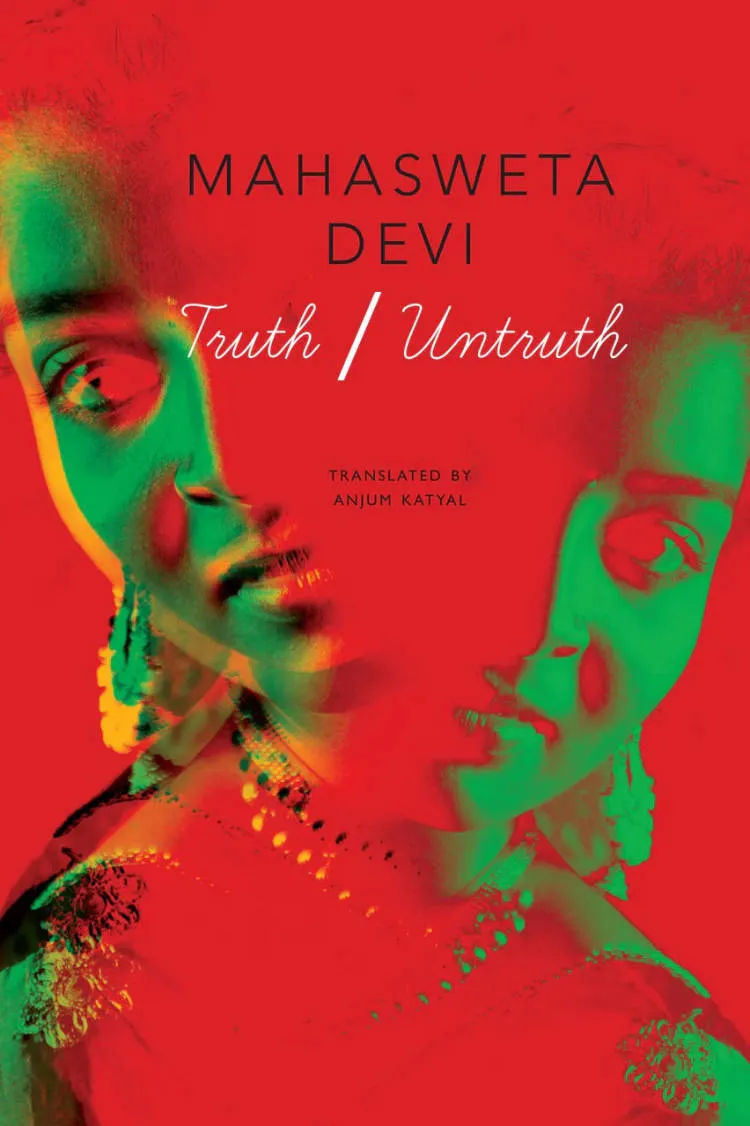
Cover of Truth / Untruth

Seagull Books

Truth / Untruth

mahasweta devi, Anjum Katyal

€22.00

A trenchant, darkly humorous, and unsentimental look at Calcutta society. 

Set in Calcutta in the mid-1980s, Truth/Untruth is a fast-paced thriller built around the death of the pregnant Jamuna—a maid in a newly affluent residential apartment complex—and Arjun, the upwardly mobile businessman who seduced her. Packed with a cast of colourful characters, this novel is a trenchant, darkly humorous, and unsentimental look at the different segments of Calcutta society: from the middle-class culture vultures to the unscrupulous ‘promoter’ class and the domestic helpers and slum goons who form an intrinsic part of the city’s life. All are implicated in a complex web of guilt and bizarre twists and turns. Sex, lies, death—the great modernist themes—run like a thread through this book, exposing societal greed, lust, corruption, and moral hypocrisy with a sardonic tone that spares none. An unusual novel by an author who is otherwise known for her hard-hitting activist-feminist stories, Truth/Untruth underlines the exploitative vicious cycle that defines urban relations between the haves and have-nots.

‘Although not of the margins herself, Devi was accomplished in writing from the margins [ . . . ] However, it is indeed worth it if you are looking for an exhilarating social commentary and biting satire that remains relevant today. Devi also reflects the jargon and dialects of the lower classes as deftly as the peculiarities of upper-class speech patterns. A feat of this work is Katyal’s ability to mediate these multiple registers, rewarding the reader with sharp writing that is at once funny, sardonic, and darkly pleasurable to read.‘—Jack Greenbert, Cha: An Asian Literary Journal.

Published in 2023 ┊ 144 pages ┊ Hardcover ┊ Language: English

recommendations

Cover of  The Book of Sleep

Seagull Books

The Book of Sleep

Haytham El-Wardany, Robin Moger

Philosophy €17.00

What is sleep? How can this most unproductive of human states—metaphorically called death's shadow or considered the very pinnacle of indolence—be envisioned as action and agency? And what do we become in sleep? What happens to the waking selves we understand ourselves to be?

Written in the spring of 2013, as the Egyptian government of President Mohammed Morsi was unraveling in the face of widespread protests, The Book of Sleep is a landmark in contemporary Arabic literature. Drawing on the devices and forms of poetry, philosophical reflection, political analysis, and storytelling, this genre-defying work presents us with an assemblage of fragments that combine and recombine, circling around their central theme but refusing to fall into its gravity.  

"My concern was not to create a literary product in the conventional sense, but to try and use literature as a methodology for thinking," El Wardany explains. In this volume, sleep shapes sentences and distorts conventions. Its protean instability throws out memoir and memory, dreams and hallucinatory reverie, Sufi fables and capitalist parables, in the quest to shape a question. The Book of Sleep is a generous and generative attempt to reimagine possibility and hope in a world of stifling dualities and constrictions.

Cover of Passage to the Plaza

Seagull Books

Passage to the Plaza

Sahar Khalifeh

Fiction €24.50

In Bab Al-Saha, a quarter of Nablus, Palestine, sits a house of ill repute. In it lives Nuzha, a young woman ostracized from and shamed by her community. When the Intifada breaks out, Nuzha’s abode unexpectedly becomes a sanctuary for those in the quarter: Hussam, an injured resistance fighter; Samar, a university researcher exploring the impact of the Intifada on women’s lives; and Sitt Zakia, the pious midwife.

In the furnace of conflict at the heart of the 1987 Intifada, notions of freedom, love, respectability, nationhood, the rights of women, and Palestinian identity—both among the reluctant residents of the house and the inhabitants of the quarter at large—will be melted and re-forged. Vividly recounted through the eyes of its female protagonists, Passage to the Plaza is a groundbreaking story that shatters the myth of a uniform gendered experience of conflict.

Cover of Living Translation

Seagull Books

Living Translation

Gayatri Chakravorty Spivak

Living Translation offers a powerful perspective on the work of distinguished thinker and writer Gayatri Chakravorty Spivak, revealing how, throughout her long career, she has made translation a central concern of the comparative humanities.

Starting with her landmark "Translator's Preface" to Jacques Derrida's Of Grammatology in 1976, and continuing with her foreword to Mahasweta Devi's Draupadi and afterword to Devi's Chotti Munda and His Arrow, Spivak has tackled questions of translatability. She has been interested in interrogating the act of translation from the ground up and at the political limit. She sees at play at border checkpoints, at sites of colonial pedagogy, in acts of resistance to monolingual regimes of national language, at the borders of minor literature and schizo-analysis, in the deficits of cultural debt and linguistic expropriation, and, more generally, at theory's edge, which is to say, where practical criticism yields to theorizing in untranslatables.

This volume also addresses how Spivak's institution-building as director of comparative literature at the University of Iowa—and in her subsequent places of employment—began at the same time. From this perspective, Spivak takes her place within a distinguished line-up of translator-theorists who have been particularly attuned to the processes of cognizing in languages, all of them alive to the coproductivity of thinking, translating, writing.

Cover of Herculine

Saga Press

Herculine

Grace Byron

Fiction €28.00

A “witty, often-chilling, compulsively readable” (Vogue) horror debut following a woman who seeks refuge at an all-trans girl commune only to discover that demons haunt her fellow comrades—and she’s their next prey!

Herculine’s narrator has demons. Sure, her life includes several hallmarks of the typical trans girl sob story—conversion therapy, a string of shitty low-paying jobs, and even shittier exes—but she also regularly debates sleep paralysis demons that turn to mist soon after she wakes and carries vials of holy oil in her purse. Nothing, though, prepares her for the new malevolent force stalking her through the streets of New York City, more powerful than any she’s ever encountered. Desperate to escape this ancient evil, she flees to rural Indiana, where her ex-girlfriend started an all-trans girl commune in the middle of the woods.

The secluded camp, named after 19th-century intersex memoirist Herculine Barbin, is a scrappy operation, but the shared sense of community among the girls is a welcome balm to the narrator’s growing isolation and paranoia. Still, something isn’t quite right at Herculine. Girls stop talking as soon as she enters the room, everyone seems to share a common secret, and the books lining the walls of the library harbor strange cryptograms. Soon what once looked like an escape becomes a trap all its own. 

While trying to untangle the commune’s many mysteries, the narrator contends with disemboweled pigs, cultlike psychosexual rituals, and the horrors of communal breakfast. And before long, she discovers that her demons have followed her. And this time, they won’t be letting her go.

Cover of Issue № 6 - Winter–Spring 2026 / SENSING BODIES

DEARS

Issue № 6 - Winter–Spring 2026 / SENSING BODIES

Poetry €15.00

Coming back to the body is rarely tranquil. Often it is turbulent, interrupting dominant narratives and entrenched meanings. It is the upset of being alive, and awake to it.

The fourteen texts in this new issue do not shy away from that turbulence. There is joy and there is pleasure, there is shame, pain, and liberation... Each text addresses this dense experience from a singular perspective, yet together they explore what emerges and becomes possible when sense-making and making sense(s) are re-anchored in the sensing practices of the body.

With texts by Valérie Hug, Marco Antonini, cassiane c. pfund, Elodie Olson-Coons, Ines Marita Schärer, Bernadette Kolonko, Jo Bahdo, Lotta Beckers, Melanie Jame Wolf, Samuel Brzeski, Madeleine Kaye, Nora Longatti, Rosanna Puyol Boralevi, Larissa Clement-Belhacel

editorial team: Delphine Chapuis Schmitz, Nicole Bachmann, Robert Steinberger, and Shelby Lee Stuart as invited editor

Cover of Through The Billboard Promised Land Without Ever Stopping

Prototype Publishing

Through The Billboard Promised Land Without Ever Stopping

Derek Jarman

Fiction €15.00

Through the Billboard Promised Land Without Ever Stopping is Derek Jarman’s only piece of narrative fiction. Written in 1971, it is a surreal, fabular, lyrical work – a literary fairytale acid-trip road movie hybrid – the energies and details of which influenced much of his later work across media. The story serves as a foundational text, laying out many of the themes, images and styling of Jarman’s work in painting, film and design whilst also being haunted by the then emerging ecological crisis in its juxtaposition of the beauty of nature with the reckless consumption of modernity.

This edition features facsimile images of the story’s handwritten drafts from Jarman’s archive, a link to an exclusive audio recording of Jarman himself reading the story in full, and is comprehensively informed by a vivid foreword from Philip Hoare, a deeply researched afterword by Jarman scholar Declan Wiffen, and a warm memoir by the artist Michael Ginsborg, a close friend of Jarman’s throughout the period of the story’s writing.

Cover of Unable To Achieve Broad Recognition In My Lifetime, I Laboured In Obscurity Until My Death Last Year

Ma Bibliotheque

Unable To Achieve Broad Recognition In My Lifetime, I Laboured In Obscurity Until My Death Last Year

Sharon Kivland

Fiction €13.00

For nearly two years the author collected phrases from the exhibition press releases she received through email, posting certain of them on Facebook in a rather unsystematic way (that is to say, when she felt like it), with only one change, that of the personal pronoun, so each statement appeared vainglorious, absurd, even tragic. She supposes the measure was if they made her laugh or gasp or used words she deplores when thinking or writing about art. The posts gathered quite a following. Some people still mention them to her, and others have asked her to look at their own press releases before circulation.

These extracts have provoked laughter, disbelief (especially when performed as public readings, when she has  been obliged to swear to their veracity), self-recognition, and yes, shame.

She had only three rules: 1) She would not quote the press release of anyone she knows (certainly she could have done—she must admit that both a friend and someone she dislikes intensely have slipped in, and she fervently hopes neither ever reads this book); 2) She would not alter anything except the pronoun (this is largely true; however, for this book, she corrected some errors of punctuation and spelling, changed spellings to their English form, and employed her beloved Oxford comma); and 3) She would not use anything the artist had written (this, too, is true, save for one exception that was too wonderful not to include).

Finally, she  gathered a collection of endorsements, some along the way, others when she indicated this work was done. She is still alive and she continues to labour in obscurity. 

Cover of Amanda

Maria Editions

Amanda

Olga Micińska

Fiction €15.00

The artist book Amanda is greatly inspired by “Tradeswomen” quarterly magazine for women in blue-collar work, published in the 1980’s and 1990’s in the United States. Amanda is similarly thought as a periodical dealing with the subjects of technology and industry from a feminist (not solely female) angle. The first issue contains fiction stories of an emancipatory character, citing trade associations, oil industry in Iran and ghosts of the printer feeders.

The publication is made in the framework of The Building Institute, an experimental organisation aiming to strengthen the position of femmes builders in the domain of technical construction work. Amanda brings together literary texts by Maria Toumazou, Samantha McCulloch, Sepideh Karami and Madeleine Morley, combining fiction stories with visual artwork. 

Olga Micińska is a visual artist currently living in Amsterdam. Graduated from the MA Art Praxis program at the Dutch Art Institute and holds an MFA in Sculpture from the Academy of Fine Arts in Warsaw. Also trained as a woodworker, collaborates with craft studios of various domains. Recently she has initiated The Building Institute.

The Building Institute (TBI) is an experimental platform aiming to emancipate the undermined knowledges dwelling in the craft domains, and to unpack diverse questions related to technology and the means of production. TBI combines art’s speculative competences with the grounded practice of manual labor, manifesting its objectives through educational activities, exhibitions, and publications.