rile*books

Search books

Search books by title, author, publisher, keywords...

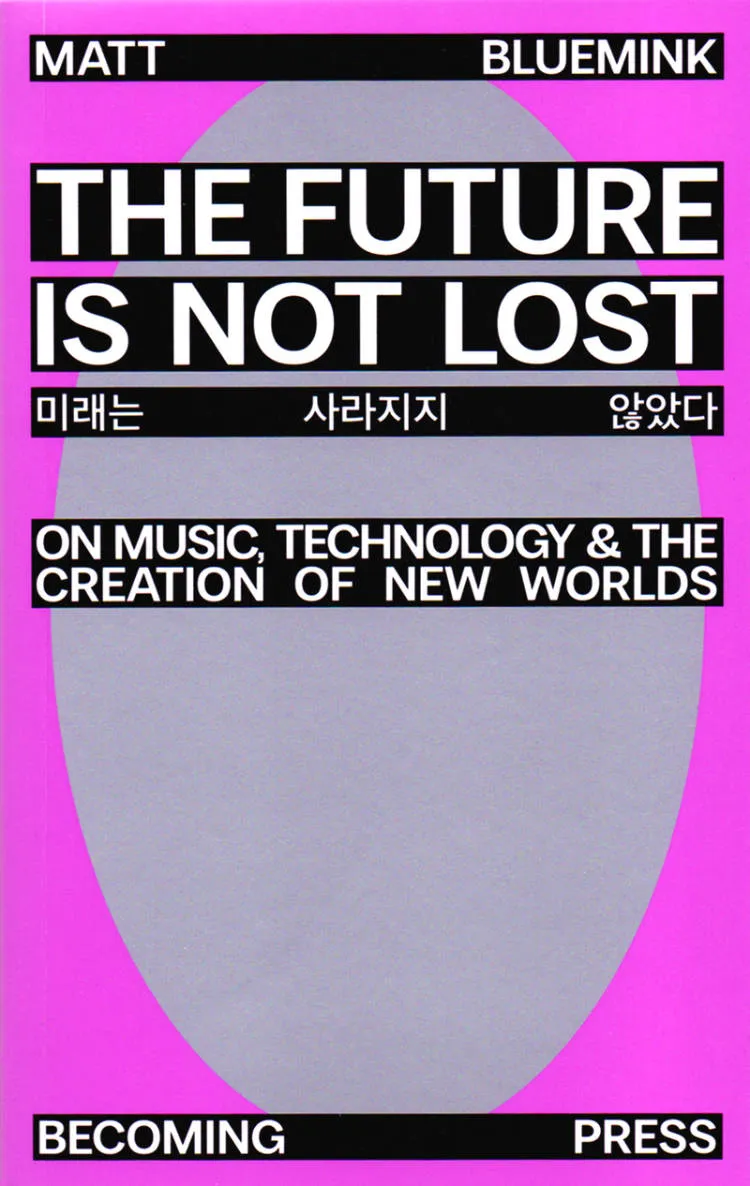
Cover of The Future is not Lost: On Music, Technology, and the Creation of New Worlds

becoming press

The Future is not Lost: On Music, Technology, and the Creation of New Worlds

Matt Bluemink, Alessandro Sbordoni ed.

€16.00

Mark Fisher taught a generation to hear the future's disappearance in contemporary music, as if the rhythm of the world was synchronised to the periodic flowering of new creative forms. His diagnosis was devastating: stagnation in music was akin to a venous insufficiency, or worse, some kind of nuclear winter that would ward off the spring for endless generations to come. 

Drawing on musicians like SOPHIE, Arca and Iglooghost, Matt Bluemink declares that the future is not lost; it still speaks to us through music. If Fisher’s Hauntology — dwelling on ghosts of the past — is the logic of depression, then Bluemink’s Anti-Hauntology posits a logic of hope where voices from the future continue to guide the development of the present. 

Island-hopping through Stiegler's philosophy of technics, Simondon's theory of individuation, and the spatial imaginaries of cyberpunk and solarpunk, Bluemink builds a theoretical framework equal to the times — one that takes seriously our capacity to, not only diagnose the world, but remake it. In order to create a new future we must re-imagine our relationship with music, with technology, and with culture. The world of tomorrow is a blank canvas; an open book. New beginnings are always possible. 

Matt Bluemink is the founder and editor-in-chief of Blue Labyrinths online magazine. His research is focused on the relationship between the philosophy of technology, media theory and urbanism. He also writes on contemporary music, literature, and digital culture. 

Published in 2026 ┊ 192 pages ┊ Language: English

recommendations

Cover of Where does a Body begin? Biology's function in contemporary capitalism

becoming press

Where does a Body begin? Biology's function in contemporary capitalism

MYB

Non-fiction €12.00

While presented as a contiguous work, the book is formed of different essays that have been dissected, recomposed with artificial connective tissue. The result lies somewhere between the rhizomatic continuity of a Body-without-Organs, and the disjointed assemblage of roadkill; either way, the question of where to even begin remains the same. 

These essays each grow out of a particular resentment that developed through years of experience as a working-student of biology, but the task of the book was to transform this into something productive, something that sticks granular propositions into Biology like acupuncture needles. Inherent sexism within Biological research is, after all, not entirely disconnected to Pharmaceutical giants flooding the streets with opiates—and it is simply a writer’s hope that some well positioned words can remind enough people of how its all connected. 

In what could be perceived as a philosophical turn, the importance of talking about science, as much as doing it, is re-entering the popular scientific consciousness, and it is high time, too. What was already getting bad under Biden, became catastrophic under Trump, and the infiltration into public research by private institutions and capitalist enterprises, which this book highlights, is proving dire. The capitalisation of all things bio, whether -yoghurt, -metric data or -logical institutions, is necrotic—MeltdownYourBooks didn’t flinch, they just grabbed the scalpel, dowsed the flesh in ethanol, and asked the question we all forget needs answering: where first, Doc? 

Meltdown Your Books (M.Y.B.), the pen name, was made as a portmanteau of the seminal essay Meltdown by Nick Land, and the landmark film Throw Away Your Books, Rally in the Streets by Shuji Terayama. I chose the name, almost 3 years ago now, to reflect the political and digital black hole I saw hovering at the edge of contemporary media experience, and to present my work without the muddy veneer of personal identity. It has remained, since its inception, an anonymous project in only the loosest terms. The dedicated could always find my real identity, and some have, and so its anonymous character existed primarily as an element of presentation. Its anonymity existed to emphasize its deindividuated character. The things I discuss and emphasize under the M.Y.B. label are not items with definitive characteristics, they are collective experiences. M.Y.B. is something I cherish beyond self.

Cover of Christian Eschatology of Artificial Intelligence: Pastoral Technologies of Cybernetic Flesh

becoming press

Christian Eschatology of Artificial Intelligence: Pastoral Technologies of Cybernetic Flesh

Giorgi Vachnadze

Non-human €12.00

The book tracks the overlap of various “regimes of truth” from the Greco- Roman period through to the AI and cybernetic period, in order to present a continuity that ties together Christian Pastoralism and Neoliberal Self-Governance. The result is a fascinating and detailed examination of western hegemonial doctrines and signs, such as the Logos, the Flesh, and the Fall. 

Vachnadze leaves us with no conclusion besides a certain feeling in our stomachs, a feeling that often comes when someone makes you aware of something fascinating, but deeply unnerving. The author weaves scripture and theory together in a way which can be as exciting as conspiratorial fictions, but it is executed without compromising the respectable position he has established at the point where non meets sense.

Cover of Of Enemies & Venison: First Materials for an Aztec Cosmotechnic

becoming press

Of Enemies & Venison: First Materials for an Aztec Cosmotechnic

Lou Manuel Arsenault

Philosophy €15.00

A new future for Mexico depends upon unearthing what colonialism has buried below the ground.

Situated deep within the ontological turn, this book brings together the philosophical anthropology of Descola and Viveiros de Castro, with the discourse that runs, through Heidegger, towards the world-building technics of Yuk Hui. Through a detailed study of the sacrificial and symbolic practices of Warfare & Hunting, Lou Manuel Arsenault uses these philosophies as tools to uncover a Cosmotechnic of the Aztecs.

In the cosmology and way of life of Nahuatl-speaking populations of the Valley of Mexico and the surrounding regions during the post-classical period, Warfare & Hunting were inseparable ritual practices within which the distinction between beings—Human, Jaguar, and Deer, or Aztec, Mimixcoa, or Mother and Enemy—became blurred. Articulated here as an Aztec Cosmo-Technique of identification, it is argued that these ritual practices enacted a world with its own destiny, one which was trampled by colonial violence. Yet this destiny—Batalla’s “Deep Mexico”—lies dormant, buried underground, buried in the literature, and in the archaeological record; this book works to unearth it.

Cover of Retrograde Prometheus: Subjectivity & Computation

becoming press

Retrograde Prometheus: Subjectivity & Computation

Christian Nirvana Damato

Philosophy €15.00

This book proposes a reversal of a common convention within contemporary critical theory, the idea that desire is an entropic, creative and potentially emancipatory force. Against this view, the author figures desire as negentropic, structured around stability, prediction, and calculation. Far from being disrupted by technocapital, this desire finds there a troubling affinity, and is seemingly propelled towards increasingly self-destructive forms. Retrograde Prometheus, part a poetic narrative, and part speculative treatise, seeks to reformulate these categories through which we understand desire, along with all the existential, ethical, and political implications that such a radical change in perspective may entail. 

So much has changed since Anti-Oedipus (or even since Anti-Narcissus!), let alone since the Seminars of Lacan—the amount that has changed since Freud, therefore, is unimaginable. Where is psychoanalysis today, post-internet, post-covid? What has changed for the subject (as well as how we understand the subject) due to these advancements in technology and science, with these changes in how we understand our history and genesis, and with how we understand the relationship between technology, language and worlds?

Retrograde Prometheus tells a story of psychoanalysis today—two decades into the Ontological Turn—and its encounter with computation, advancements in quantum theory, with Exocapitalism, with pluralism, and so on.

Cover of Multiplication of Organs (Manifesto) – Body, Technology, Identity, Desire

becoming press

Multiplication of Organs (Manifesto) – Body, Technology, Identity, Desire

Christian Nirvana Damato

Philosophy €13.00

A queering of psychoanalysis put together by the forerunner of Inactual Magazine. 

Organ Multiplication Manifesto is an essay that delves into the transformations of sociality and sexuality in the context of digital technologies. Using an interdisciplinary approach that blends philosophy, erotic literature, media theory, psychoanalysis, gender studies, and neuroscience, the text explores how devices, platforms, and technologies shape and produce normative systems that influence our perceptions, desires, and relationships with others. By examining the interplay between desire and digital mediation and drawing comparisons with authors such as Deleuze, Ballard, Žižek, Butler, Preciado, Bataille, and others, this book aims to present a new theoretical, critical, and philosophical perspective in the contemporary discourse on the relationship between humans, technology, and society.

This book begins with an analysis of three iconic erotic texts from Masoch, Ballard and Bataille, and uses this analysis as the departure point for its main theoretical work on the four topics listed in the subtitle. The book passes through a lot of interesting phases, including an analysis of Phenomenology and Gucci, class struggle and OnlyFans and much more, until eventually arriving at the actual manifesto for Organ Multiplication and the beautifully named notion of the "Caged Sun". 

Foreword by Vincenzo Estremo.
Afterword by Franco "Bifo" Berardi.

"One may think that the history of the human culture is going to be enormously impoverished by the disappearance of the body, one may think that, on the contrary, human culture has been enriched by the renounce to presence and physical contact. It is not the intention of Damato to save this dilemma, His intention is rather to open a new field of investigation, and possibly to start a reflection on a more advanced dilemma: will the change of perception make possible the emergence of a new ontology, or is the disappearance of the body going to mark the final dissolution of human life itself?" — Franco "Bifo" Berardi

Christian Nirvana Damato is a writer, curator, and independent researcher working in the fields of philosophy, technology, psychoanalysis, and visual culture. He teaches media theory at the IED in Turin and runs various workshops on publishing and writing. He writes for and collaborates with various magazines and publishing houses. He is the founder and editorial director of Inactual. He has also published Medial Disorders. Interpretive and Non-statistical Compendium of Technological Disorders. Vol I, with contributions by Geert Lovink, Alfie Bown, Isabel Millar, Eyal Weizman (Forensic Architecture) et al. (ed. by, Inactual, 2024), Wearable Statistical Desires. Re-programming the performativity of the body through digisexuality (Mimesis 2025; Everyday Analysis, 2025) and Medial Disorders Vol II.

Cover of Death by Landscape

Soft Skull Press

Death by Landscape

Elvia Wilk

Essays €17.00

From the acclaimed author of the novel Oval comes a book of "fan nonfiction" about living and writing in the age of extinction.

In this constellation of essays, Elvia Wilk asks what kinds of narratives will help us rethink our human perspective toward Earth. The book begins as an exploration of the role of fiction today and becomes a deep interrogation of the writing process and the self.  

Wilk examines creative works across time and genre in order to break down binaries between dystopia and utopia, real and imagined, self and world. She makes connections between works by such wide-ranging writers as Mark Fisher, Karen Russell, Han Kang, Doris Lessing, Anne Carson, Octavia E. Butler, Michelle Tea, Helen Phillips, Kathe Koja, Jeff and Ann VanderMeer, and Hildegard von Bingen.  

What happens when research becomes personal, when the observer breaks through the glass? Through the eye of the fan, this collection delves into literal and literary world-building projects—medieval monasteries, solarpunk futures, vampire role plays, environments devoid of humans—bridging the micro and the macro and revealing how our relationship to narrative shapes our relationships to the natural world and to one another.

Cover of Sonic Faction: Audio Essay as Medium and Method

Urbanomic

Sonic Faction: Audio Essay as Medium and Method

Maya B. Kronic, Steve Goodman and 1 more

Essays €20.00

Explorations of the audio essay as medium and method.

With contributors including Justin Barton, Angus Carlyle, Kodwo Eshun, Steve Goodman, Robin Mackay, Paul Nataraj, and Iain Sinclair, Sonic Faction presents extended lines of thought prompted by two Urbanomic events which explored the ways in which sound and voice can produce new sensory terrains and provoke speculative thought.

Three recent pieces provide the catalyst for a discussion of the potential of the "audio essay" as medium and method, a machine for intensifying listening and unsettling the boundaries between existing forms: documentary, music, ambient sound, audiobook, field recording, radio play….

Kode9's Astro-Darien (2022) is a sonic fiction about simulation, presenting an alternative history of the Scottish Space Programme, haunted by the ghosts of the British Empire. Justin Barton and Mark Fisher's On Vanishing Land (2006) is a dreamlike account of a coastal walk that expands into questions of modernity, capitalism, fiction, and the micropolitics of escape. Robin Mackay's By the North Sea (2021) is a meditation on time, disappearance, and loss as heard through the fictions of Lovecraft, Ccru, and the spectre of Dunwich, the city that vanished beneath the waves.

Alongside photographic documentation of the events and edited transcripts of the artists' discussions, Sonic Faction brings together contributors with diverse perspectives to address the question of the audio essay and to imagine its future.

Contributors
Lawrence Abu Hamdan, Lendl Barcelos, Justin Barton, Ben Borthwick, Angus Carlyle, Matt Colquhoun, Jessica Edwards, Kodwo Eshun, Steve Goodman, Ayesha Hameed, Eleni Ikoniadou, Lawrence Lek, Robin Mackay, Paul Nataraj, Emily Pethick, Iain Sinclair, Shelley Trower

Cover of In the Delirium of the Simulation: Baudrillard Revisited

becoming press

In the Delirium of the Simulation: Baudrillard Revisited

Achim Szepanski

Philosophy €15.00

Third edition featuring afterword by Alessandro Sbordoni & several appendices, including a new translation & edit of “Taylor Swift Does Not Exist”. 

This is a monumental and extensive work from someone who is arguably the most well-versed scholar of Baudrillard, Deleuze & Laruelle in the German-speaking world, Achim Szepanski, the original founder of Mille Plateaux, Force Inc Music Works and NON. This book is dedicated to Jean Baudrillard, who would be described by Achim as the most radical and advanced stimmung in Philosophy. Through this comprehensive and devouring analysis of Baudrillard’s work, the author presents a gripping account of their own philosophy; alongside his magnum opus Die Ekstasie der Spekulation, this book, In the Delirium of the Simulation, provides the strongest case for what might be called, in light of his passing, Szepanskism or Szepanskian Economics. 

From Finance, to non-philosophy and radical experimental music, Szepanski is an anomalous and unique theoretician with one hell of a history. 

CONTENTS:

  • Metabox of Terms: Simulation, Code, Hyperreality, Fractal, Seduction and Implosion 
  • Baudrillard's Maximisation Hypothesis: the System and the Other
  • Baudrillard & Marxism: Signs, Production and Money
  • Distinguishing the Consumer System (or Shopping Mall) from the Landfill
  • Baudrillard & the Financial Simulacrum
  • Excursus on Jonathan Beller's World Computer 
  • Hyperreality & Artificial Intelligence
  • Baudrillard & Quantum Theory
  • Afterword: Hyperculture by Alessandro Sbordoni
  • Appendix 1: Taylor Swift Does Not Exist
  • Appendix 2: Baudrillard: After the Orgy
  • Appendix 3: Imagination & Reality: Psychoanalysis vs Baudrillard
Cover of Semiotics of the End: Essays on Capitalism and the Apocalypse

becoming press

Semiotics of the End: Essays on Capitalism and the Apocalypse

Alessandro Sbordoni

Philosophy €12.00

The apocalypse as such will not take place, as it is already finished. Today, there is no longer any difference between the end of the world and capitalism itself: from Britney Spears’ Till the World Ends to The Caretaker’s Everywhere at the End of Time, from Avenger’s Endgame to Donnie Darko, and all the way down to the internet’s Backrooms, the world never ends but is reproduced again and again according to the semio-logic of capital. 

In contrast with Mark Fisher’s Capitalist Realism, Semiotics of the End is a manifesto for the imagination of another relationship with the end. If it is easier to imagine the end of the world than the end of capitalism, as Slavoj Žižek, Fredric Jameson, and Mark Fisher put it, it is only because we have not imagined anything yet. The end is just the beginning.

With an Afterword by Matt Bluemink 

Cover of If UR Reading This It's 2 Late

Argos Arts

If UR Reading This It's 2 Late

Tony Cokes

The first monograph on the work of artist Tony Cokes, creating a visual cartography of a body of moving image work that spans twenty years.

Tony Cokes's video works are eviscerating critiques and affective art works, bringing together color theory, sound, music, and texts, and quoting a polyphony of voices including Aretha Franklin, Mark Fisher, David Bowie, Public Enemy, and Donald Trump. Combining political and social commentary with cultural theory and a critique of capitalism, Cokes's works viscerally confront the social condition, particularly the prejudices and threats suffered by black subjects. This book is the first monograph on his practice, creating a visual cartography of a body of work that spans twenty years.

It features four critical pathways into Cokes's decades-long practice, with essays contributed by notable academics, and conversations between Cokes and artist Kerry Tribe. Cokes's work deals with mediation and distribution, and the book itself becomes another conduit for the dissemination of theory, critique, and counter-narrative—a process that Cokes so powerfully engages in as an artist.

This book accompanies Cokes's solo exhibition, If UR Reading This It's 2 Late: Vol. 1–3, across three international art institutions: Goldsmiths Centre for Contemporary Art, London; Carpenter Center for the Visual Arts, Harvard University; and ARGOS centre for audiovisual arts, Brussels.

Cover of Dominique: The Case of an Adolescent

Divided Publishing

Dominique: The Case of an Adolescent

Françoise Dolto

Non-fiction €17.00

"Dolto’s Dominique is the only case I’ve found that rivals Freud, and brings us up to date, replete with questions of incestuous trauma, repressed sexualities, autism and cognitive disability, and a profound sense for the contradictions of polite society and histories of colonial and racist violence. I love this child and encountering Dolto’s otherworldly voice as an analyst." — Jamieson Webster

While the child psychoanalyst Françoise Dolto stands alongside Jacques Lacan as a leading light of the Other French School, she has been little translated and remains curiously unknown in the English-speaking world. First published in 1971, Dominique: The Case of an Adolescent is frank and close to the clinical experience. A masterpiece of the genre, it is at once a granular psychological portrait of a troubled adolescent and his familial inheritance, and a historical case study, set in the France of the 1960s, of the of the relationship between subjectivity, nationality, and time and space.

With a foreword by Michael Ryzner-Basiewicz

Translated by Ivan Kats, revised by Lionel and Sharmini Bailly

Cover image by Mike Kelley, Untitled 1975

Françoise Dolto (born 6 November 1908, Paris) was a psychoanalyst and paediatrician. Alongside private practice at her home, where she saw adults and children, Dolto practised in four institutions where she saw only children patients: the Polyclinique Ney, the Centre Claude Bernard, the Hôpital Trousseau and the Centre Etienne Marcel. From 1967 to 1969, Dolto answered adult and child listeners of the French radio station Europe No. 1, live and anonymously under the name ‘Docteur X’. The programme enjoyed excellent ratings, but Dolto found dialogue to be hindered by the demands of live broadcasting and advertising. In 1976, she agreed to return to radio with Lorsque l’enfant paraît on France Inter, on the condition that she replied to listeners’ letters, which enabled her to go into depth. The programme was a huge success, and would make her a household name. In 1978 Dolto retired as an adult psychoanalyst: her fame had become such that it distorted the therapeutic relationship with patients. She now devoted herself to prevention, training of young analysts, group and individual supervision, publications, conferences and radio and television broadcasts. She also continued her work with children in the care of the Aide Sociale à l’Enfance, some of whom she received at her home until the end of her life. In 1979, along with a small team, she founded the Maison Verte, a place for early-years socialisation welcoming children from ages zero to four along with their caregivers, for sessions of play and talk. This model spread throughout France and Europe, to Russia, Armenia and Latin America. Dolto is the author of more than a dozen books, and several essays, interviews and seminars. In English, her books have been translated as Psychoanalysis and Pediatrics (Routeledge, 2013) and The Unconscious Body Image (Routledge, 2022). Françoise Dolto died on 25 August 1988 in Paris.

Cover of A Map of Absence: An Anthology of Palestinian Writing on the Nakba

Saqi Books

A Map of Absence: An Anthology of Palestinian Writing on the Nakba

Atef Alshaer

Poetry €24.00

A Map of Absence presents the finest poetry and prose by Palestinian writers over the last seventy years. Featuring writers in the diaspora and those living under occupation, these striking entries pay testament to one of the most pivotal events in modern history – the 1948 Nakba.

This unique, landmark anthology includes translated excerpts of works by major authors such as Mahmoud Darwish, Ghassan Kanafani and Fadwa Tuqan alongside those of emerging writers, published here in English for the first time. Depicting the varied aspects of Palestinian life both before and after 1948, their writings highlight the ongoing resonances of the Nakba.

An intimate companion for all lovers of world literature, A Map of Absence reveals the depth and breadth of Palestinian writing.