rile*books

Search books

Search books by title, author, publisher, keywords...

Cover of Subjective Atlas of Palestine

Subjective Editions

Subjective Atlas of Palestine

Annelys de Vet ed.

€25.00

Sublime landscapes, tranquil urban scenes, frolicking children; who would associate these images with Palestine? All too often the Western media show the country’s gloomy side, and Palestinians as aggressors. It is this that makes identifying with them virtually impossible. If we are to relate to the Palestinians other images are needed, images seen from a cultural and more human vantage point.

Palestinian artists, photographers and designers have mapped their country as they see it. Given their closeness to the subject, this has resulted in unconventional, very human impressions of the landscape and the architecture, the cuisine, the music and the poetry of thought and expression. The drawings, maps and photographs reveal individual life experiences. The contributions give an entirely different angle on a nation in occupied territory. In this subjective atlas it is the Palestinians themselves who show the disarming reverse side of the black-and-white image generally resorted to by the media.

CURATOR: Khaled Hourani (International Academy of Arts Palestine)
CONTRIBUTORS: Sameh Abboushi, Majd Abdel Hamid, Senan Abdelqader, Mohammed Amous, Tayseer Barakat, Sami Bandak, Baha Boukhari, Mahmoud Darwish (poem), Reem Fadda, Shadi Habib Allah, Majdi Hadid, Shuruq Harb, Dima Hourani, Khaled Hourani Munther Jaber, Khaled Jarrar, Abed Al Jubeh, Hassan Khader (foreword), Yazan Khalili, Suleiman Mansour, Basel Al Maqousi, Sani P. Meo, Inas Moussa, Hafez Omar, Hosni Radwan, Awatef Rumiyah, Ahmad Saleem, Shareef Sarhan, Majed Shala, Sami Shana’ah, Maissoon Sharkawi, Mamoun Shrietch, Lena Sobeh, Mohanad Yaqubi, Inass Yassin

Published in 2024 ┊ 160 pages ┊ Language: English

recommendations

Cover of A Map of Absence: An Anthology of Palestinian Writing on the Nakba

Saqi Books

A Map of Absence: An Anthology of Palestinian Writing on the Nakba

Atef Alshaer

Non-fiction €24.00

A Map of Absence presents the finest poetry and prose by Palestinian writers over the last seventy years. Featuring writers in the diaspora and those living under occupation, these striking entries pay testament to one of the most pivotal events in modern history – the 1948 Nakba.

This unique, landmark anthology includes translated excerpts of works by major authors such as Mahmoud Darwish, Ghassan Kanafani and Fadwa Tuqan alongside those of emerging writers, published here in English for the first time. Depicting the varied aspects of Palestinian life both before and after 1948, their writings highlight the ongoing resonances of the Nakba.

An intimate companion for all lovers of world literature, A Map of Absence reveals the depth and breadth of Palestinian writing.

Cover of In the Presence of Absence

Archipelago Books

In the Presence of Absence

Mahmoud Darwish, Sinan Antoon

Poetry €19.00

By one of the most transcendent poets of this generation, a remarkable collection of prose poems that explores themes of love, pain, isolation, and connection. In this self-eulogy written in the final years of Mahmoud Darwish's life, Palestine becomes a metaphor for the injustice and pain of our contemporary moment.

Mahmoud Darwish (1941-2008) was one of the most acclaimed poets in the Arab world. His poetry collections include Why Did You Leave the Horse Alone? and A River Dies of Thirst (Archipelago Books). In 2001 Darwish was awarded the Lannan Cultural Freedom Prize.

Cover of I have brought you a severed hand

Divided Publishing

I have brought you a severed hand

Ghayath Almadhoun, Catherine Cobham

Poetry €15.00

Fluid and unselfconscious, Ghayath Almadhoun writes love poems in the shape of nightmares: I have brought you a severed hand is a surreal mix of absurd humour, heteroerotic lust and dead seriousness. Caught between two exiles, the one inherited from his Palestinian father and the one he chose and lives, Almadhoun attempts to explain water and tame hope.

This book never misses the defiant beat of an exile’s haunted footing across wars, seas and memory. Almadhoun turns the genocidal logic of colonialism upside down, emptying out the crumbs of humanity and civilisation. —Don Mee Choi

Almadhoun uses every possible means of silence to make the total devastation palpable. —Alfred Schaffer

Many poets attempt to traverse the gulf between the experience of tragedy and the ability to relay its magnitude to anyone else. But few living have done it with such flourish, such sustained passion and formal precision as Ghayath Almadhoun. —Kaveh Akbar

Ghayath Almadhoun (born 1979, Damascus) is a Syrian-Palestinian poet who moved to Sweden in 2008. He has published five collections of poetry in Arabic, the latest being Adrenalin (Almutawassit, 2017) and I have brought you a severed hand (Almutawassit, 2024). In 2017, Adrenalin was translated into English by Catherine Cobham and published by Action Books. In 2023, Almadhoun curated, edited and translated the poetry anthology Kontinentaldrift: Das Arabische Europa (Verlag Das Wunderhorn and Haus für Poesie), which includes thirty-one Arabic poets living in Europe. The English translation of I have brought you a severed hand is published simultaneously by Divided in the UK and Europe and by Action Books in the USA. Almadhoun currently lives between Berlin and Stockholm. His work has been translated into nearly thirty languages.

Catherine Cobham taught Arabic language and literature at the University of St Andrews, Scotland, for many years and was head of the department of Arabic and Persian from 2011 until 2021. She has translated the work of a number of Arab writers, including poetry by Adonis, Mahmoud Darwish, Ghayath Almadhoun, Tammam Hunaidy and Nouri al-Jarrah, and novels and short stories by Yusuf Idris, Naguib Mahfouz, Hanan al-Shaykh, Fuad al-Takarli and Jamal Saeed. She has written articles in academic journals and co-written with Fabio Caiani The Iraqi Novel: Key Writers, Key Texts (Edinburgh University Press, 2013).

Cover of Stories of Wounds and Wonder

If I Can't Dance

Stories of Wounds and Wonder

Nuraini Juliastuti

This experimental children’s book narrates cross-species practices of survival across the Indonesian archipelago, centring the perspectives of local animals such as endangered monkeys, cosmopolitan rats, migrant sparrows and fugitive dogs. Written in the form of a play, its six episodes ground the readers in the animals’ struggles and aspirations as they go about their daily lives and face the consequences of postcolonial erasure, ecological destruction and capitalist expansion. While the stories unfold, their interconnected existences become an archive of uncertainties, where the fate of many different creatures, humans included, is inseparable from each other.

As a script for intergenerational transmission, the book thoughtfully combines dialogues, songs and drawings, with contextualising essays and extensive notations. Through these different modes of reading, children and adults alike will learn about cross-species solidarity and rebellious movements, but also about disappearing Indigenous cosmologies, and the brave women who wove cloths around the mountains in eco-political resistance.

Cover of sex and place vol 1

Self-Published

sex and place vol 1

Adriano Wilfert Jensen, Andrea Zavala Folache

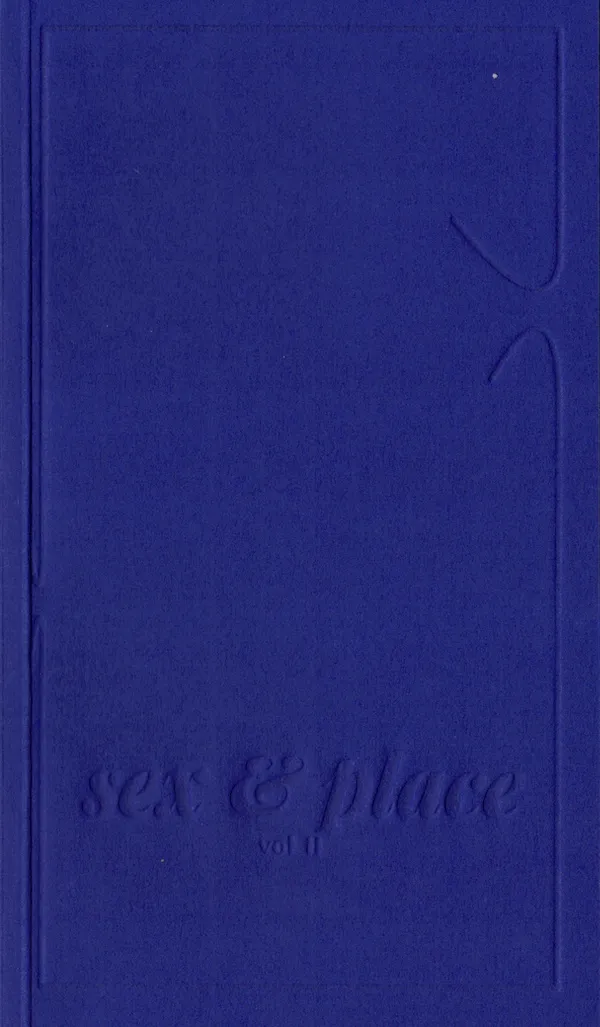
sex and place is a series of workshops and publications exploring score-based and semi-anonymous writing as a tool for articulating shared concerns.

Vol. 1 ‘preliminiaries’ is written by Andrea Zavala Folache and Adriano Wilfert Jensen. In the midst of (learning) child care, (unlearning) performance and (experimenting with) sex, the publication interweaves three registers of writing as analogies and interruptions of each other.

The ‘sex and place’ series is part Domestic Anarchism, a project devoted to coalition-building beyond biological, chosen, or national conceptions of family. Dance serves as a set of tools and knowledge that can be applied beyond “the spectacle” to collectively study, write, and move. 

Andrea Zavala Folache and Adriano Wilfert Jensen are choreographers and they co-parent three-year-old Penélope Cleo. Andrea and Adriano use dance and choreography to think about the distribution of care and solidarity beyond ‘the family’, and in turn consider how such a distribution could inform their dance practice. Inevitably themes like sex, economy, gender, and class get activated. But also notions such as prefiguration, anarchism, clitoridian* thinking, zones of non-domination and coalition building. They see dance as a knowledge that can be applied to different practices. Some of these include: co-habitations, score based writing and dancing, self-organised study groups and publications, workshops and dance performances. 

Cover of YouYou Group – A li'nuage

newpolyphonies

YouYou Group – A li'nuage

Justine Maxelon, Will Holder

Performance €15.00

Handmade artist's book combining drawings, photographs, and archival materials. This publication reflects on the YouYou Group's ten-year journey and its evolving relationship with space. It marks a transitional moment from the group's long-term engagement with public space toward a growing understanding of spatiality and collective presence.

YouYou Group is a Belgian choir that specializes in what is known in Arabic as zaghareed. This trilling cry is used by women at weddings and festive occasions, but also at funerals. Youyou is the French name for zaghareed. Depending on the regional origin, it is also called kululu, tsahalulim, or irrintzi. It is a long, shrill tone that is modulated (by the throat, glottis, or rapid tongue movements) and can be heard from far away. Brussels artist Myriam Van Imschoot was one of the founders of this singing group.

Cover of Appendix #2 - How to organize a library

Time has fallen asleep in the afternoon sunshine

Appendix #2 - How to organize a library

Mette Edvardsen, Léa Poiré and 1 more

The Appendixes #1–4 is an editorial series by Mette Edvardsen, Léa Poiré and Victoria Pérez Royo that developed out of the project Time has fallen asleep in the afternoon sunshine. For a two-year residency at Les Laboratoires d’Aubervilliers* (2022–23), they came together as a small work group, shaping the work process, hosting presentation formats and making this publication series on paper as four cahiers.

The cahiers comprise a collection of commissioned texts and contributions created for this context, selected documents and traces from work sessions and encounters organized during their residency, texts read together and republished for this occasion, a collection of references, notes in progress, unfinished thoughts and loose fragments – on paper, between pages.

The Appendixes are organized around four themes: (1) The gesture of writing, (2) How to organize a library, (3) Orality and (4) Translation. In addition to being published on paper, the editorial series also consisted of other formats of presentations, exchanges and meetings organized as workshops, fieldwork, performances, conferences, collective readings and oral publications, taking place during their residency at Les Laboratoires d’Aubervilliers and in the vicinity.

Cover of Jennifer Lacey & Nadia Lauro – Dispositifs chorégraphiques

Les Presses du Reel

Jennifer Lacey & Nadia Lauro – Dispositifs chorégraphiques

Alexandra Baudelot

Un essai consacré au travail de la chorégraphe et danseuse Jennifer Lacey et de la plasticienne et scénographe Nadia Lauro, qui rend compte de l'univers visuel des deux artistes au travers de nombreuses illustrations.

Dans cet essai, Alexandra Baudelot s'attache à saisir l'ensemble des œuvres co-écrites par la chorégraphe Jennifer Lacey et la plasticienne et scénographe Nadia Lauro, en observant de quelle manière elles s'architecturent les unes aux autres pour constituer des extensions inédites d'une forme artistique vers une autre.

Elle les observe à la manière de parcours envisagés comme des supports d'expériences cherchant à déborder constamment ses propres cadres de représentation. Ceci afin de saisir les politiques mises en jeu pour penser le corps, sa place dans un environnement fictif ou quotidien, son impact dans les enjeux chorégraphiques contemporains et ses liens avec notre époque.

L'espace de cet essai se prête également à l'univers visuel des deux artistes qui se livrent ici à un jeu de construction entre l'exploration d'images d'archive, de déclinaisons de projets inédits et périphériques aux pièces publiques, d'illustrations, et d'exposition d'un portfolio de dessins.

Originaire de New York, la chorégraphe et danseuse Jennifer Lacey est établie à Paris. Depuis 1991, elle a développé son propre travail chorégraphique qui a été présenté aux États-Unis (P.S. 122, The Kitchen) et en Europe (Klapstuk Festival, Vienna Festival, Danças na Cidade, Biennale d'art contemporain de Lyon, Big Torino). Depuis qu'elle réside en France, elle a créé et présenté plusieurs œuvres : $Shot (Lacey / Lauro / Parkins / Cornell), Châteaux of France no. 2 et no. 3, un projet conçu en collaboration avec Nadia Lauro, et Prodwhee!, une série de courts modules. En 2002, elle a été accueillie en résidence aux Laboratoires d'Aubervilliers. Jennifer Lacey a collaboré à différents projets avec de nombreux artistes : Loïc Touzé, Boris Charmatz, Emmanuelle Huynh, Benoît Lachambre, Catherine Contour et Latifa Laâbissi. Elle développe actuellement ses créations au sein de l'association Megagloss.

Nadia Lauro est artiste visuelle et scénographe basée à Paris. Elle développe son travail dans divers contextes et conçoit des environnements, des installations visuelles et des costumes pour différents projets chorégraphiques. Outre Jennifer Lacey, elle collabore notamment avec les chorégraphes Ami Garmon, Vera Montero, Benoît Lachambre, Frans Poelstra, Barbara Kraus, figures de la danse contemporaine en Europe. En 1998, elle fonde avec l'architecte paysagiste Laurence Crémel l'association Squash Cake Bureau – scénographie et paysage au sein de laquelle elle conçoit des installations paysagères et du mobilier urbain. Elle a également créé la scénographie de plusieurs défilés de mode.