Sex I
Sex I, de Camille Kingué est un récit intime à la première personne qui traite des relations sexuelles/intimes comme espaces de (re) découverte de soi et d'(in) accessibilité à l'autre.
How To Become est une maison d'édition autogérée basée à Paris. Nous publions les textes d'auteuces engagés dans des pratiques féministes et peu diffusés par le réseau des grandes maisons d'édition françaises.
Créée en 2016, elle est composée d'artistes et écrivaires en majorité gouines, HTB publie de la litterature expérimentale née d'influences post-post- sapphiques ainsi qu'un choix de tradu d'auteuices non traduites en langue française. HTB s'articule autour d'ateliers d'écriture: How to Become a Lesbian, et d'une revue annuelle publiant les choses issues de l'atelier.
Aodhan Madden, Claire Star Finch
Oh oh this is the first issue of Tongue Ring, a journal of experimental writing in English & French, with original contributions and translations of texts* by Ariana Reines*, CAConrad*, Camille Kingué, Kaur Alia Ahmed*, Rafael Moreno, Taos Bertrand, and Théo Robine-Langlois*.
Vous voyez, c’est ça mon genre. Je ne sais pas ce que c’est.
Mais c’est mon genre. J’ai cet esprit en moi—qui est très ému
par la féminité. Je pourrais me mettre à pleurer. Je veux poser
mon manteau par terre pour la laisser marcher dessus
—Ariana Reines
Premier numéro de la nouvelle revue fantastique et bilingue (FR + EN) d’écriture expérimentale Tongue Ring, avec des contributions originales ainsi que des traductions* de textes de Ariana Reines*, CAConrad*, Camille Kingué, Kaur Alia Ahmed*, Rafael Moreno, Taos Bertrand, and Théo Robine-Langlois*.
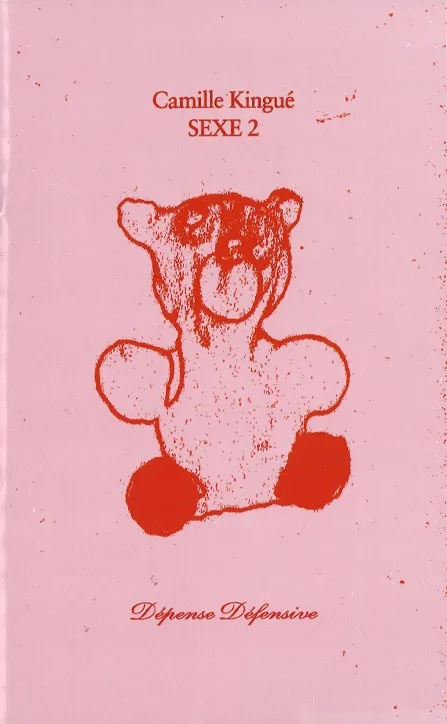
Confession sur le désir (l’action et l’objet du), les liens de mutualité et de résistance, Sexe 2 alterne prose et versification en 27 fragments numérotés à l’adresse plus ou moins dure, plus ou moins sincère, plus ou moins formulée car plus ou moins éloignée du Toi et du Je. Camille Kingué s’attache à révéler, à voir quelque chose à travers son image réelle et virtuelle, agrandie et rétrécie, droite et renversée, déployant une recherche des principes de l’amour (l’amour comme amour, pourquoi est ce qu’il y a de l’amour) où la métaphysique et la compréhension de soi – donc de l’autre – n’ont jamais été aussi sexy.
Claire Star Finch, dans la magnifique préface qu’iel signe au début de l’ouvrage, écrit : « Après avoir lu tous les livres de Kingué, je ne sais pas si je crois en “l’amour”, que ce soit en tant que substantif absolu ou en tant que proto-résidu de tout ce que “le sexe” peut signifier. Mais je crois définitivement qu’il faut l’écrire. » Définitivement.
Cruz Alejandra Lucas Juárez, Wendy Call and 1 more
Through a voice at once intimate and collective, Lucas Juárez expands the powerful presence of Tutunakú roots to open up territories and to interweave desirous bodies, dream relationships, and the memories of women ancestors. This beautiful translation by Wendy Call and Whitney DeVos, in a precious handmade edition, affirms the trilingual (Tutunakú, Spanish and English) as an ethical strategy of listening to and translating the world. Red Seed collects twelve poems of women's sexualities and spirits in which body, language and territory are political spaces that Indigenous memory expands within and renews.
—Maricela Guerrero, author of The Dream of Every Cell
Metamorphoses springs from Ovid's epic poem to explore the slipperiness of identity, its propensity for change and transience. In poems that shift registers from travelogue to elegy, from nature documentary to a simple record of the realities of daily life, Evan Kennedy focuses on transformation, personal and collective, in an empire in decline, in a world transfigured by ecological upheaval.
With a range of reference from Roman household Gods to San Francisco poetic titans to musical celebrities like Madonna and Bob Dylan, Metamorphoses confronts change as an inevitable molecular process.
Inch Aeons is a meditation on the form of meaning, the nature of nature, and the locality of tradition in an over-wired-world.
Here, award-winning poet Nuala Archer adopts, breaks and recreates the limits of haiku, evoking moments of collision and convergence, from "Beyond Conception- / Without Regeneration- / Big Bang's Leave let Be" to "Am-Is-Are-Was-Were- / Has-Have-Had-Do-Does-Did-Shall- / Should-Can-Could-Will-Would-."
Poet Juliet Patterson calls Inch Aeons "a complex and wondrous book," while poet Pam Ore says the poems are "like starlight, resonat[ing] with the brightness of an original violence, cooling-healing and coalescing into the word."
Published as part of the TrenchArt Casements series, Inch Aeons includes inside illustrations by Japanese artist Tamzo and visual art (back cover) by American artist Molly Corey.
Nuala Archer is the author of Whale on the Line, Two Women, Two Shores (with Medbh McGuckian), PAN/AMA, and From a Mobile Home. She served as the primary English-language editor for University Over the Abyss: The Story Behind 520 Lecturers & 2,430 Lectures in Kz Theresienstadt 1942-1944. In 1995 she survived a catastrophic car accident; recovering in Jerusalem, she enrolled in a theatre degree program at the School of Visual Theatre. Archer continues to perform with the Jerusalem Theatre Company at festivals around the world, including in Auschwitz, London, Dublin, New Delhi, Bangalore, Seoul and Kagoshima. She is an Associate Professor at Cleveland State University.
David J. Melnick published the first book of Men in Aida, a homophonic, but also homoeroticized translation of Homer's epic Iliad, in December 1983 in an edition of 450 at Tuumba Press. After appearing in many guises and fragments, Book Two was published online in 2002 as part of the Eclipse Archive. Book Three appears for the first time in the present publication, which brings together all three books of one of the most important American avant-garde poems.
According to Sean Gurd, who wrote the introduction to this unified edition: "The labor of more than 20 years, Men in Aïda filters the sound of Homer's Iliad through the words and phraseology of English. Far more than an exercise in homophonic translation, David J. Melnick's epoch-marking poem packs thousands of years of linguistic history into three riotous books."