rile*books

Search books

Search books by title, author, publisher, keywords...

Cover of Post-Nationalism

Berggruen Press

Post-Nationalism

Rosi Braidotti

€6.50

Why is post-nationalism so difficult to accept? Why is it that everyone still clings to ideas about their nations and cultures that limit exchange and construction? Why is it that Europe, the post-national project par excellence, is still facing a deficit in commitment compared to national and even local commitments?

In this riveting essay, Rosi Braidotti tackles these questions through a renewed examination of the social imaginary underlying how people understand their communities, cultures and nations. Europeans in particular need to become Europeans just as we became French, Italian or German in the past.

In the contemporary geopolitical context — war, the rise of authoritarian right-wing politics, the return of illiberal, neofascist political movements spreading a climate of gloom and crisis — the unfinished task of becoming post-national has acquired new urgency. The way to make it possible might lie in a renewal of love and solidarity, creative energy and affirmative ethics.

Rosi Braidotti is a philosopher and feminist theorist. A distinguished university professor emerita at Utrecht University and honorary professor at RMIT University, her work is discussed all around the world. She has authored more than 20 books. Her last book in English is Posthuman Feminism (Polity, 2022).

Published in 2026 ┊ 60 pages ┊ Language: English

recommendations

Cover of Archives on Show – Revoicing, Shapeshifting, Displacing – A Curatorial Glossary

Archive Books

Archives on Show – Revoicing, Shapeshifting, Displacing – A Curatorial Glossary

Beatrice von Bismarck

Archives on Show brings the potential of reformulating the social and political relevance of archives by curatorial means into focus.

Based on the specific properties, faculties and methods of curation, the volume highlights those techniques and strategies that deal with archives not only to make their genesis and history apparent but also to open them up for the future. The 22 different ways of dealing with archives testify to the curatorial participation in (re)shaping the archival logic, structures and conditions. As process-oriented, collective and relational modes of producing meaning, these curatorial practices allow for the alteration, reconfiguration and mobilization of the laws, norms and narratives that the archive preserves as preconditions of its power.

The contributions to this volume by artists, curators and theorists demonstrate approaches that curatorially insist on building other relations between human and non-human archival participants. Each is using the book to create a curatorial constellation that generates and forms new connections between different times and spaces, narratives, disciplines and discourses. Configured as a glossary, the positions assembled in this volume exemplify curatorial methods with which to treat the archive as site and tool of collective, ongoing negotiations over its potential societal role and function.

Contributions by Heba Y. Amin, Talal Afifi, Eiman Hussein, Tamer El Said, Stefanie Schulte, Strathaus, Haytham El Wardany, Julie Ault, Kader Attia, Roger M. Buergel, Sophia Prinz, Yael Bartana, Rosi Braidotti, Kirsten Cooke, Ann Harezlak, Alice Creischer, Andreas Siekmann, Octavian Esanu, Megan Hoetger, Carlos Kong, Iman Issa, Kayfa ta, Kapwani Kiwanga, Doreen Mende, Stefan Nowotny, Marion von Osten, pad.ma, Abdias Nascimento, Eran Schaerf, Magdalena Tyżlik-Carver, Françoise Vergès.

Cover of Can the Monster Speak?: Report to an Academy of Psychoanalysts

Semiotext(e)

Can the Monster Speak?: Report to an Academy of Psychoanalysts

Paul B. Preciado

Essays €16.00

Paul Preciado's controversial 2019 lecture at the École de la Cause Freudienne annual conference, published in a definitive translation for the first time. 

In November 2019, Paul Preciado was invited to speak in front of 3,500 psychoanalysts at the École de la Cause Freudienne's annual conference in Paris. Standing in front of the profession for whom he is a mentally ill person suffering from gender dysphoria, Preciado draws inspiration in his lecture from Kafka's Report to an Academy, in which a monkey tells an assembly of scientists that human subjectivity is a cage comparable to one made of metal bars.  

Speaking from his own mutant cage, Preciado does not so much criticize the homophobia and transphobia of the founders of psychoanalysis as demonstrate the discipline's complicity with the ideology of sexual difference dating back to the colonial era, an ideology which is today rendered obsolete by technological advances allowing us to alter our bodies and procreate differently. Preciado calls for a radical transformation of psychological and psychoanalytic discourse and practices, arguing for a new epistemology capable of allowing for a multiplicity of living bodies without reducing the body to its sole heterosexual reproductive capability, and without legitimizing hetero-patriarchal and colonial violence.  

Causing a veritable outcry among the assembly, Preciado was heckled and booed and unable to finish. The lecture, filmed on smartphones, was published online, where fragments were transcribed, translated, and published with no regard for exactitude. With this volume, Can the Monster Speak? is published in a definitive translation for the first time.

Cover of T*

Mousse Publishing

T*

Giordano Bonora, Ilaria Bombelli

Essays €20.00

A photographic archive of the transgender community in Bologna in the 1980s. With critical texts by scholars and queer theorists.

This book is inspired by the pictures that Giordano Bonora, a young streetcar operator and aspiring photographer, took of Bologna's small transgender community in 1980 (although it would be more correct to speak, in this case, of proto-Transgenderism). Reproduced here for the first time, these raw and gilded images reflect—during a period in Italy characterized by subversive movements and political revolts that were not just rooted in questions of identity—attempts made by T* people at a construction of the self outside the binary logic of the genotypically XY male/genotypically XX female. By people like Valérie—a woman's face, a hairless chest with no breasts, a fleur-de-lis tattooed on the shoulder, and two pairs of pantyhose—for whom “gender” is not determined biologically but something to be embraced depending on the circumstances. A box containing a jigsaw puzzle with a picture that is constantly changing. Bundled with the photographs, a handful of texts set out to explain how the question of gender involves two cultural levels of sexual difference, the normative and the dissident, and how the decision-making power over organs outside heteropatriarchal systems of sexuality and processes of disidentification are the stakes in the new “somato-political” struggle against hegemonic regimes of oppression conducted by enchanting, allied, opaque, and vulnerable bodies.

Texts by Paolo Barbaro, Paul B. Preciado, Helena Velena, Salvatore Vitale, Wendy Vogel.

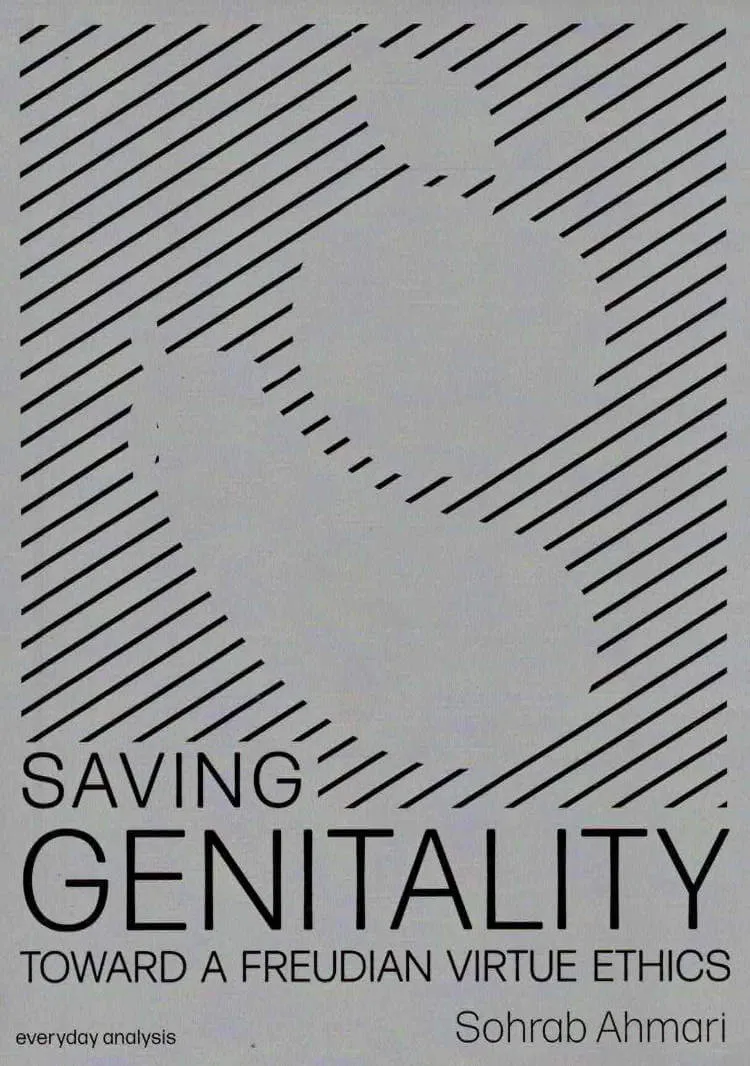
Cover of Saving Genitality: Toward A Freudian Virtue Ethics

Everyday Analysis

Saving Genitality: Toward A Freudian Virtue Ethics

Sohrab Ahmari

Essays €9.00

Western societies have dismantled many of the prohibitions that ringfenced errant sexual drives in Freud’s time. The psychoanalytic project describes people caught between two fundamental and contradictory principles: One a relentless sexual drive, the libido; the other our species’ collective need for social order and harmony. Part of this harmony, for true Freudians, is embedded in the binary mutuality of men’s and women’s bodies, which remains indispensable for society to reproduce itself, even in our sexually liberated age. In this essay, Ahmari revisits the idea of ‘genitality’ arguing that perhaps the "heteronormative" orthodox Freudians were right about some things after all.

Cover of Reclaiming Mythological Rituals

Mousse Publishing

Reclaiming Mythological Rituals

Le Nemesiache, Sonia D'Alto

Enchanted €30.00

The first monograph dedicated to the Neapolitan feminist and pacifist artists' collective: unpublished documents, images, photographs, and manifestos are accompanied by new creative, political, and historical contributions, evoking the collective joy of Le Nemesiache's history so as to bring a sense of myth back into the world, rewriting and embodying it anew.

Nemesiache is an informal feminist group co-founded in Naples in 1970 by the multidisciplinary and visionary artist and writer Lina Mangiacapre (1946-2002). The collective, which included up to twelve women (centered around Claudia Aglione, Fausta Base, Silvana Campese, Consuelo Campone, Conni Capobianco, Bruna Felletti, Anna Grieco, and Teresa Mangiacapre), fostered an experimental artistic practice and a way of being in the world rooted in feminism, mythology, folktales, sci-fi, and radical imagination, while also introducing "transfeminism" in the early '80s. 

Throughout their long-lasting practice spanning several decades, the group retrieved an androgynous mythosophy to transcend art as mere representation and challenge the feminine as a modern identity category. Their distinct transformative approach within both Italian and Western feminist art history led not only to the emergence of an interdisciplinary practice—encompassing film, performance, writing, rituals, poetry, music, collage, costumes, protests, and conferences—but also the creation of a new political language, grounded in cosmological creativity and justice through mythological rituals.

Edited by Sonia D'Alto.
Texts by Chiara Bottici, Federica Bueti, Cairo Clarke, Sonia D'Alto, Giulia Damiani, Giusi Palomba, Imma Tralli & Roberto Pontecorvo, Elvira Vannini, Giovanna Zapperi, Arnisa Zeqo.

Cover of Schismatics

LAPAS

Schismatics

Goda Palekaite

Essays €20.00

Schismatics consists of 10 short stories, in a fictitious way dealing with forgotten historical personas. Among them, artist Goda Palekaitė includes Mary Anning –– an amateur discoverer of dinosaurs, Emanuel Swedenborg –– a mystic who empirically explored the architecture of heaven, and Essad Bey –– a Jewish-Muslim writer and orientalist. Here their lives are revived and balance between the lines of history and story.

The book fuses elements of fiction, academic writing, and artistic research, and intertwines with rumors, forgeries, and inventions. Previously, its characters and narratives have already appeared in Palekaitė’s performances and installations, which are presented in the middle of this bilingual edition. In the introductory essay, Valerio Del Baglivo analyses the author’s exploration of facts and fiction, the mechanisms of knowledge production, and the trans-chronological perception of time. At the end of the book, Monika Lipšic ‘Riddle’ reflects on a ‘schismatic poetics’. 

Goda Palekaitė is a contemporary artist and researcher whose work combines visual, literary, performative, and anthropological practices. Exploring the politics of historical narratives, the agency of dreams and collective imagination, and social conditions of creativity, her work evolves around long-term projects that manifest as performances, scenographies, installations, and texts. Her performances, solo and group shows are being presented internationally. In 2019 Goda Palekaitė received The Golden Stage Cross and the Young Artist’s Prize for her artistic contributions across disciplines.

Published September 2020