rile*books

Search books

Search books by title, author, publisher, keywords...

Cover of Memory

Siglio Press

Memory

Bernadette Mayer

€45.00

In July 1971, Bernadette Mayer embarked on an experiment: for one month she shot a roll of 35mm film each day and kept a journal. The result was a conceptual work that investigates the nature of memory, its surfaces, textures and material. Memory is both monumental in scope (over 1,100 photographs, two hundred pages of text and six hours of audio recording) and a groundbreaking work by a poet who is widely regarded as one of the most innovative experimental writers of her generation. Presaging Mayer's durational, constraint-based diaristic works of poetry, it also evinces her extraordinary —and often unheralded— contribution to conceptual art.

Mayer has called Memory "an emotional science project," but it is far from confessional. This boldly experimental record follows the poet's eye as she traverses early morning into night, as quotidian minutiae metamorphose into the lyrical, as her stream of consciousness becomes incantatory. In text and image, Mayer constructs the mercurial consciousness of the present moment from which memory is —as she says— "always there, to be entered, like the world of dreams or an ongoing TV show."

This publication brings together the full sequence of images and text for the first time in book form, making space for a work that has been legendary but mostly invisible. Originally exhibited in 1972 by pioneering gallerist Holly Solomon, it was not shown again in its entirety until 2016 at the Poetry Foundation in Chicago and then again in 2017 in New York City at the CANADA Gallery. The text was published without the photographs in 1975 by North Atlantic Books in an edition that has long been out of print.

Bernadette Mayer (born 1945) is the author of over 30 books, including the acclaimed Midwinter Day (1982), a book-length poem written during a single day in Lenox, Massachusetts, The Desires of Mothers to Please Others in Letters (1994) and Work and Days (2016), which was a finalist for the National Book Critics Circle Award. Associated with the New York School as well as the Language poets, Mayer has also been an influential teacher and editor. In the art world, she is best known for her collaboration with Vito Acconci as editors of the influential mimeographed magazine 0 TO 9.

Language: English

recommendations

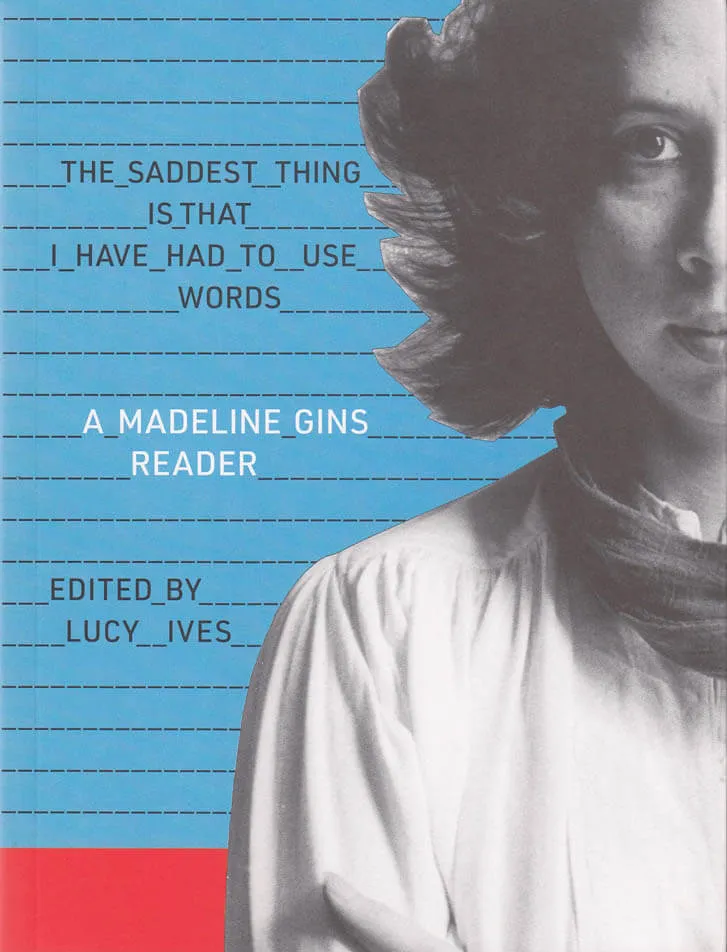
Cover of The Saddest Thing Is That I Have Had to Use Words: A Madeline Gins Reader

Siglio Press

The Saddest Thing Is That I Have Had to Use Words: A Madeline Gins Reader

Madeline Gins

Poetry €28.00

Poet, philosopher, speculative architect and transdisciplinary artist, Madeline Gins is well known for her collaborations with her husband, the artist Arakawa, on the experimental architectural project Reversible Destiny, in which they sought to arrest mortality by transforming the built environment. Yet, her own writings — in the form of poetry, essays, experimental prose and philosophical inquiries — represent her most visionary and transformative work. Like Gertrude Stein before her, Gins transfigures grammar and liberates words. Like her contemporaries in conceptual art, her writing is attuned to the energized, collaborative space between reader and page.

The Saddest Thing Is That I Have Had to Use Words: A Madeline Gins Reader is a revelatory anthology, edited and with an introduction by the writer and critic Lucy Ives. It brings never-before-published poems and essays together with a complete facsimile reproduction of Gins' 1969 masterpiece, WORD RAIN (or A Discursive Introduction to the Intimate Philosophical Investigations of G, R, E, T, A, G, A, R, B, O, It Says), along with substantial excerpts from her two later books What the President Will Say and Do!! (1984) and Helen Keller or Arakawa (1994). Long out of print or unpublished, Gins' poems and prose form a powerful corpus of experimental literature, one which is sure to upend existing narratives of American poetics at the close of the 20th century.

Edited by Lucy Ives. 

Cover of Studying Hunger Journals

Station Hill Press

Studying Hunger Journals

Bernadette Mayer

Non-fiction €27.00

In 1972 Bernadette Mayer began this project as an aid to psychological counseling, writing in parallel journals so that, as she wrote in one (in bed, on subways, at parties, etc.), her psychiatrist read the other. Using colored pens to “color-code emotions,” she recorded dreams, events, memories, and reflections in a language at once free-ranging and precise—a work that creates its own poetics. She sought “a workable code, or shorthand, for the transcription of every event, every motion, every transition” of her own mind and to “perform this process of translation” on herself in the interest of evolving an innovative, inquiring language. STUDYING HUNGER JOURNALS registers this intention within a body of poetry John Ashbery has called “magnificent.”

Cover of The Letters of Rosemary & Bernadette Mayer, 1976-1980

Swiss Institute

The Letters of Rosemary & Bernadette Mayer, 1976-1980

Bernadette Mayer, Rosemary Mayer

Poetry €25.00

This collection of the correspondence between artist Rosemary Mayer (1943-2014) and poet Bernadette Mayer (born 1945) occurs between the years of 1976 and 1980, a period of rich creativity in New York's artistic avant-garde, and one which includes the development of major bodies of work by the two women.

Rosemary Mayer was creating sculptures, watercolors, books and temporary monuments from weather balloons and snow, while Bernadette Mayer was working on some of her best-known publications, including the book-length poem Midwinter Day and the poetry collection The Golden Book of Words.

Spanning the worlds of Conceptual art, Postminimalism, feminism, the New York School, Language poetry and more, these letters elucidate the bonds of sisterhood through intimate exchanges about art, relationships and everyday life.

Cover of Midwinter Day

New Directions Publishing

Midwinter Day

Bernadette Mayer

Poetry €17.00

Midwinter Day, as Alice Notley noted, is an epic poem about a daily routine. A poem in six parts, Midwinter Day takes us from awakening and emerging from dreams through the whole day-morning, afternoon, evening, night-to dreams again:...

a plain introduction to modes of love and reason/ Then to end I guess with love, a method to this winter season/ Now I've said this love it's all I can remember/ Of Midwinter Day the twenty-second of December// Welcome sun, at last with thy softer light/ That takes the bite from winter weather/ And weaves the random cloth of life together/ And drives away the long black night!

Cover of Tripwire 15 - Narrative/Prose

Tripwire Journal

Tripwire 15 - Narrative/Prose

Renee Gladman, David Buuck

Fiction €20.00

Narrative/Prose issue, featuring a special section: I was writing, but it was drawing: a Renee Gladman mini-feature with work by Renee Gladman * Earl Jackson, Jr. * Bruna Mori * Alexis Almeida on Renee Gladman & Julie Carr * Lewis Freedman & Vanessa Thill on Renee Gladman & Mirtha Dermisache. as well as work by Isabel Waidner * sissi tax (translated by Joel Scott & Charlotte Theißen) * Susan Hefuna * Mira Mattar * Lital Khaikin * Maryam Madjidi (translated by Ruth Diver) * Omer Wasim & Saira Sheikh * Ilse Aichinger (translated by Christian Hawkey & Uljana Wolf) * Bronka Nowicka (translated by Katarzyna Szuster) * Maude Pilon (translated by Simon Brown) * Mehmet Dere * Syd Staiti * Jena Osman * Germán Sierra * Natani Notah * Julia Bloch on Bernadette Mayer * Robert Glück on Clarice Lispector * Rob Halpern on Bruce Boone & Dennis Cooper *Dylan Byron on/after Bruce Boone * Linda Bakke on Communal Presence: New Narrative Writing Today * Anna Fidler * Corey Zielinski on Bob Glück & Writers Who Love Too Much: New Narrative 1977-97 * Jackie Kirby on From Our Hearts to Yours: New Narrative as Contemporary Practice * David W. Pritchard on Kevin Killian * Dale Enggass on Simone White * Allison Cardon on Anne Boyer * Robert Balun on Leslie Kaplan * Marco Antonio Huerta on Omar Pimienta * Allison Grimaldi Donahue on Josué Guébo * Sara Florian on Lasana Sekou * Louis Bury on Allison Cobb * Hugo Gibson on Annie Ernaux.

Cover of  Memory

Semiotext(e)

Memory

Dorothea Lasky

Poetry €18.00

A spiritual homage to Bernadette Mayer's monumental artwork of the same title, Dorothea Lasky's Memory is a cycle of "poet's essays" stirred by two profound questions. What constitutes personhood and consciousness? What memories get lost, and why?

Expansive in her quest for answers, Lasky launches an inspired investigation of the forces that form our lives and deepest senses of ourselves. She identifies three dimensions of memory—ancestral, personal, and poetic—and in her singularly clear voice, undertakes to enter into their mysteries. From those recesses, she returns with a wide-ranging collection of essays that like lyric poems find the universal inside the particular. Memory reflects on the banal; private emotions and historical trauma; dear departed poets (Diane di Prima, Lucie Brock-Broido); her father's battle with Alzheimer's; and cultural events that have become charged sites of collective reminiscence (the moon landing, the music of Neutral Milk Hotel). Other pieces face the flip side of memory, asking what's left where memory is absent, and what's "real" beyond the horizon of death. The book closes with "Time, the Rose, and the Moon," an ars poetica published here in English for the first time, which offers the ancient symbol of the Ouroboros as a figure for the nonlinear processes of time, memory, and art.

Like Mayer before her, Lasky reveals memory to be huge and haunting, as she accumulates impressions that challenge the very possibility of fixed meaning. "Every rose has the scent of death," she writes. "And poetry is a perfume. That will stay on your body forever.... Whatever happens this time around, remember that."

Dorothea Lasky is the author of six full-length collections of poetry, including, most recently, The Shining (2023). She is also the author of the prose book Animal (2019) and a forthcoming book about Sappho, as well as the editor of Essays (2023) and a coeditor of Open the Door: How to Excite Young People About Poetry (2013). Her writing has appeared in POETRY, The New Yorker, The Paris Review, The Atlantic, and Boston Review, among other places.

Cover of Sitt Marie Rose

Litmus Press

Sitt Marie Rose

Etel Adnan

Fiction €17.00

Sitt Marie Rose is the story of a woman abducted by militiamen during the civil war in Lebanon. Already a classic of war literature, this extraordinary novel won the France-Pays Arabes award in Paris and has been translated into six languages. Sitt Marie Rose is part of Comparative Literature, World Literature, Women’s Studies and Middle East Studies curricula at more than thirty universities and colleges in the U.S.

Translated by Georgina Kleege.

Etel Adnan was born in Beirut, Lebanon in 1925. She is a celebrated writer, essayist, and playwright, and is the author of more than twenty books in all these disciplines. Her work as a whole is a faithful record of the times and places she has lived in Beirut, Paris, and in the San Francisco Bay Area. At least eighteen works by Adnan have been published in English. They include Sitt Marie Rose (Post-Apollo Press, 1982); The Arab Apocalypse (Post-Apollo Press, 1989); Sea and Fog (Nightboat Books, 2012), winner of the Lambda Literary Award for Lesbian Poetry and the California Book Award for Poetry; Premonition (Kelsey Street Press, 2014); Surge (Nightboat Books, 2018); Time (Nightboat Books, 2019), winner of the Griffin Poetry Prize and the Best Translated Book Award; and Shifting the Silence (Nightboat Books, 2020). In 2021, Litmus Press published a second edition of Journey to Mount Tamalpais (originally published by The Post-Apollo Press), which included nine new ink drawings by Adnan. Her paintings, described by New York Times art critic Roberta Smith as "stubbornly radiant abstractions," have been widely exhibited. Spanning media and genres, Adnan's writings have led to numerous collaborations with artists and musicians, including the French part of CIVIL warS, a multi-language opera by American stage director Robert Wilson, performed in Lyon and Bobigny in 1985. In 2014 she was named Chevalier des Arts et des Lettres, France's highest cultural honor, by the French Government. She died in Paris, in 2021.

Georgina Kleege is an internationally known writer and disability studies scholar. Her collection of personal essays, Sight Unseen (1999) is a classic in the field of disability studies. Kleege’s latest book, More Than Meets the Eye: What Blindness Brings to Art (2018) is concerned with blindness and visual art. Kleege joined the English department at the University of California, Berkeley in 2003 where in addition to teaching creative writing classes she teaches courses on representations of disability in literature, and disability memoir. Kleege is also the author of Home for the Summer (The Post-Apollo Press, 1989).

Cover of Paris, When It's Naked

Post Apollo Press

Paris, When It's Naked

Etel Adnan

Fiction €16.00

Etel Adnan's novel Paris, When It's Naked amazes our retinas, ears, lips, fingertips, and noses with sensing, talking, and envisioning the city of Baudelaire and Delacroix, Mallarme and Picasso, Sartre and Djuna Barnes, Miller and Nin, Vietnamese and African refugees, revolutions and Bohemia.

This tale of the Creative Now is told through the fine-tuned sensibility of Etel Adnan, the expatriate poet-painter who knew the French Capital as wholly as she did Beirut and San Francisco, her other homes. She is also the author of Sitt Marie-Rose, an underground novel of the Lebanese Civil War, and many books of poetry. This work is a philosophically charged lyric in prose. The elan vital of every word evokes the eternal present of this wise woman. A highly personal, life-enhancing masterpiece in a deathly age of impersonality. An indespensable book by an indispensable writer. (Words by Morgan Gibson)