rile*books

Search books

Search books by title, author, publisher, keywords...

Cover of Intelligent Life

Blank Forms

Intelligent Life

Maryanne Amacher

€60.00

Comprehensive and previously unpublished documentation on the American composer's unproduced magnum opus.

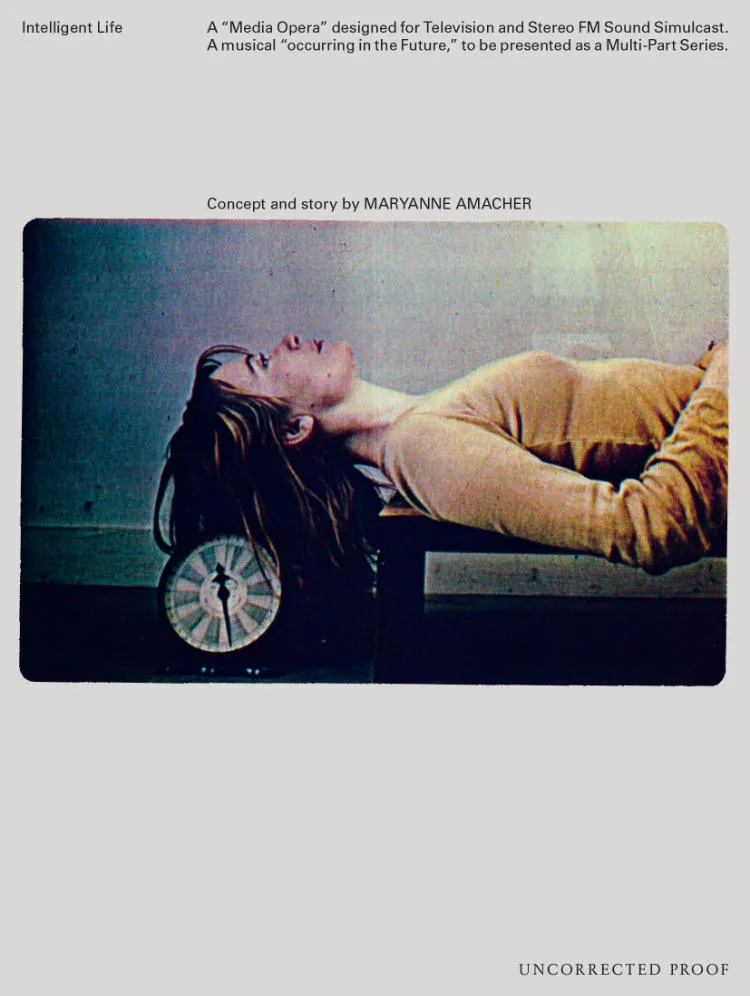
Had it been produced, Maryanne Amacher's media opera Intelligent Life would have represented the summation of the composer's concept to date. As she wrote to John Cage in the autumn of 1983, following the untimely deaths of the opera's patrons—Wies Smals, founder of De Appel, and curator Josine van Droffelaar, in a plane crash in the Swiss Alps—she would have at last had the support to "communicate the finest of my thought to others." Amacher's serial, intended for broadcast, sought to transmit her evolving ideas about perception, listening, and composition to a broader public—shifting music away from "nod and tap recognition" toward a transformative practice that could awaken intelligence to "unrecognized and new perceptual modes."

Set in the year 2021, Intelligent Life follows the employees of Supreme Connections LLC, a music entertainment corporation navigating a future in which artificial intelligence generates music faster than composers can. Anticipating an industry-wide downturn, Supreme Connections president Aplisa Kandel seeks advanced technologies that will revolutionize the act of listening and the future of music, including a bio-music script that lets the user hear Bach from the aural perspective of a reindeer and a wearable device that goes beyond replicating the mechanical tympanic resonances of the listening subject to produce the "listening mind" or the "sophisticated perceiver"—capturing and reproducing all the emotional and psychological associations unique to each individual.
Though Amacher could not realize Intelligent Life in any of its intended forms—she theorized its publication as a serialized radio broadcast and television simulcast, among other configurations—she continued designing "treatments" for the opera for much of her career. This volume makes the most complete of these working documents—including episodic scripts, notes on the use of LaserDisc, and an illustrated storyboard for the pilot—available to the public for the first time.

Maryanne Amacher (1938-2009) was a composer of large-scale fixed-duration sound installations and a highly original thinker in the areas of perception, sound spatialization, creative intelligence, and aural architecture. She is frequently cited as a pioneer of what has come to be called “sound art,” although her thought and creative practice consistently challenges key assumptions about the capacities and limitations of that genre. Often considered to be a part of a post-Cagean lineage, her work anticipates some of the most important developments in network culture, media arts, acoustic ecology, and sound studies.

Published in 2026 ┊ 456 pages ┊ Language: English

recommendations

Cover of Better Do It Now before You Die Later: Sonny Simmons with Marc Chaloin

Blank Forms

Better Do It Now before You Die Later: Sonny Simmons with Marc Chaloin

Sonny Simmons, Marc Chaloin

Though his years in the New York free-jazz scene of the sixties cemented his reputation as "one of the most forceful and convincing composers and soloists in his field," saxophonist Sonny Simmons (1933–2021) was nearly forgotten by the '80s, which found him broke, heavily dependent on drugs and alcohol, and separated from his wife and kids. "I played on the streets from 1980 to 1994, 365 days a year," Simmons tells jazz historian and biographer Marc Chaloin. "I would go to North Beach, and I'd sleep in the park. The word got around town that Sonny is a junkie, really strung out."

The resurrection of Simmons' career―upon the release of his critically acclaimed Ancient Ritual (Qwest Records) in 1994―has become a modern legend of the genre. In the last two decades of his musical career, Simmons broke through to a new echelon of recognition, joining the pantheon of great innovators and masters of the music. But to this day he remains an undersung figure. Here, in the first ever book dedicated to his life, Simmons recounts his childhood in the backwoods of Louisiana, his adolescence in the burgeoning Bay Area jazz scene and his star-studded life in New York playing alongside the greats.

Cover of Wistlin is did

Cordite Books

Wistlin is did

Chris Mann

Poetry €19.00

Chris Mann is an Australian-American composer, poet and performer specializing in compositional linguistics. Mann studied Chinese and linguistics at the University of Melbourne, and his interest in language, systems, and philosophy is evident in his work. Mann founded the New Music Centre in 1972 and taught at the State College of Victoria in the mid-1970s. Mann moved to New York in the 1980s and was an associate of American composers John Cage and Kenneth Gaburo. Mann has recorded with the ensemble Machine For Making Sense with Amanda Stewart and others, Chris Mann and the Impediments, and Chris Mann and The Use. Mann currently teaches in the Media Studies Graduate program at The New School.

Cover of Spectres #02 – Resonances

Shelter Press

Spectres #02 – Resonances

Bartolomé Sanson, François Bonnet

The second issue of Spectres is devoted to the concept of resonances, with contributions by Maryanne Amacher, Chris Corsano, Ellen Fullman, Christina Kubisch, Okkyung Lee, Pali Meursault, Jean-Luc Nancy, David Rosenboom, Tomoko Sauvage, The Caretaker, David Toop, and Christian Zanési.

To resonate: re-sonare. To sound again—with the immediate implication of a doubling. Sound and its double: sent back to us, reflected by surfaces, diffracted by edges and corners. Sound amplified, swathed in an acoustics that transforms it. Sound enhanced by its passing through a certain site, a certain milieu. Sound propagated, reaching out into the distance. But to resonate is also to vibrate with sound, in unison, in synchronous oscillation. To marry with its shape, amplifying a common destiny. To join forces with it. And then again, to resonate is to remember, to evoke the past and to bring it back. Or to plunge into the spectrum of sound, to shape it around a certain frequency, to bring out sonic or electric peaks from the becoming of signals.

Cover of Schizo-Culture: The Event, The Book

Semiotext(e)

Schizo-Culture: The Event, The Book

Sylvère Lotringer, David Morris

Philosophy €42.00

The legendary 1975 "Schizo-Culture" conference, conceived by the early Semiotext(e) collective, began as an attempt to introduce the then-unknown radical philosophies of post-'68 France to the American avant-garde. The event featured a series of seminal papers, from Deleuze's first presentation of the concept of the "rhizome" to Foucault's introduction of his History of Sexuality project. The conference was equally important on a political level, and brought together a diverse group of activists, thinkers, patients, and ex-cons in order to address the challenge of penal and psychiatric institutions. The combination proved to be explosive, but amid the fighting and confusion "Schizo-Culture" revealed deep ruptures in left politics, French thought, and American culture.

The "Schizo-Culture" issue of the Semiotext(e) journal came three years later. Designed by a group of artists and filmmakers including Kathryn Bigelow and Denise Green, it documented the chaotic creativity of an emerging downtown New York scene, and offered interviews with artists, theorists, writers, and No Wave and pre-punk musicians together with new texts from Deleuze, Foucault, R. D. Laing, and other conference participants.

This slip-cased edition includes The Book: 1978, a facsimile reproduction of the original Schizo-Culture publication; and The Event: 1975, a previously unpublished and comprehensive record of the conference that set it all off. It assembles many previously unpublished texts, including a detailed selection of interviews reconstructing the events, and features Félix Guattari, William Burroughs, Kathy Acker, Michel Foucault, Sylvère Lotringer, Guy Hocquenghem, Gilles Deleuze, John Rajchman, Robert Wilson, Joel Kovel, Jack Smith, Jean-François Lyotard, Ti-Grace Atkinson, François Peraldi, and John Cage.

Cover of Silence: Lectures and Writings

Wesleyan

Silence: Lectures and Writings

John Cage

Essays €27.00

Silence: Lectures and Writings is a book by American experimental composer John Cage (1912–1992), first published in 1961 by Wesleyan University Press. Silence is a collection of essays and lectures Cage wrote during the period from 1939 to 1961.

Most of the works are preceded by a short commentary on their origins, some have an afterword provided. Several works feature unorthodox methods of presentation and/or composition. "The Future of Music: Credo" juxtaposes paragraphs of two different texts. The text of the first part of "Composition as Process" is presented in four columns, the text of "Erik Satie" in two. "45' for a Speaker" is similar to Cage's "time length" compositions: it provides detailed instructions for the speaker as to exactly when a particular sentence or a phrase should be said. "Where Are We Going? and What Are We Doing?" is presented in several types of typeface to better reflect the concept of the lecture, which was originally presented as four tapes running simultaneously. "Indeterminacy" is a collection of various anecdotes and short stories taken from life or books Cage read: the concept is to tell one story per minute, and to achieve the speaker has to either speed up or slow down, depending on the length of the story.

Cover of STW, your favourite station!

het balanseer

STW, your favourite station!

buren

STW, your favourite station! functioneert als een radioprogramma. Een boek dat lyrisch proza uitzendt van We make stuff up for a living (een CV medley) tot COMPUTER_SONG, een ceremoniële quiz met Adult Hood & Young als protagonisten, een grillige anekdote van iemand die zich ergert aan een Call Service, en meer! Thanks for tuning in!

Cover of Bodies of Sound: Becoming a Feminist Ear

Silver Press

Bodies of Sound: Becoming a Feminist Ear

Sarah Shin, Irene Revell

Fiction €20.00

‘I am concerned with the power of sound! and what it can do to the body and the mind,’ wrote composer Pauline Oliveros. In the body, histories and politics come together with sound and listening, memory and feeling. Bodies of Sound offers a resonant exploration of feminist sonic cultures and radical listening in over fifty contributions. In this book of echoes, a variety of forms – from essays to text scores to art, fiction and memoir – speak across gender, ways of knowing, witnessing, sounding and voicing, translation, displacement, violence and peace.

With contributions from: 

Sara Ahmed, Ximena Alarcón, Svetlana Alexievich, Ain Bailey & Frances Morgan, Anna Barham, Xenia Benivolski, Leanne Betasamosake Simpson & Kite, Elena Biserna, Karen Barad & Black Quantum Futurism, Anne Bourne, Daniela Cascella, Theresa Hak Kyung Cha, Maria Chávez, Don Mee Choi, Carson Cole Arthur, Petero Kalulé & AM Kanngieser, Lindsay Cooper, Julia Eckhardt, Lucia Farinati & Claudia Firth, Ella Finer, Annie Goh, Louise Gray, Christina Hazboun, Johanna Hedva, Sarah Hennies, Tomoko Hojo, IONE, Lee Ingleton, Hannah Catherine Jones, Christine Sun Kim, Nat Lall, Cathy Lane, Jeanne Lee & Lona Foote, Marysia Lewandowska, Annea Lockwood & Jennifer Lucy Allan, Cannach MacBride, Elaine Mitchener & Hannah Kendall, Alison O'Daniel, Naomi Okabe, Pauline Oliveros, Daphne Oram, Gascia Ouzounian, Holly Pester, Roy Claire Potter, Anna Raimondo, Tara Rodgers, Aura Satz & Barbara London, Shortwave Collective, Sisters of the Order of Celestial Nephology, Sop, Syma Tariq, Marie Thompson, Trinh T. Minh-ha & Stoffel Debuysere, Salomé Voegelin

Cover of Thing

Primary Information

Thing

Robert Ford, Trent Adkins and 1 more

Started in 1989 by designer and writer Robert Ford, THING magazine was the voice of the Queer Black music and art scene in the early 1990s. Ford and his editors were part of the burgeoning House music scene, which originated in Chicago’s Queer underground, and some of the top DJs and musicians from that time were featured in the magazine, including Frankie Knuckles, Gemini, Larry Heard, Rupaul, and Deee-Lite. THING published ten issues from 1989-1993, before it was cut short by Ford’s death from AIDS-related illness. All ten issues of THING are collected and published here for the first time.

As House music thrived, THING captured the multidisciplinary nature of the scene, opening its pages to a wide range of subjects: poetry and gossip, fiction and art, interviews and polemics. The HIV/AIDS crisis loomed large in its contents, particularly in the personal reflections and vital treatment resources that it published. An essay by poet Essex Hemphill was published alongside the gossip columnist Michael Musto and Rupaul dished wisdom alongside a diary from the March on Washington for Lesbian, Gay, and Bi Equal Rights and Liberation. Joan Jett Blakk’s revolutionary presidential campaign is contained in these pages, as are some of the most underground, influential literary voices of the time, such as Dennis Cooper, Vaginal Davis, Gary Indiana, Marlon Riggs, David Wojnarowicz, and even David Sedaris.

THING was very much in dialogue with the club kids in New York and other Queer publishing ventures, but in many ways, it fostered an entirely unique perspective—one with more serious ambitions. In a moment when the gay community was besieged by the HIV/AIDS crisis and a wantonly cruel government, the influence and significance of this cheaply-produced newsprint magazine vastly exceeded its humble means, presenting a beautiful portrait of the ball and club culture that existed in Chicago with deep intellectual reflections. THING was a publication by and for its community and understood the fleetingness of its moment. To reencounter this work today, is to reinstate the Black voices who were so central to the history of HIV/AIDS activism and Queer and club culture, but which were often sidelined by white Queer discourse. In many ways, THING offered a blueprint for the fundamental role a magazine plays in bringing together a community, its tagline summing up the bold stakes of this important venture: “She Knows Who She Is.”

The magazine included contributions from Trent D. Adkins, Joey Arias, Aaron Avant Garde, Ed Bailey, Freddie Bain, Basscut, Belasco, Joan Jett Blakk, Simone Bouyer, Lady Bunny, Bunny & Pussy, Derrick Carter, Fire Chick, Chicklet, Stephanie Coleman, Bill Coleman, Lee Collins, Gregory Conerly, Mark Contratto, Dennis Cooper, Dorian Corey, Ed Crosby, The Darva, Vaginal Davis, Deee-Lite, Tor Dettwiler, Riley Evans, Evil, The Fabulous Pop Tarts, Mark Farina, Larry Flick, Robert Ford, Scott Free, David Gandy, Gemini, Gabriel Gomez, Roy Gonsalves, Chuck Gonzales, Tony Greene, André Halmon, Lyle Ashton Harris, Larry Heard, Essex Hemphill, Kathryn Hixson, Sterling Houston, Ishmael Houston-Jones, Gary Indiana, Candy J, Jamoo, Jazzmun, Gant Johnson, Owen Keehnen, Lady Miss Kier, Spencer Kincy, Iris Kit, Erin Krystle, Steve LaFreniere, Larvetta Larvon, Marc Loveless, Lypsinka, Malone, Marjorie Marginal, Terry A. Martin, Rodney McCoy Jr., Alan Miller, Bobby Miller, Michael Musto, Ultra Naté, Willi Ninja, Scott “Spunk” O’Hara, DeAundra Peek, Earl Pleasure, Marlon Riggs, Robert Rodi, Todd Roulette, RuPaul, Chantay Savage, David Sedaris, Rosser Shymanski, Larry Tee, Voice Farm, Lawrence D. Warren, Martha Wash, LeRoy Whitfield, Stephen Winter, David Wojnarowicz, and Hector Xtravaganza.

Cover of أحمد [Ahmed] – Writing

KASK & Conservatorium

أحمد [Ahmed] – Writing

[Ahmed]

[Ahmed] is the quartet of Pat Thomas (piano), Joel Grip (double bass), Antonin Gerbal (drums) and Seymour Wright (alto saxophone). Since 2014, أحمد [Ahmed] have excavated and re-imagined the music of Ahmed Abdul-Malik, in an ever ongoing search for future music.

[Ahmed] – Writing (EXV01) gathers together the [Ahmed] ‘paper’ texts from the last decade: liner-notes; covers of the releases; and writing by the band members – Antonin and Joel have written two fresh ones for this book, Seymour’s have appeared alongside the records, and some of Pat’s come from a time (long) before [Ahmed]. “Together, the ideas-energy in these things gives a sense of what we have done, do, think together (and apart) in living music, how our different ways come together, and how, together, we learn through be-doing [Ahmed]… These texts are woven together (the etymology of text is from weave) through (and into) a rich fabric of enquiry. A collaborative weaving together of difference(s) to make a whole (thing).” (Seymour Wright)

Contributions by Pat Thomas, Seymour Wright, Antonin Gerbal, Joel Grip, Robert Levin, James G. Spady, John Chantler, Edward George, Fred Moten

Edited by [Ahmed]
Series Editors: Stoffel Debuysere, Jef Lambrechts, Will Holder
Initiated by Stoffel Debuysere
Produced and designed by Will Holder [lps’ original design: Maja Larsson]

Cover of Alice Notley, Live in Seattle

Fonograf Editions

Alice Notley, Live in Seattle

Alice Notley

Poetry €23.00

Entirely comprised of poems contained in her latest collection, 2016’s Certain Magical Acts, Live in Seattle elucidates why Alice Notley is one of the world’s most revered poets, the recipient of the Los Angeles TimesBook Award, the Griffin Prize, the Shelley Memorial Award, the Lenore Marshall Prize, and the Poetry Foundation’s Ruth Lilly Prize. “I am alive outside written memory” is how one of the speakers of Notley’s poem “Voices” puts it and listening to the poet read her work live, in front of an entranced audience, serves to detail the intangibility of sound vis-à-vis language.

Live in Seattle also includes excerpts of the onstage conversation Notley had with Seattle poets John Marshall, Christine Deavel and Rebecca Hoogs. Among other topics, the talk revolves around concepts of success, what it means to write a female poetry circa 2017, and the importance of always creating from a position of disobedience.

As part of Seattle Arts & Lectures’ Poetry Series, Live in Seattle was recorded at McCaw Hall in Seattle, Washington on Wednesday, April 5th, 2017 and mastered and engineered by Gus Elg at Sky Onion in Portland, Oregon in the Summer of 2017. 

Purchase of Live in Seattle includes a 11×11 insert of Notley’s poem “FOUND WORK (lost lace),” as well as a download card for the entire album. Live in Seattle can also be found digitally on Spotify and Bandcamp. The record itself is not black but clear.