rile*books

Search books

Search books by title, author, publisher, keywords...

Cover of Imaginary Languages: Myths, Utopias, Fantasies, Illusions, and Linguistic Fictions

The MIT Press

Imaginary Languages: Myths, Utopias, Fantasies, Illusions, and Linguistic Fictions

Marina Yaguello

€25.00

In Imaginary Languages, Marina Yaguello explores the history and practice of inventing languages, from religious speaking in tongues to politically utopian schemes of universality to the discoveries of modern linguistics. She looks for imagined languages that are autonomous systems, complete unto themselves and meant for communal use; imaginary, and therefore unlike both natural languages and historically attested languages; and products of an individual effort to lay hold of language. Inventors of languages, Yaguello writes, are madly in love: they love an object that belongs to them only to the extent that they also share it with a community.

Yaguello investigates the sources of imaginary languages, in myths, dreams, and utopias. She takes readers on a tour of languages invented in literature from the sixteenth to the twentieth century, including that in More's Utopia, Leibniz's "algebra of thought," and Bulwer-Lytton's linguistic fiction. She examines the linguistic fantasies (or madness) of Georgian linguist Nikolai Marr and Swiss medium Hélène Smith; and considers the quest for the true philosophical language. Yaguello finds two abiding (and somewhat contradictory) forces: the diversity of linguistic experience, which stands opposed to unifying endeavors, and, on the other hand, features shared by all languages (natural or not) and their users, which justifies the universalist hypothesis.

Recent years have seen something of a boom in invented languages, whether artificial languages meant to facilitate international communication or imagined languages constructed as part of science fiction worlds. In Imaginary Languages (an updated and expanded version of the earlier Les Fous du langage, published in English as Lunatic Lovers of Language), Yaguello shows that the invention of language is above all a passionate, dizzying labor of love.

Published in 2023 ┊ 352 pages ┊ Language: English

recommendations

Cover of Death by Landscape

Soft Skull Press

Death by Landscape

Elvia Wilk

Essays €17.00

From the acclaimed author of the novel Oval comes a book of "fan nonfiction" about living and writing in the age of extinction.

In this constellation of essays, Elvia Wilk asks what kinds of narratives will help us rethink our human perspective toward Earth. The book begins as an exploration of the role of fiction today and becomes a deep interrogation of the writing process and the self.  

Wilk examines creative works across time and genre in order to break down binaries between dystopia and utopia, real and imagined, self and world. She makes connections between works by such wide-ranging writers as Mark Fisher, Karen Russell, Han Kang, Doris Lessing, Anne Carson, Octavia E. Butler, Michelle Tea, Helen Phillips, Kathe Koja, Jeff and Ann VanderMeer, and Hildegard von Bingen.  

What happens when research becomes personal, when the observer breaks through the glass? Through the eye of the fan, this collection delves into literal and literary world-building projects—medieval monasteries, solarpunk futures, vampire role plays, environments devoid of humans—bridging the micro and the macro and revealing how our relationship to narrative shapes our relationships to the natural world and to one another.

Cover of Lost & Found: The CUNY Poetics Document Initiative, Series VI

CUNY Center for the Humanities

Lost & Found: The CUNY Poetics Document Initiative, Series VI

CUNY

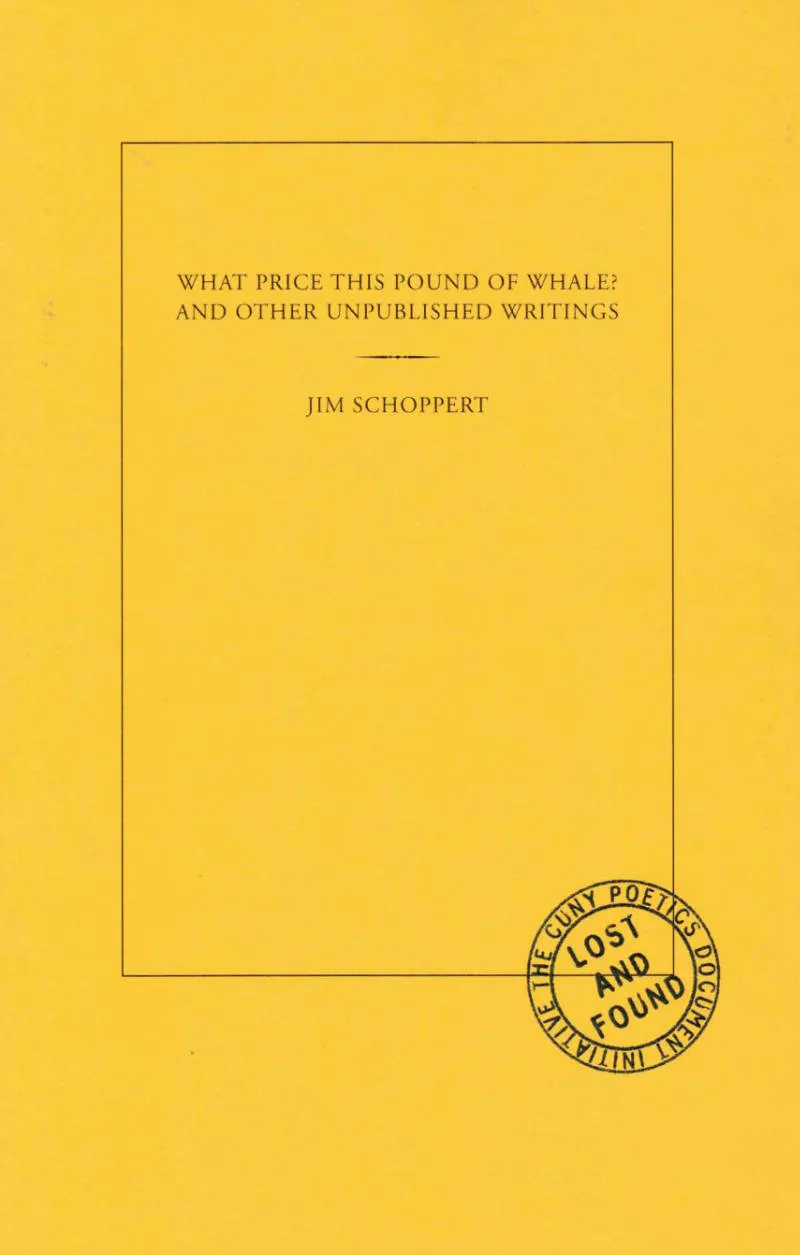
Lost & Found: The CUNY Poetics Document Initiative publishes unexpected, genre-bending works by important 20th century writers. Unearthed from personal and institutional archives in the United States and abroad, these materials are edited by doctoral students at the Graduate Center, CUNY.

LOST & FOUND SERIES VI presents work by Gregory Corso, Judy Grahn, Bobbie Louise Hawkins, and Ted Joans. While the styles and experiences of these writers are radically different, each project presented here enacts a commitment to the exploration of knowledge unbound by disciplinary constraints.

Gregory Corso: Naropa Lectures 1981, introduced by Anne Waldman, includes two transcribed and annotated lectures that illustrate Corso's vast storehouse of cultural knowledge, animating his poetics both on the page and in the classroom.

Bobbie Louise Hawkins: The Sounding Word presents two very different lectures from the Jack Kerouac School of Disembodied Poetics, and a new interview with the author. Whether looking at iconic French novelist Colette or examining the poetics of prose, The Sounding Word describes an unflinching empirical approach to knowledge and its transmission through direct experience.

Judy Grahn: Selections from Blood, Bread, and Roses explores mythic, societal, and personal relationships to menstruation throughout time, and is accompanied by a recent interview with the legendary poet, teacher, scholar, and activist.

Ted Joans: Poet Painter / Former Villager Now / World Traveller, introduced by Diane di Prima, presents an array of previously unpublished texts on jazz, surrealism, travel guides to Africa and Paris, his inimitable Negative Cowboy, and photographs from his life and times. As writers, each considers and refigures the malleable conditions of historical truth and the pursuit of knowledge as part of their creative process. And as readers, we are encouraged to do the same.

SERIES VI includes:

Gregory Corso: Naropa Lectures 1981 (Part I & II) (ed. William Camponovo, Mary Catherine Kinniburgh, Öykü Tekten)

Bobbie Louise Hawkins: The Sounding Word (ed. Iris Cushing)

Judy Grahn: Selections from Blood, Bread, and Roses (ed. Iemanjá Brown & Iris Cushing)

Ted Joans: Poet Painter / Former Villager Now / World Traveller (Part I & II) (ed. Wendy Tronrud & Ammiel Alcalay)

Cover of L'Écriture de Monique Wittig À La Couleur De Sappho

Éditions de Ixe

L'Écriture de Monique Wittig À La Couleur De Sappho

Catherine Écarnot

Invitation au voyage à travers l’œuvre littéraire de Monique Wittig, ce livre nous embarque dans une passionnante exploration de ses textes de fiction, de L’opponax à Virgile, non. Il rend compte de la lutte amoureuse qu’elle livre au langage – matériau brut qu’elle travaille au corps pour faire advenir dans la réalité ce qui n’y a pas (encore) droit de cité. La convocation malicieuse et grave des grands récits du passé, les nombreux emprunts aux auteurs anciens, la pratique de la citation font des Guérillères une formidable épopée féministe, du Corps lesbien un Évangile selon Sappho, du Voyage sans fin le combat drôle et tragique d’une Quichotte féministe et lesbienne.

En soulignant la cohérence des textes et leur fragmentation, Catherine Écarnot met en évidence la passion poétique qui habite ces livres que Wittig concevait comme des « chevaux de Troie » : des machines de guerre destinées à fissurer la réalité pour y inscrire une subjectivité mouvante, échappée du continent noir de la féminité, rétive aux assignations de genre. Uniques et radicalement disruptives, les fictions ainsi créées ouvrent grands les chemins qui relient littérature et lesbianisme.

Publié pour la première fois en 2002, cet ouvrage, le premier consacré en Europe à l’œuvre witigienne, reparaît dans une nouvelle édition remaniée, actualisée et enrichie de nombreuses références aux études publiées depuis sa parution.

Cover of Wretched Strangers

Boiler House Press

Wretched Strangers

Ágnes Lehóczky, JT Welsch

Poetry €18.00

In response to surges of violent British nationalism and political paranoia around borders, and to related social and ethical crises, JT Welsch and Ágnes Lehóczky have assembled an anthology to mark the vital contribution of non-UK-born writers to this country’s poetry culture. Wretched Strangers brings together innovative writing from around the globe, celebrating the irreducible diversity such work brings to ‘British’ poetry. While documenting the challenges faced by writers from elsewhere, these pieces offer hopeful re-conceptions of ‘shared foreignness’ as Lila Matsumoto describes it, and the ‘peculiar state of exiled human,’ in Fawzi Karim’s words.

The book is published by Boiler House Press to commemorate the anniversary of the June 2016 EU Referendum and in solidarity through struggles ongoing and to come. Proceeds will be donated to charities fighting for the rights of refugees.

Alireza Abiz • Astrid Alben • Tim Atkins • Andre Bagoo • Veronica Barnsley • Khairani Barokka • Leire Barrera-Medrano • Katherine E. Bash • Áine Belton • Caroline Bergvall • Sujata Bhatt • Rachel Blau DuPlessis • Fióna Bolger • Ben Borek • Andrea Brady • Serena Braida • Wilson Bueno • James Byrne • Kimberly Campanello • J.R. Carpenter • Mary Jean Chan • che • Matthew Cheeseman • Iris Colomb • Giovanna Coppola • Anne Laure Coxam • Sara Crangle • Emily Critchley • Ailbhe Darcy • Nia Davies • Tim Dooley • Benjamin Dorey • Angelina D’Roza • Katherine Ebury • Dan Eltringham • Ruth Fainlight • Kit Fan • León Felipe • Alicia Fernández • Veronica Fibisan • Steven J Fowler • Livia Franchini • Ulli Freer • Anastasia Freygang • Kit Fryatt • Monika Genova • Geoff Gilbert • Peter Gizzi • Chris Gutkind • Cory Hanafin • Edmund Hardy • David Herd • Jeff Hilson • Áilbhe Hines • Alex Houen • Anthony Howell • Nasser Hussain • Zainab Ismail • Maria Jastrzębska • Lisa Jeschke • Evan Jones • Loma Sylvana Jones • Maria Kardel • Fawzi Karim • Kapka Kassabova • Özgecan Kesici • Mimi Khalvati • Robert Kiely • Michael Kindellan • Igor Klikovac • Ágnes Lehóczky • Éireann Lorsung • Patrick Loughnane • John McAuliffe • Aodán McCardle • Niall McDevitt • Luke McMullan • Christodoulos Makris • Ethel Maqeda • Lila Matsumoto • Luna Montenegro • Stephen Mooney • Ghazal Mosadeq • Erín Moure • Vivek Narayanan • Cristina Navazo-Eguía Newton • Alice Notley • Terry O’Connor • Wanda O’Connor • Gizem Okulu • Claire Orchard • Daniele Pantano • Astra Papachristodoulou • Fani Papageorgiou • Richard Parker • Sandeep Parmar • Albert Pellicer • Pascale Petit • Adam Piette • Jèssica Pujol Duran • Alonso Quesada • Ariadne Radi Cor • Nat RahaNisha Ramayya • Peter Robinson • William Rowe • Lisa Samuels • Jaya Savige • Ana Seferovic • Sophie Seita • Seni Seneviratne • Timea Sipos • Zoë Skoulding • Irene Solà • Samuel Solomon • Agnieszka Studzinska • James Sutherland-Smith • George Szirtes • Rebecca Tamás • Harriet Tarlo • Shirin Teifouri • Virna Teixeira • David Toms • Sara Torres • Kinga Toth • Claire Trévien • David Troupes • Arto Vaun • Juha Virtanen • J. T. Welsch • David Wheatley • Elżbieta Wójcik-Leese • Jennifer Wong • Isaac Xubín • Jane Yeh

Cover of Lost & Found: The CUNY Poetics Document Initiative, Series III

CUNY Center for the Humanities

Lost & Found: The CUNY Poetics Document Initiative, Series III

John Wieners, Lorine Niedecker and 3 more

Anthology €35.00

Lost & Found: The CUNY Poetics Document Initiative publishes unexpected, genre-bending works by important 20th century writers. Unearthed from personal and institutional archives in the United States and abroad, these materials are edited by doctoral students at the Graduate Center, CUNY.

SERIES III is a collection of 8 chapbooks that authenticate Edward Dahlberg's claim that "There is more political energy in friendship than in ideology."

Langston Hughes & Nancy Cunard cement their personal relationship by penning notes across the ocean throughout the Spanish Civil War. After meeting at Black Mountain, John Wieners & Charles Olson remain in close correspondence until months before Olson's death. In "Old Father, Old Artificer," part lecture and part evocation of Charles Olson, Diane di Prima helps to establish how key figures in "New American Poetry" were processing their own past, while the breathless Olson lecture by Ed Dorn erodes the fictive dualism that pits poetic theory against practical action. In his letters, Michael Rumaker invites you to share his life, its radiant pursuit of love, "dirty realism," literature, and lasting community, and Joanne Kyger booms "communication is essential" in her Letters to & from. In Homemade Poems, a gift-book mailed to a friend in 1964, Lorine Niedecker insists that the handmade chapbook is the material continuation of the poems so carefully nestled in its pages.

Breaking up the monolith of the historical lens, Series III continues to track individuals as they tell their stories, cast their lifelines, and position themselves in relation to the times they lived in—and the times we live in—through intimate journals, letters, lectures, and friendships. Edited, annotated, and with accompanying essays, The London Review of Books calls this "a serious and worthy enterprise." Diane di Prima calls the series "a gold mine" and Joanne Kyger writes: "What a brilliant cast of characters. Just exactly what one (myself) would like to read."

SERIES III includes:

Lorine Niedecker: Homemade Poems (John Harkey, editor)

John Wieners & Charles Olson: Selected Correspondence (Parts I & II) (Michael Seth Stewart, editor)

Diane di Prima: Charles Olson Memorial Lecture (Ammiel Alcalay and Ana Božičević, editors)

Edward Dorn: The Olson Memorial Lectures (Lindsey Freer, editor)

Michael Rumaker: Selected Letters (Megan Paslawski, editor)

Letters to & from Joanne Kyger (Ammiel Alcalay and Joanne Kyger, editors)

Langston Hughes, Nancy Cunard & Louise Thompson: Poetry, Politics & Friendship in the Spanish Civil War (Anne Donlon, editor)