rile*books

Search books

Search books by title, author, publisher, keywords...

Cover of Double Trio: Tej Bet, So's Notice, Nerve Church (Limited Edition Box Set)

New Directions Publishing

Double Trio: Tej Bet, So's Notice, Nerve Church (Limited Edition Box Set)

Nathaniel Mackey

€65.00

For thirty-five years American poet Nathaniel Mackey has been writing a long poem of fugitive making like no other: two elegiac, intertwined serial poems—"Song of the Andoumboulou" and " Mu—that follow a mysterious, migrant "we" through the rhythms and currents of the world with lyrical virtuosity and impassioned expectancy. In a note to this astonishing box set of new work, Mackey writes:

"I turned sixty-five within a couple of months of beginning to write Double Trio and I was within a couple of months of turning seventy-one when I finished it.... It was a period of distress and precarity inside and outside both. During this period, a certain disposition or dispensation came upon me that I would characterize or sum up with the words all day music. It was a period during which I wanted never not to be thinking between poetry and music, poetry and the daily or the everyday, the everyday and the alter-everyday. Philosophically and technically, the work meant to be always pertaining to the relation of parts to one another and of parts to an evolving whole."

Structured in part after the last three movements of John Coltrane's Meditations — "Love," "Consequence," and "Serenity"— Double Trio stretches the explorations and improvisations of free jazz into unprecedented poetic territory.

Nathaniel Mackey was born in Miami, Florida in 1947. He is the author of several books of poetry, fiction, and criticism, and has received many awards for his work, including the National Book Award in poetry for Splay Anthem, the Stephen Henderson Award from the African American Literature and Culture Society, and the Bollingen Prize from the Beinecke Library at Yale University. Mackey is the Reynolds Price Professor of English at Duke University, and edits the literary journal Hambone.

Published April 2021.

Published in 2021 ┊ 976 pages ┊ Language: English

recommendations

Cover of Nightwood

New Directions Publishing

Nightwood

Djuna Barnes

Nightwood, Djuna Barnes' strange and sinuous tour de force, "belongs to that small class of books that somehow reflect a time or an epoch" (Times Literary Supplement). That time is the period between the two World Wars, and Barnes' novel unfolds in the decadent shadows of Europe's great cities, Paris, Berlin, and Vienna—a world in which the boundaries of class, religion, and sexuality are bold but surprisingly porous.

The outsized characters who inhabit this world are some of the most memorable in all of fiction—there is Guido Volkbein, the Wandering Jew and son of a self-proclaimed baron; Robin Vote, the American expatriate who marries him and then engages in a series of affairs, first with Nora Flood and then with Jenny Petherbridge, driving all of her lovers to distraction with her passion for wandering alone in the night; and there is Dr. Matthew-Mighty-Grain-of-Salt-Dante-O'Connor, a transvestite and ostensible gynecologist, whose digressive speeches brim with fury, keen insights, and surprising allusions. Barnes' depiction of these characters and their relationships (Nora says, "A man is another persona woman is yourself, caught as you turn in panic; on her mouth you kiss your own") has made the novel a landmark of feminist and lesbian literature.

Cover of Unfit

New Directions Publishing

Unfit

Ariana Harwicz, Jessie Mendez Sayer

Mothering €16.00

A bracing novel that asks how far we would go for the ones we love—and what we would do to destroy the ones we hate. 

Lisa has lost custody of her young twin boys. Caught between the French legal system’s sluggish bureaucracy and her sinister, scheming in-laws, she’s alone and lost, an Argentine migrant in rural France picking grapes for a pittance, only allowed to see her children in supervised visits once a month. Scapegoated and outcast, destitute and desperate, Lisa decides to take radical action: early one morning, she sneaks into her in-laws’ farmhouse, takes back her children, sets the barn ablaze, and makes her escape.

What follows is a white-knuckled road trip that explores human beings pushed to the edge. Clearly, Lisa is not in her right mind, and as Harwicz deftly mingles a chorus of contradictory voices into her very unreliable narration, the reader comes to regard the protagonist with an unsettling mixture of sympathy and suspicion. Written in savage, chiseled prose, Unfit shoots off, a gripping chase that questions all our assumptions—and points out our hypocrisies— about motherhood, custody rights, love, violence, anti-semitism, and migration. The latest novel by the acclaimed author of Die, My Love (soon to be adapted to a film starring Jennifer Lawrence), Unfit is addictively terrifying, savagely sophisticated, and shockingly brilliant.

Translated from Spanish by Jessie Mendez Sayer

Cover of Exophony

New Directions Publishing

Exophony

Yoko Tawada

Non-fiction €17.00

Yoko Tawada's first essay collection in English presents and electrifying new side of the National Book Award-winner as she dives deep into her lifelong fascination with cross-hybridizing languages. The accent here, as in her fiction, is on the art of drawing closer to the world through defamiliarization. Tawada famously writes in both Japanese and German, but her interest in language reached beyond any mere dichotomy. 

The term "exophonic," which she first heard in Senegal, has a special allure for the author: "I was already familiar with similar terms. 'immigrant literature,' or 'creole literature,' but 'exophonic' had a much broader meaning, referring to the general experience of existing outside of one's mother tongue." Exophony opens a new vista into Yoko Tawada's world and delivers more of her signature erudite wit—at once cross-grained and generous, laser-focused and multidimensional, slyly ironic and warmly companionable.

A New Yorker Best Book of 2025. Translated from Japanese by Lisa Hofmann-Kuroda.

Cover of The Hour of the Star

New Directions Publishing

The Hour of the Star

Clarice Lispector

Fiction €14.00

The devastating final work by Brazil’s greatest modern writer, The Hour of the Star tells the haunting tale of Macabéa—a typist who lives in the slums of Rio—underfed, sickly, and unloved, yet inwardly free.

Translated from the Portuguese by Benjamin Moser. With a contribution by Paulo Gurgel and Valente Colm Tóibín.

The Hour of the Star, Clarice Lispector's consummate final novel, may well be her masterpiece. Narrated by the cosmopolitan Rodrigo S.M., this brief, strange, and haunting tale is the story of Macabéa, one of life's unfortunates. Living in the slums of Rio de Janeiro and eking out a poor living as a typist, Macabéa loves movies, Coca-Cola, and her rat of a boyfriend; she would like to be like Marilyn Monroe, but she is ugly, underfed, sickly, and unloved. Rodrigo recoils from her wretchedness, and yet he cannot avoid realization that for all her outward misery, Macabéa is inwardly free. She doesn't seem to know how unhappy she should be. Lispector employs her pathetic heroine against her urbane, empty narrator—edge of despair to edge of despair—and, working them like a pair of scissors, she cuts away the reader's preconceived notions about poverty, identity, love, and the art of fiction. In her last novel she takes readers close to the true mystery of life, and leaves us deep in Lispector territory indeed.

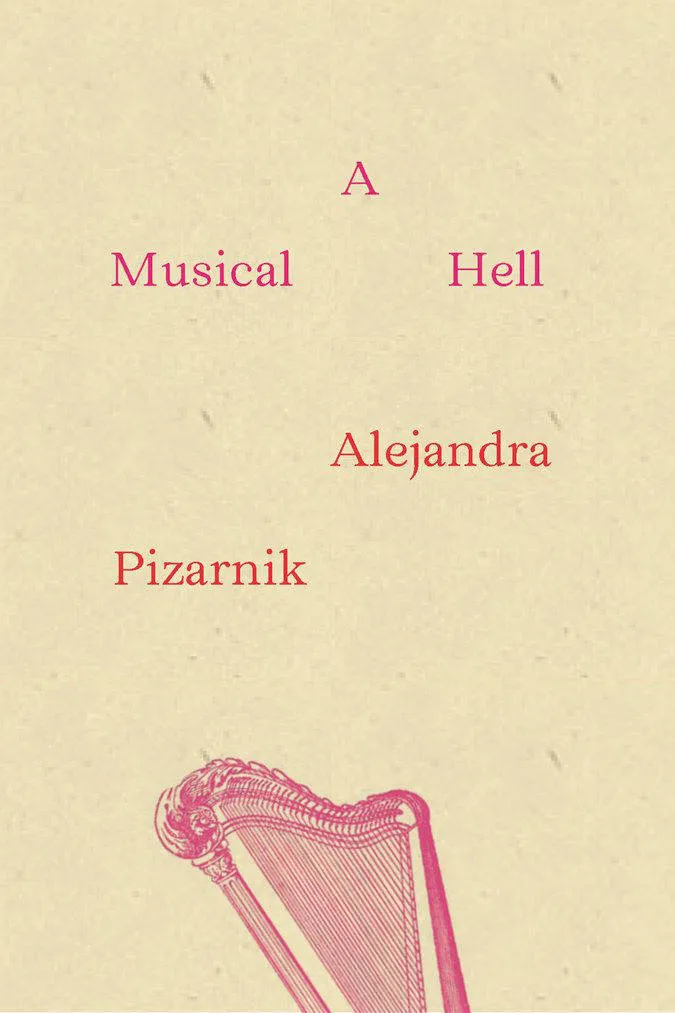
Cover of A Musical Hell

New Directions Publishing

A Musical Hell

Alejandra Pizarnik, Yvette Siegert

Poetry €13.00

“An aura of legendary prestige surrounds the work of Alejandra Pizarnik,” writes César Aira. Her last collection to be published before her suicide in 1972, A Musical Hell is the first book of poems by Pizarnik to be published in its entirety in the U.S. Pizarnik writes at the edge of poetic impossibility, opening with a blues singer, expanding into silence, and closing into a theater of shadows and songs of the drowned.

Cover of Dregs, Beacons

Self-Published

Dregs, Beacons

Anna-Rose Stefatou

Poetry €22.00

Poems on light and remnants. Light as mordant, as acid that etches through surface, as something that wraps itself around and between things, revealing form. The writing touches on dregs, remnants, residue and how we make sense of them, by making constellations and navigating through those diagrams. 

Anna-Rose Stefatou (b.1996, Athens) is a Greek-British artist based between Athens and London, working between moving image, installation, photography, and writing. Stefatou’s interdisciplinary works attend to stories attached to place and beginning to exist through writing, whether they become a structure to hold it, or whether language simply runs through them. Language is used both as an outset and as a distillation mechanism for ideas, with materials and imagery in visual works responding directly to the text. Gathering and repositioning knowledge guides her creative process: research includes archival footage, taking interviews, collecting objects, and location visits. This process is made visible through her material approach to the photographic image, transformed through different materials, forms and uses, as it unfolds and re-invents itself within new contexts. Stefatou graduated from the Slade School of Fine Art in 2019. Recently, she undertook a residency at Hospitalfield House, Scotland in 2023.  Upcoming projects include an exhibition at Pharmakeion, Athens in 2025 as well as a publication Dregs, Beacons that will be realised in 2025.

Cover of The Hormone of Darkness: A Playlist

Graywolf Press

The Hormone of Darkness: A Playlist

Tilsa Otta, Farid Matuk

Poetry €19.00

In Tilsa Otta’s The Hormone of Darkness, we find a queer, Latinx person who has lived through iterations of authoritarian rule, and who answers these conditions by creating poetry that doubles down on a life force that precedes and exceeds received notions of the poetic. Here poetry is bawdy, fabulist, and spiritual—in short, it is alive. Otta has created a heaven where readers can go after they die. 

Drawing from four volumes spanning Otta’s career, translator-poet Farid Matuk has curated a playlist we can dance and dream to, one that honors Otta’s drive toward liberation through both perreo in the club and transdimensional wandering among the stars.

We can go on like that forever
building paradise from our urges
out of our fetishes our loves our vices
How lucky
We’ll wait for you then
Don’t be too long
Bookmark the page
We’ll be Here
—From “The New Heaven”

Translated from the Spanish by Farid Matuk.

Cover of The Undying (paperback)

Picador

The Undying (paperback)

Anne Boyer

Poetry €20.00

Blending memoir with critique, an award-winning poet and essayist's devastating exploration of sickness and health, cancer and the cancer industry, in the modern world

A week after her 41st birthday, Anne Boyer was diagnosed with highly aggressive triple-negative breast cancer. For a single mother living payslip to payslip, the condition was both a crisis and an initiation into new ideas about mortality and the gendered politics of illness.

In The Undying - at once her harrowing memoir of survival, and a 21st-century Illness as Metaphor - Boyer draws on sources from ancient Roman dream diarists to cancer vloggers to explore the experience of illness. She investigates the quackeries, casualties and ecological costs of cancer under capitalism, and dives into the long line of women writing about their own illnesses and deaths, among them Audre Lorde, Kathy Acker and Susan Sontag.

Genre-bending, devastating and profoundly humane, The Undying is an unmissably insightful meditation on cancer, the cancer industry and the sicknesses and glories of contemporary life.

Winner of The Pulitzer Prize for Nonfiction 2020; Windham Campbell Prize for Nonfiction 2020

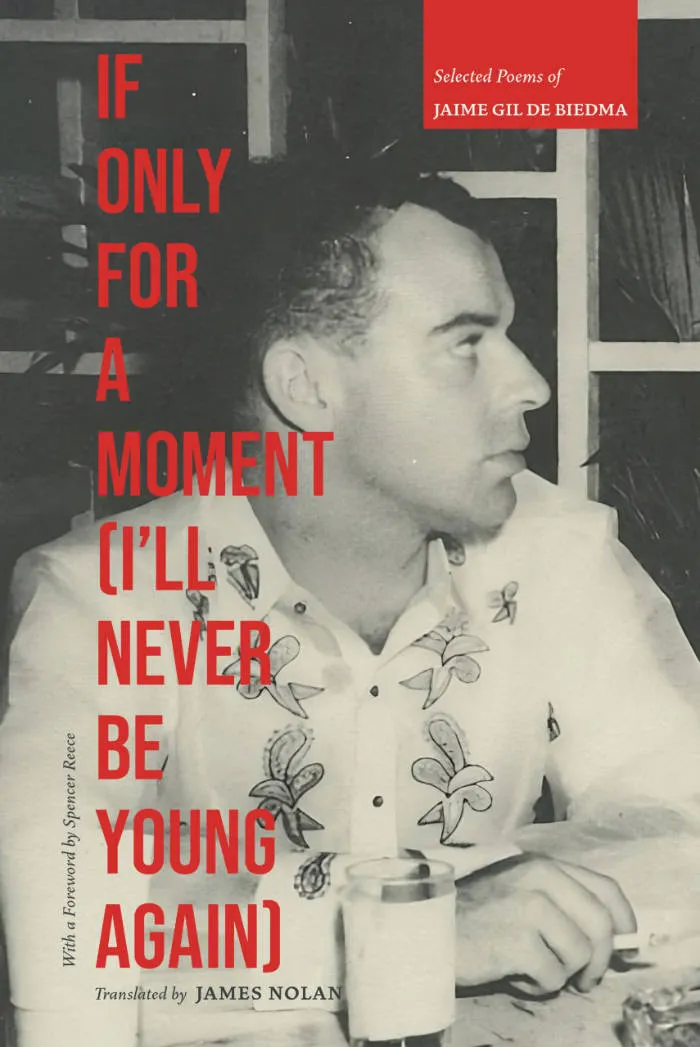
Cover of If Only For a Moment (I’ll Never Be Young Again)

Fonograf Editions

If Only For a Moment (I’ll Never Be Young Again)

Jaime Gil de Biedma, James Nolan

Poetry €19.00

Jaime Gil de Biedma is the most original and influential among the poets known as the ‘50’s Generation in Spain, and is considered the greatest Spanish poet to emerge in the second half of the 20th century. His life and literary career were bracketed almost entirely by the rise and fall of Generalissimo Francisco Franco, notorious for the suppression of literature. Born in 1929, Gil de Biedma was six years old when García Lorca was murdered in Granada at the outbreak of the Civil War, and his collected poems, Las personas del verbo, first appeared in 1975, the year Franco died. What is surprising is that Gil de Biedma was a leftist, homosexual poet from the Catalan capitol, Barcelona – all of Franco’s favorite things – who not only published books of autobiographical poetry in Spain but was known as a poet of social conscience as well as erotic lyricism. Like other Spanish poets of his time, he chose his words carefully. Gil de Biedma died of AIDS in 1990.

If Only For a Moment (I’ll Never Be Young Again) consists of an extensive bilingual selection of Gil de Biedma’s poetry, including all of his most well-known work. The book additionally consists of a Foreword by Spencer Reece, Jaime Gil de Biedma’s short essay “I wanted to be the poem,” and two different essays on Gil de Biedma and the art of translation by James Nolan, the volume’s translator.

Cover of Slow Mania

Futurepoem

Slow Mania

Nazareth Hassan

Poetry €22.00

Nazareth Hassan’s devastatingly brilliant Slow mania is a powerful document of senses and sense-making where estrangement and ugliness meets longing and beauty. The artist begins with a photographic sequence: two white-blue sky panels; a shattered glass storefront window; a street gutter clutching leaves, smashed straw sleeves and plastic lids; then snow holding a disassembled red stained chest of drawers. These are the writer’s plinths where form as waste is configured: “smoggy breath thru burnt-edged holes tracking acid mucous inside your home.” Slow mania provokes through enumerative structures, for instance, “screening bodies” who keep a sex club’s gates open only to some: “…197 mmm maybe lemme think / 151 yes / 162 yes / 197 ok yes, but keep your shirt on.” The poet deftly folds human intimacy into interspecies metaphor: “The rat torso twitches in agreement. Across / the street, the flies continue to starve,” where “…you’re lost in your own hole: what did you find?” Hassan attends to this painful search, bearing witness to the disturbingly exultant, offering a radical state of being, in and out of which the stunning and timely Slow mania lives and thrives. — Ronaldo V. Wilson

Slow mania is resistance to resolution, it’s pointillistic magic, it’s Seurat in Bed-Stuy: the tighter you zoom, the more undifferentiated beauty you encounter. It’s kinky (the kinked-up curls of somebody’s greased-up chops). It’s tender (bruised and brown, like the overripe fruit that haunts your summer kitchen waiting to be crumbled into a crumble). The colors are blurry, the edges are soft, the stakes are high, and everything—everything!—shimmers in the space between life and afterlife. Hassan’s gaze is a hot summer steam that sneaks into the skinniest, stinkiest crevices; the grimiest seams, the most miraculous cracks. Breathe into the abyss, that’s the invitation. Take it in, let it in. Be a wit(h)ness to every single being. — Steffani Jemison

This amazing book reads like a synesthetic performance, the only thing missing is the smell of sweat, of streets, of loss. A book of choreographed pages, scores, movements, image blur, hand-scribbles. The bleak, unsparing texts hidden among the materials turn out to be the record of sudden eruptions, violent street scenes, pick-up scenes, unclear dialogues, insults, self-debasing verbal injuries on repeat. The performers are racialized, sexualized, anonymized “persons,” “meats,” numbers, lovers, passers-by, all caught up in these dangerous yet desperately emotional and triggering dances at the limit. It will leave you raw, spaced-out, both roused and alarmed as though coming out of an intoxicating show, and wanting more. — Caroline Bergvall