rile*books

Search books

Search books by title, author, publisher, keywords...

Cover of After Kathy Acker

Semiotext(e)

After Kathy Acker

Chris Kraus

€17.50

The first authorized biography of postmodernism's literary hero, Kathy Acker.

Acker's life was a fable; and to describe the confusion and love and conflicting agendas behind these memorials would be to sketch an apocryphal allegory of an artistic life in the late twentieth century. It is girls from which stories begin, she wrote in her last notebook. And like other lives, but unlike most fables, it was created through means both within and beyond her control.—from After Kathy Acker

Rich girl, street punk, lost girl and icon… scholar, stripper, victim, and media-whore: The late Kathy Acker's legend and writings are wrapped in mythologies, created mostly by Acker herself. Twenty years after her death, Acker's legend has faded, making her writing more legible.In this first, fully authorized, biography, Chris Kraus approaches Acker both as a writer and as a member of the artistic communities from which she emerged. At once forensic and intimate, After Kathy Acker traces the extreme discipline and literary strategies Acker used to develop her work, and the contradictions she longed to embody. Using exhaustive archival research and ongoing conversations with mutual colleagues and friends, Kraus charts Acker's movement through some of the late twentieth century's most significant artistic enterprises.

Language: English

recommendations

Cover of Playboy

Semiotext(e)

Playboy

Constance Debré

Fiction €18.00

The prequel to Love Me Tender, narrating Debré's transformation from affluent career woman to broke single lesbian and writer.

I see all her beauty, I see the beauty of women. I see my own body, new. I tell myself there are so many things that are possible.

First published in France in 2018, Playboy is the first volume of Constance Debré's renowned autobiographical trilogy that describes her decision, at age forty-three, to abandon her marriage, her legal career, and her bourgeois Parisian life to become a lesbian and a writer.

The novel unfolds in a series of short, sharp vignettes. The narrator's descriptions of her first female lovers—a married woman fifteen years older than her, a model ten years her junior—are punctuated by encounters with her ex-husband, her father, and her son.

As Debré recently told Granta: “It was a bit like Saint Augustine and his conversion. In the same week, I had sex with a girl and I had the feeling that I could write. I had this incredible feeling that I could catch things, that life was there to be caught.”

Looking at the world through fresh eyes, the narrator of Playboy questions everything that once lay beneath the surface of her well-managed life. Laconic, aggressive, and radically truthful, she examines gender and marriage, selfishness and sacrifice, money and family, even the privilege inherent in her downward mobility.

Writing her way toward her own liberation, Debré chronicles the process that made her one of the most brilliant, important French writers today.

Cover of Do Everything in the Dark (2023)

Semiotext(e)

Do Everything in the Dark (2023)

Gary Indiana

Fiction €17.00

Faced with photos of a once-tumultuous New York art world, the narrator's mind in this scathing, darkly funny novel begins to erupt. Memories jostle for center stage, just as those that they are about always did. These brilliant but broken survivors of the '80s and '90s have now reached the brink of middle age and are facing the challenge of continuing to feel authentic. Luminous with imagery, cackling with bitter humor, and with a new foreword by the author, this roman a cle spares no one.

First published in 2003, Gary Indiana's turn-of-the-millennium novel traces the lives of a loosely connected group of New York artists and the dissolution of their scene.  

During the summer of 2001, the narrator of Do Everything in the Dark, a gallery curator, receives intermittent dispatches from his far-flung friends, many of whom resemble well-known figures in the art and intellectual worlds, who are spread out across the globe, from Istanbul to Provincetown to Santa Fe. Seeking various reprieves from a changed New York, the long-festering, glossed-over incompatibilities of these aging bohemians blossom into exotic and unbearable relief. Beneath the contemporary excesses Indiana chronicles, we can see the outlines of the earlier New York bohemia captured by Dawn Powell.  

Arguably Indiana's most intimate, internal, and compassionate work to date, Do Everything in the Dark is a chilling chronicle of madness and failure, success and disappointment, and the many ways love dies in a world people find increasingly unlivable.

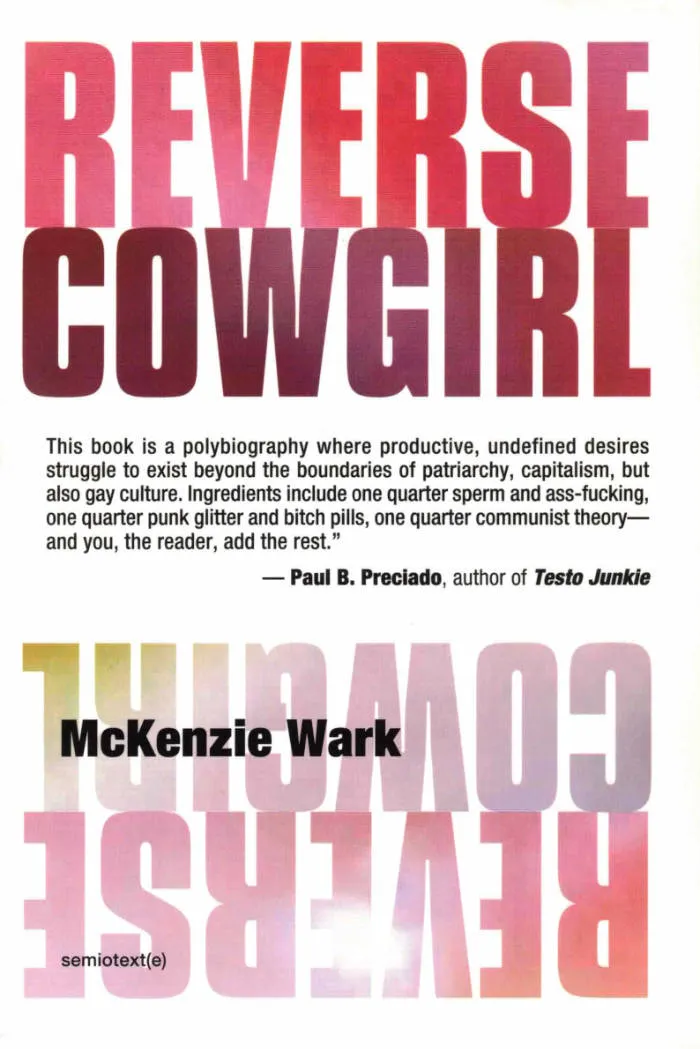
Cover of Reverse Cowgirl

Semiotext(e)

Reverse Cowgirl

McKenzie Wark

Fiction €16.00

McKenzie Wark invents a new genre for another gender: not a memoir but an auto-ethnography of the opacity of the self.

Another genre for another gender.

What if you were trans and didn't know it? What if there were some hole in your life and you didn't even know it was there? What if you went through life not knowing why you only felt at home in your body at peak moments of drugs and sex? What if you expended your days avoiding an absence, a hole in being? Reverse Cowgirl is not exactly a memoir. The author doesn't, in the end, have any answers as to who she really is or was, although maybe she figures out what she could become.

Traveling from Sydney in the 1980s to New York today, Reverse Cowgirl is a comedy of errors, chronicling the author's failed attempts at being gay and at being straight across the shifting political and media landscapes of the late twentieth century. Finding that the established narratives of being transgender don't seem to apply to her, Wark borrows from the genres of autofiction, fictocriticism, and new narrative to create a writing practice that can discover the form of a life outside existing accounts of trans experience: an auto-ethnography of the opacity of the self.

Cover of hello, world?

Semiotext(e)

hello, world?

Anna Poletti

Fiction €18.00

Abandoned by their Dutch partner after giving up their home and their job to follow him to the Netherlands, humanities scholar Seasonal finds themself single in a strange place for the first time in a decade. 

Dipping into the rabbit hole of digital eroticism, Seasonal soon meets László, a male sub who volleys back their cerebral sexts and is seeking a  dominant guide. His dating-app profile—a photo of Foucault and the  ingenuous greeting “Hello, World?”—thinly veils his desire to be annihilated. It's a desire that Seasonal senses they can fulfill. But to do this means crossing the frightening gap between their desires and capacities.  

Seasonal and László embark on an experiment in remaking intimacy outside the Republic of Gender. But as it continues, the two realize they are staging separate confrontations with domination: Seasonal finds they must confront their own relation to the violence and anger that marked their upbringing in working-class, small-town Australia, while László stages his own confrontation with his  decision to leave Viktor Orbán’s Hungary. As they attempt to improvise a  theater of domination that opens up possibilities of reciprocity, the energies of their sexuality stalk this collaboration, threatening to give them exactly what they bargained or begged for. 

A feminist paean to perversity in the tradition of Pauline Réage’s Story of O and Anaïs Nin's Delta of Venus, Anna Poletti's hello, world? dares to fully inhabit female power, and to fully face the violence, beauty, and uncharted territories of human sexuality.

Cover of Can the Monster Speak?: Report to an Academy of Psychoanalysts

Semiotext(e)

Can the Monster Speak?: Report to an Academy of Psychoanalysts

Paul B. Preciado

Essays €16.00

Paul Preciado's controversial 2019 lecture at the École de la Cause Freudienne annual conference, published in a definitive translation for the first time. 

In November 2019, Paul Preciado was invited to speak in front of 3,500 psychoanalysts at the École de la Cause Freudienne's annual conference in Paris. Standing in front of the profession for whom he is a mentally ill person suffering from gender dysphoria, Preciado draws inspiration in his lecture from Kafka's Report to an Academy, in which a monkey tells an assembly of scientists that human subjectivity is a cage comparable to one made of metal bars.  

Speaking from his own mutant cage, Preciado does not so much criticize the homophobia and transphobia of the founders of psychoanalysis as demonstrate the discipline's complicity with the ideology of sexual difference dating back to the colonial era, an ideology which is today rendered obsolete by technological advances allowing us to alter our bodies and procreate differently. Preciado calls for a radical transformation of psychological and psychoanalytic discourse and practices, arguing for a new epistemology capable of allowing for a multiplicity of living bodies without reducing the body to its sole heterosexual reproductive capability, and without legitimizing hetero-patriarchal and colonial violence.  

Causing a veritable outcry among the assembly, Preciado was heckled and booed and unable to finish. The lecture, filmed on smartphones, was published online, where fragments were transcribed, translated, and published with no regard for exactitude. With this volume, Can the Monster Speak? is published in a definitive translation for the first time.

Cover of Adorno's Noise

Essay Press

Adorno's Noise

Carla Harryman

Philosophy €18.00

Adorno’s Noise is a collection of experimental, poetic, and conceptual essays. Adorno’s Noise takes a stunning plunge into a kaleidoscopic world of globalization, female sexuality, the place of art and artist, and the looming power of the state. Phrases from Theodor Adorno’s aphoristic philosophical text, Minima Moralia, serve as catalysts for an explosion of thought and language that quickly breaks Adorno’s orbit.

“This work by Carla Harryman, startlingly astute, once again proves how necessary an encounter with her writing has become for us today. Her grasp of theoretical and poetic exigencies is unbypassable, and she moves lightly, lifting the prose poem into the amplitude of a new articulation.” — AVITAL RONELL

“Adorno’s ‘noise’ may be nothing more than the consonance of late modern capital talking to itself, but Carla Harryman listens to Adorno listening, and what she hears is a very different sort of dissonance, something Adorno himself may have been deaf to. Listening for a noise that can’t be heard, Harryman attends to the disruption of signal the aesthetic artifact called a corpse at the limit of Adorno’s magisterial eloquence, where thought steps over the body. Atonally faithful to his negativity the afterglow of torment passing through figures of speech while refusing the authority of a masterful dialectic, Harryman makes our unthought horizon “normality is death” audible, presencing a body that can’t be redeemed by aesthetics the bosy wants tobe art and fails at it. From Gender the Status of Dogs to works by Sun Ra, Anais Nin, Robert Smithson, and Kenzaburo Oe, this radically asynthetic writing moves thru polyphonic configuration of word, image and concept. Synthesia? Emotional truth? The intersection between abstraction and narration? Practicing a militant ethic of non-mastery as every one of its sentences sounds like a sensory organ in the process of becoming its own theoretician. Adorno’s Noise reinvents the “essay as form,” but it doesn’t stop short of reinventing thinking.” — ROB HALPERN

Carla Harryman is the author of twenty-four books of poetry, prose, plays, and essays. Harryman is widely acknowledged as an innovator in poetry, prose, and inter-disciplinary performance. An active collaborator, she is one of ten co-authors of The Grand Piano, an Experiment in Collective Autobiography: San Francisco, 1975-1980 (2006-2010). Open Box, a CD of music and spoken text performance created with composer and musician Jon Raskin was released on the Tzadik label in 2012. Her Poets Theater plays and music/text collaborations have been performed nationally and internationally, including at dOCUMENTA 13, where she presented the closing keynote performance Occupying Theodor W. Adorno’s “Music and New Music,” a music/text work that folds segments of Adorno’s Noise into her poetic adaptation of Adorno’s lecture. She is the editor of two critical volumes: Non/Narrative, a special issue of the Journal of Narrative Theory ( 2012) and Lust for Life: On the Writings of Kathy Acker (with Avital Ronell and Amy Scholder, Verso, 2006).

Other books by Carla Harryman include the collection of poetry and performance writings published in French and English editions Sue in Berlin and Sue á Berlin (2017); A Voice to Perform (Split/Level 2020); the epistolary essay, Artifact of Hope (2017); the diptych W—/M— (2013), Gardener of Stars: A Novel (2001), and two volumes of selected writing: Animal Instincts: Prose, Plays, Essays (1989) and There Never Was a Rose without a Thorn (1995). Her grants and awards include The Foundation of Contemporary Art, New York, Opera America Next Stage (with Erling Wold), and The Ronald W. Collins Distinguished Faculty in Creative Activity Award from Eastern Michigan University, where she serves on the faculty of an interdisciplinary creative writing program.

Cover of Schizo-Culture: The Event, The Book

Semiotext(e)

Schizo-Culture: The Event, The Book

Sylvère Lotringer, David Morris

Philosophy €42.00

The legendary 1975 "Schizo-Culture" conference, conceived by the early Semiotext(e) collective, began as an attempt to introduce the then-unknown radical philosophies of post-'68 France to the American avant-garde. The event featured a series of seminal papers, from Deleuze's first presentation of the concept of the "rhizome" to Foucault's introduction of his History of Sexuality project. The conference was equally important on a political level, and brought together a diverse group of activists, thinkers, patients, and ex-cons in order to address the challenge of penal and psychiatric institutions. The combination proved to be explosive, but amid the fighting and confusion "Schizo-Culture" revealed deep ruptures in left politics, French thought, and American culture.

The "Schizo-Culture" issue of the Semiotext(e) journal came three years later. Designed by a group of artists and filmmakers including Kathryn Bigelow and Denise Green, it documented the chaotic creativity of an emerging downtown New York scene, and offered interviews with artists, theorists, writers, and No Wave and pre-punk musicians together with new texts from Deleuze, Foucault, R. D. Laing, and other conference participants.

This slip-cased edition includes The Book: 1978, a facsimile reproduction of the original Schizo-Culture publication; and The Event: 1975, a previously unpublished and comprehensive record of the conference that set it all off. It assembles many previously unpublished texts, including a detailed selection of interviews reconstructing the events, and features Félix Guattari, William Burroughs, Kathy Acker, Michel Foucault, Sylvère Lotringer, Guy Hocquenghem, Gilles Deleuze, John Rajchman, Robert Wilson, Joel Kovel, Jack Smith, Jean-François Lyotard, Ti-Grace Atkinson, François Peraldi, and John Cage.

Cover of Reynaldo Rivera

Semiotext(e)

Reynaldo Rivera

Lauren Mackler, Hedi El Kholti

LGBTQI+ €35.00

Throughout the 1980s and 1990s, Reynaldo Rivera took personal photos of the Los Angeles that he lived in and knew: a world of cheap rent, house parties, subversive fashion, underground bands, and a handful of Latino gay and transvestite bars: Mugi’s, The Silverlake Lounge, and La Plaza. Most of these bars are long closed and many of the performers have died. But in Rivera’s photographs, these men and women live on in a silvery landscape of makeshift old-style cinematic glamour, a fabulous flight from unacceptable reality. 

As a teenager, Rivera took refuge in used bookstores and thrift stores, where he discovered old  photo books of Mexican film stars and the work of Lisette Model, Brassai, and Bresson. Inspired, he bought a camera and began  photographing people at his hotel. In 1981 he moved to Echo Park and began taking photos for the LA Weekly. 

This book is an ensemble of almost 200 images selected by Hedi El Kholti and Lauren Mackler spanning more than two decades in Los Angeles and Mexico. The  book also includes Luis Bauz’s story, “Tatiana,” about one of the  subjects of these photographs; a critical essay on Rivera’s work by Chris Kraus; and a novella-length conversation between Rivera and his  friend and contemporary Vaginal Davis about their lives, work, fantasies, and collective histories.

Edited by Hedi El Kholti and Lauren Mackler
With Luis Bauz, Vaginal Davis and Chris Kraus

Cover of Flood Tide

Divided Publishing

Flood Tide

Ana Schnabl, Rawley Grau

Fiction €15.00

In moderate physical decline, and with an immoderate weed habit, the novelist Dunja Anko returns home to the Adriatic coast to play detective and solve the mystery of her brother’s death. The going is arduous, the people inscrutable; her old friends have had years to forget – or to convince themselves they don’t remember. Dunja must contend with desire and disgust, curiosity and fear, as she begins to doubt her reasons for returning. Elegantly plotted, funny and self-reflexive, Flood Tide is a psychologically deft exploration of the trauma wrought by human limitation and indecision.

"A dazzling mix of narrative styles (even genres), a linguistic rollercoaster, and a book that demands both close attention and literary sensibility . . . The reader is hooked." — Boštjan Videmšek

"Mysterious, precise and haunting, Flood Tide suggests that every homecoming is a return to a crime scene." — Chris Kraus

Ana Schnabl (b. 1985) is a Slovenian writer and editor. She writes for several Slovenian media outlets and is a monthly columnist for the Guardian. Her collection of short stories Razvezani (Beletrina, 2017) met with critical acclaim and won the Best Debut Award at the Slovenian Book Fair, followed by the Edo Budiša Award in Croatia; the collection has been translated into German and Serbian. Three years later Schnabl published her first novel Masterpiece (Mojstrovina, Beletrina, 2020). She toured Europe with the English, German and Serbian translations of the book, which included a residence in the Museumsquartier in Vienna, the Literarisches Colloquium Berlin, and the first European Writer’s Festival in London. The novel was given favourable reviews and mentions in numerous Austrian, German and English media, and was longlisted for the Dublin Literary Award. Her second novel Flood Tide (Plima, Beletrina, 2022) was nominated for the Slovenian Kresnik Award. Her third novel September (Beletrina, 2024) won the Kresnik Award in 2025.

Rawley Grau has been translating literary works from Slovenian for over twenty years, including by such first-rate novelists as Dušan Šarotar, Mojca Kumerdej, Sebastijan Pregelj, Gabriela Babnik and Vlado Žabot. Six of his translations have been longlisted for the Dublin Literary Award, while his translations of Šarotar’s Panorama and Billiards at the Hotel Dobray were shortlisted for the Oxford-Weidenfeld Translation Prize. He has also translated poetry by Miljana Cunta, Miklavž Komelj, Janez Ramoveš and Tomaž Šalamun, among others. In 2021, he received the prestigious Lavrin Diploma from the Association of Slovenian Literary Translators. Translations from other languages include A Science Not for the Earth: Selected Poems and Letters by the Russian poet Yevgeny Baratynsky, which received the AATSEEL prize for best scholarly translation, and, co-translated with Christina E. Kramer, The Long Coming of the Fire: Selected Poems by the modernist poet Aco Šopov, which won the 2025 International Dragi Award for best translation from Macedonian. Originally from Baltimore, Maryland, he has lived in Ljubljana since the early 2000s.

Cover of Myth Lab: Theories of Plastic Love

Far West Press

Myth Lab: Theories of Plastic Love

Jack Skelley

Fiction €13.00

Myth Lab: Theories of Plastic Love is a genre-defiant sex-trip to post-human dimensions. If C.G Jung, magic-mushroom shaman Terence McKenna and Camille Paglia (Sexual Personae) had a three-way while binging on George Bataille and undergoing Hormone Replacement Therapy, their baby might be the erotic cocktail of Myth Lab. Its extreme theme is nothing less than the fate of the species.

“Brilliant and wild, Jack Skelley’s Myth Lab is a manifesto of exuberance disguised as a sci-fi sex test-center for the invention of communal futures. Skelley’s a mad scientist, scholar and poet.” - Chris Kraus, author of After Kathy Acker
 
“In Myth Lab, Jack Skelley adroitly molds an “Einsteinian elasticity between objects and ether” to the “clitoverse.”  If this formulation seems too vast, just think about a) the last time you felt good about power and b) all the ways to say yes to pleasure as a source of liberation. In conducting a “cosmologic psychoanalysis,” Myth Lab thrillingly hot wires our neurons to an endless mirror stage reflective of our own instinctual nature.” - Kim Rosenfield, author of Phantom Captain
 
"An explosion of clit-cock-and-pop-culture worship. Skelley’s eroto-celestial universe fights back not only against the denial of desire – “also known as fuckheadocracy and market forces” – but against death itself."  - Francesca Lia Block, author of Weetzie Bat
 
"A hallucinatory book that straddles gender studies, science-fiction, and cultural criticism (to name but three of many genres). Ever eager to use a newfound Skelley-ism, I urge everyone to read Myth Lab and be “Kardashian'd” with love (i.e buy it now, it's great)." - Susan Finlay, author of The Jacques Lacan Foundation
 
"In Jack Skelley’s Myth Lab, something weird and beautiful is forged in the crucible of infinite horny grief. It’s an epic, delirious descent into the inferno, navigating the concentric circles of romance and desire as literary malady, TikTok psyop, benevolent cosmological principle, and more. Simultaneously a quest, a physics experiment and an elegy. I loved following its narrator - a tender, erotomanic, Blakean particle - seeking and finding visionary head." - Daisy Lafarge, author of Love Bug

Cover of When My Body Was A Clinched Fist

Black Lawrence Press

When My Body Was A Clinched Fist

Enzo Silon Surin

Biography €17.00

"Back in the day when KRS-One intoned —The Bridge is over!— he did not prefigure a poet from Queens of the fierce attitude and intellectual magnitude of Enzo Silon Surin. WHEN MY BODY WAS A CLINCHED FIST gives the Heisman to such a refrain with lyrical power-packing poetics that settles the score with a succinct— Not! No the Bridge is not over, for Surin's Queens is alive and well and under the gaze of a master observer who eulogizes lives that though at times are battered have always mattered.

Enzo Silon Surin's poems get you caught up in the deeply personal experiences of growing and visceral all-encompassing knowing from an acute witness of every breath and follicle of Black life from palm trees, sand and sea to street corner projects, suburban houses and fistfuls of black water. Surin writes about the confused and disconnected, trigger happy wannabes trapped by outdated notions of masculinity, the cracked head crackheads all held in the clutch of society's clinched fist through which the trauma that comes with being of color, addicted, broke, lost and tossed, is itself a clinched fist of black bodies caught in the Russian nesting doll America's clinched fists make.

WHEN MY BODY WAS A CLINCHED FIST is an elegy for 'the premature exits.' It is a blues for the black-on-black black and blue. Surin yields his pen like a microscopic scalpel whereby an autopsy of possibility is performed to un-clinch the remarkable bone gristle poetry in these unflinching heart-wrenching pages."—Tony Medina

Enzo Silon Surin, Haitian-born poet, educator, speaker, publisher and social advocate, is the author of two chapbooks, A Letter of Resignation: An American Libretto (2017) and Higher Ground. He is the recipient of a Brother Thomas Fellowship from The Boston Foundation and is a PEN New England Celebrated New Voice in Poetry. Surin's work gives voice to experiences that take place in what he calls "broken spaces" and his poems have appeared in numerous publications including Crab Orchard Review, Origins, Transition Magazine/Jalada, Interviewing the Caribbean, jubilat, Soundings East, The BreakBeat Poets: New American Poetry in the Age of Hip-Hop, and sx salon. Surin holds an MFA in Creative Writing from Lesley University and is currently Professor of English at Bunker Hill Community College and founding editor and publisher at Central Square Press. His debut full-length poetry collection is WHEN MY BODY WAS A CLINCHED FIST (Black Lawrence Press, 2020).

Cover of Theory for Moving Houses

Wave Books

Theory for Moving Houses

Renee Gladman

Essays €22.00

You are asking me where I live and it’s making me think all these things about space, where I start and end in space and where space starts and ends in me and when, in space, I am a body and when I’m a book, in space.

So begins Renee Gladman's Theory for Moving Houses, and with these lines we are invited into a liminal space of imagination and investigation, as Gladman guides us through the architectures of her poetics. Foundational here is a sense of fluidity, a slippage of time, a devotion to “non-linear and hyper gestural movement,” a communal spirit. Gladman’s inquiry into her intersecting practices of writing and drawing reveals a deep commitment to uncertainty and “fictional knowing.” Yet again, Gladman upends traditional expectations of prose, as she leads us through landscape of her Ravicka series novels, ultimately surprising us with a novel within nonfiction. The latest volume in Wave’s Bagley Wright Lecture Series, Theory for Moving Houses is not only visionary in its contemplations but also is a virtuosic example of the ways in which language can shape utopian sites of possibility.