rile*books

Search books

Search books by title, author, publisher, keywords...

Cover of About Playwriting (A Lecture)

Self-Published

About Playwriting (A Lecture)

Nico Boon

€18.00

This book is part of Nico Boon’s doctoral thesis at the Associated Faculty of the Arts (KU Leuven/LUCA School of Arts). His research started out as an investigation into the legacy of the well-made play, but soon morphed into a more paradoxical, ambiguous, and tentative inquiry. In About Playwriting (A Lecture), Boon approaches playwriting as a practice of continuous improvisation, in which chance, rhythmic intuitions, auditory awareness, bodily impulses, shapeshifting, and experimenting are more important than fixed narrative structures, or clear meanings, or distinct boundaries. He views playwriting as a transgressive enterprise that always refuses to choose a definitive form. This is Book 1 in a series of works about playwriting.

“If you look
under your hood,
you will see that
in the middle of
the intricate landscape
that we call
the human brain,
there lives…
a little seahorse.”

"The thing is:
a clock is not time,
a map is not a landscape,
a mirror is not an eye.
And a plot is not a play."

Published in 2026 ┊ 138 pages ┊ Language: English

recommendations

Cover of Fugues

Self-Published

Fugues

Nicole Maria Winkler

FUGUES is a study of objects. Elements repeat and imitate one another like a polyphonic canon of voices narrating stories of domestic confinement in looped time.

With images by photographer Nicole Maria Winkler & texts by artist Issy Wood, writer Ella Plevin, model Freja Beha Erichsen and curator Elaine Tam.

Cover of Person with the last name Universe

Self-Published

Person with the last name Universe

Jelena Glazova

Poetry €10.00

This book has been self-published for Latvian artist and poet Jelena Glazova's solo exhibition “Person with the last name Universe” at Riga contemporary art space (July - August 2026).  The exhibition is the artist’s act of feminist guerrilla resistance within the symbolic territory of contemporary phallocracy. The source and central figure of the post-gender universe conjured by Glazova is the Person with the last name Universe, whose creative strategy the artist unpretentiously calls Glazovism. 

Jelena Glazova (Belgium/Latvia) is a poet and multimedia artist who combines visual elements, experimental sound, installation and poetic text in her projects. As an artist, she has participated in international festivals and projects in Latvia, Estonia, Lithuania, Sweden, Austria, Belgium, Germany, the Netherlands, Turkey and other countries. Among the most notable exhibitions are "Identification of a Woman" at the Latvian Museum of Photography (2010) and "Elements of a Puzzle" at the Latvian Centre for Contemporary Art (2011). She is the author of four poetry collections. Glazova's poetry has been translated into 12 languages. Since 2012, she has given more than 200 performances in 18 countries. She is the co-founder of two poetry festivals in Riga: "Blood of a Poet" (2014–2016) and "Poetry without Borders" (2017–2022). https://www.jelena-glazova.com/

Cover of Notes on a life not lived

Self-Published

Notes on a life not lived

Despina Vassiliadou

Poetry €30.00

This publication is based on a project by Despina Vassiliadou that ran from 2015-16. It presents a collection of photographs taken during the period, accompanied by fictional short stories.

Cover of A take away cup and a cloud

Self-Published

A take away cup and a cloud

Oda Brekke

Essays €10.00

A take away cup and a cloud is an essay written alongside the dance performance Seems to be by Denise Lim and Stina Ehn. It plays with a variety of containers–the list form being one. By mixing a personal with a historical gaze it traces the trajectory of mundane commodities and  the replacement of material with imaterial objects brought about to the everyday by technical progress. 

Cover of Revolutionary Tofu

Self-Published

Revolutionary Tofu

Wu Qin

Zines €15.00

Revolutionary Tofu. Transnational Flows in the Making of Chinese Anarchism, through the clue of soy, attempts to resurface the historical threads of Chinese anarchy in the early 20th century and the transnational flow in the making of it, weaves between France and China, from Manchukuo to São Paulo. Revolutionaries from different regions encountered one another in various historical moments, quietly opening up an alternative path that history might have taken. 

The story was first published in 44 Monthly (September 2022) in China , revised, translated and printed in Berlin in 2024.

Written by Wu Qin                             
Designed by IfA
Published by Tofu Stand (Tofulogy 001)

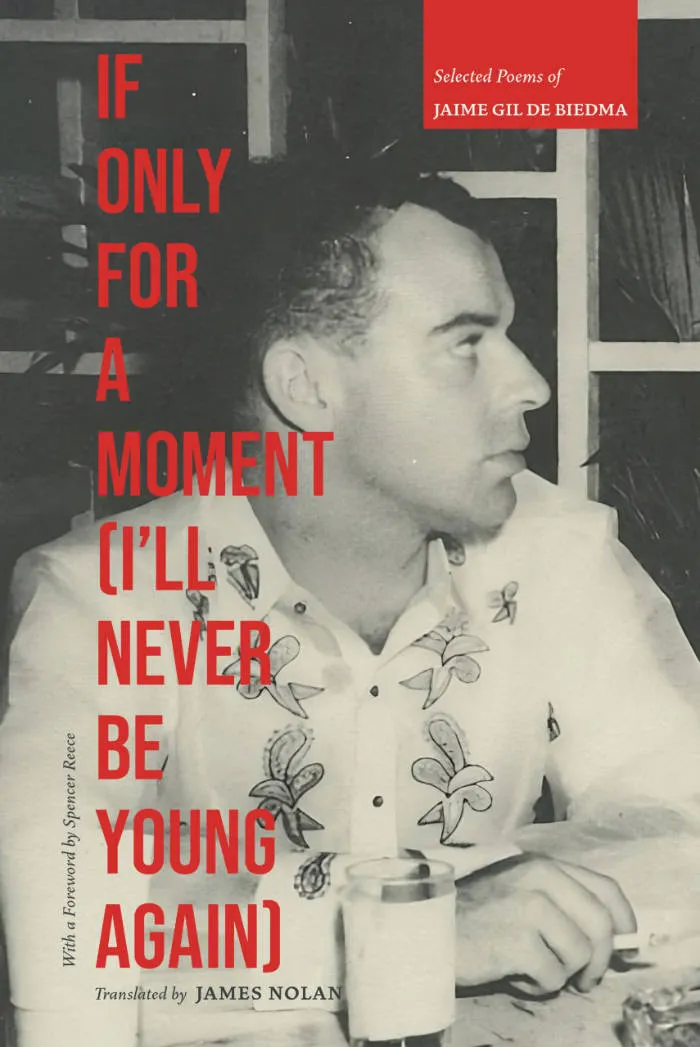
Cover of If Only For a Moment (I’ll Never Be Young Again)

Fonograf Editions

If Only For a Moment (I’ll Never Be Young Again)

Jaime Gil de Biedma, James Nolan

Poetry €19.00

Jaime Gil de Biedma is the most original and influential among the poets known as the ‘50’s Generation in Spain, and is considered the greatest Spanish poet to emerge in the second half of the 20th century. His life and literary career were bracketed almost entirely by the rise and fall of Generalissimo Francisco Franco, notorious for the suppression of literature. Born in 1929, Gil de Biedma was six years old when García Lorca was murdered in Granada at the outbreak of the Civil War, and his collected poems, Las personas del verbo, first appeared in 1975, the year Franco died. What is surprising is that Gil de Biedma was a leftist, homosexual poet from the Catalan capitol, Barcelona – all of Franco’s favorite things – who not only published books of autobiographical poetry in Spain but was known as a poet of social conscience as well as erotic lyricism. Like other Spanish poets of his time, he chose his words carefully. Gil de Biedma died of AIDS in 1990.

If Only For a Moment (I’ll Never Be Young Again) consists of an extensive bilingual selection of Gil de Biedma’s poetry, including all of his most well-known work. The book additionally consists of a Foreword by Spencer Reece, Jaime Gil de Biedma’s short essay “I wanted to be the poem,” and two different essays on Gil de Biedma and the art of translation by James Nolan, the volume’s translator.

Cover of Close to Me & Closer...(the Language of Heaven) and Desamere

O Books

Close to Me & Closer...(the Language of Heaven) and Desamere

Alice Notley

Poetry €19.00

Alice Notley's two books collected here, CLOSE TO ME & CLOSER... and DESAMERE, are works that are wholly their art, meaning they occur as their language shape measure. She's invented a measure. The text is a rich current crossing, as at the moment of imagining, into being in death and in an expanded life. Notley transgresses conventional contemporary categories of genre; rather than genre, the form of the writing is the mind's inner sense and motion.

"Alice Notley is, I think, the most challenging and engaging of our contemporary radical female poets...infused with uncommon verbal originality, intelligence and joyous playfullness, full of heart, intensity and wonder, provocatively addressing forever unsolved questions of form and identity, life and death, imagination and gender, Notley's poems are unsettling and inspiring"—the San Francisco Chronicle. 

Cover of YouYou Group – A li'nuage

newpolyphonies

YouYou Group – A li'nuage

Justine Maxelon, Will Holder

Performance €15.00

Handmade artist's book combining drawings, photographs, and archival materials. This publication reflects on the YouYou Group's ten-year journey and its evolving relationship with space. It marks a transitional moment from the group's long-term engagement with public space toward a growing understanding of spatiality and collective presence.

YouYou Group is a Belgian choir that specializes in what is known in Arabic as zaghareed. This trilling cry is used by women at weddings and festive occasions, but also at funerals. Youyou is the French name for zaghareed. Depending on the regional origin, it is also called kululu, tsahalulim, or irrintzi. It is a long, shrill tone that is modulated (by the throat, glottis, or rapid tongue movements) and can be heard from far away. Brussels artist Myriam Van Imschoot was one of the founders of this singing group.

Cover of SIXFINGERAFTERWARDS

Veer2

SIXFINGERAFTERWARDS

William Rowe

Poetry €13.00

William Rowe, the poet, and eminent translator of Latin American poetry from Vallejo to Raul Zurita & others presents his latest book of poems, Sixfingersafterwards, in six sections. The title word ‘afterwards’, which refers to a large part of the first section of poems takes inspiration from an Ayahuasca session. According to Freud, Afterwardness or Nachtraglichkeit as originally harmless memory can later be re-experienced as traumatic through the lens of new mature understanding. The Marxists view the capitalist state as inherently connected to a ‘death culture’ where the pursuit of profit overrides the human life, turning the system into a form of a vampirism that consumes the living labour. All the sections are written with a deep commitment, elaborating a painful truth in a remarkable open poetic sensitivity. Our language ravaged by ‘vampirism’ where ‘Language itself seemed to form death communiques.’  Other sections are about love, ‘when my daughter says she loves me very much.’  Or a section of Quechua poems translated by Rowe, which shed light on the extensive range of his writing and interconnectedness of his creativity. The poems in this collection leave nothing out of the traumatic pain from capitalism nor its ‘dark dark shine of money.

I dreamt of Rowe, reading these poems to the track called Walking on the ceiling, by the late Chicago blues guitarist, who played with six fingers. I renamed it to Walking the ceiling toward eternity, to honour the Sixfingersafterwards. A must-read!
- Ulli Freer

Cover of The Wedding Dress

University of California Press

The Wedding Dress

Fanny Howe

Poetry €28.00

In times of great uncertainty, the urgency of the artist's task is only surpassed by its difficulty. Ours is such a time, and rising to the challenge, novelist and poet Fanny Howe suggests new and fruitful ways of thinking about both the artist's role and the condition of doubt. In these original meditations on bewilderment, motherhood, imagination, and art-making, Howe takes on conventional systems of belief and argues for another, brave way of proceeding. In the essays "Immanence" and "Work and Love" and those on writers such as Carmelite nun Edith Stein, French mystic Simone Weil, Thomas Hardy, and Ilona Karmel—who were particularly affected by political, philosophical, and existential events in the twentieth century—she directly engages questions of race, gender, religion, faith, language, and political thought and, in doing so, expands the field of the literary essay. A richly evocative memoir, "Seeing Is Believing," situates Howe's own domestic and political life in Boston in the late '60s and early '70s within the broader movement for survival and social justice in the face of that city's racism.

Whether discussing Simone Weil, Gertrude Stein, Meister Eckhart, Saint Teresa, Samuel Beckett, or Lady Wilde, Howe writes with consummate authority and grace, turning bewilderment into a lens and a light for finding our way.