Books
Books
recent bestsellers

Bastards
Nate Lippens, author of the acclaimed novels My Dead Book, a finalist for the Republic of Consciousness Prize, and Ripcord, a New Statesman Book of the Year, completes his Wisconsin trilogy with Bastards, a book of losses, memories and survival.
A full-on breakdown, wouldn’t that be fabulously dramatic? Instead, I ended up in green gripper socks, sweatpants, and a T-shirt, a look like a California cult member or a suburban schlub (same thing) on a seventy-two-hour hold—a crack-up fortnight—until I started acting like myself. Well, not myself, because how would they know who that is? A facsimile of normal. I mimed coherence, the continuity of a person moving from room to room. I performed my sadness convincingly, pimped memories of Rudy, flensed my crazy down to thimbles of death, an understandable loss.
You win. I say it all the time to people. You win. You won. You’re the winner. Congratulations. I said it when a boyfriend told me he didn’t love me. I said it on the ward. I said it when I got evicted. You win. Good for you.
Recently sprung from a stint on a psychiatric ward, the narrator of Bastards works hard to perform at being a person while questioning the concept of identity and what it means to be an aging working-class gay man when the word queer has become so elastic and gentrified it’s used to conservative ends. Struggling to survive, pay rent, and navigate a hostile world, he takes solace in art and his friends and measures what makes a life.
Borrowing from the tropes of fragmented lyric essays, New Narrative, autofiction, and transgressive literature, Lippens is a bricoleur who creates a confected new form in his short novels. Queer pessimism in the age of affirmation. A search for something honest. An old queen’s cackle.
“What a gift to encounter such intelligent homosexuality!” Robert Glück
“His bracing novels represent an honest reckoning with the post-AIDS era and its effect on life and imagination.” The Nation

Tongue Ring: Issue 02
Aodhan Madden, Claire Star Finch
Character fractures and narration slides and shifts (or transcendentally shits? To quote Geneviève Pastre) as Tongue Ring returns for its second issue of experimental writing in English/French, this time with original contributions and translations* of texts by HippolyNe NxNN, Geneviève Pastre, Leonora Dora Donova, Wayne Kostenbaum*, Benjamin Krusling*, Jonathan Martin, Mawena Yehouessi, Brontez Purnell, Gorge*, Anne-Sarah Huet PLUS trenchant reviews, mysterious gossip, lonely hearts, ads and more.
Graphic design by Charlotte Collin (Formula Projects).

Telling is Listening: Selected Essays 1973-2014
Ursula K. Le Guin, Conner Bouchard-Roberts
An essential collection of essays on language, the imagination, and the art of words by one of the great literary masters of the last century.
This book traces a long sweep (1973-2014) through Ursula K. Le Guin's career; offering both a portrait of the author as a philosopher and a reference text for new generations of wordworkers and bookmakers.

Pirate Care: Acts Against the Criminalization of Solidarity
Tomislav Medak, Marcell Mars and 1 more
In many places around the world, the freedom to simply care for one another is under attack by the powerful, and acts of solidarity are being made illegal. In a moment of struggle defined by the rollback of social welfare programs, the criminalisation of migration, and the right-wing clampdown on bodily autonomy, radical networks of care are fighting back.
From volunteer rescue boats in the Mediterranean to underground labs for preparing gender-affirming hormones, from the sharing of copyrighted health knowledge to the provision of abortion and contraception, people are reclaiming the means to care for one another in defiance of a system that devalues and exploits the labour of care.
Against atomised despair, Pirate Care shows that fighting back isn't only about legal and legislative changes but also about organizing, direct action, and disobedient care.

Quantum Listening
What is the difference between hearing and listening? Does sound have consciousness? Can you imagine listening beyond the edge of your own imagination?
In response to the anti-war movements of the 1960s, pioneering musician and composer Pauline Oliveros began to expand the way she made music, experimenting with meditation, movement and activism in her compositions. Fascinated by the role that sound and consciousness play in our daily lives, Oliveros developed a series of Sonic Meditations that would eventually lead to the creation of Deep Listening – a practice for healing and transformation open to all, rooted in her musicianship.
Quantum Listening is a manifesto for listening as activism. Through simple yet profound exercises, Oliveros shows how Deep Listening is the foundation for a radically transformed social matrix: one in which compassion and peace form the basis for our actions in the world.
This timely edition brings Oliveros’ futuristic vision – blending technology and spirituality – together with a new Foreword and Introduction by Laurie Anderson and IONE.
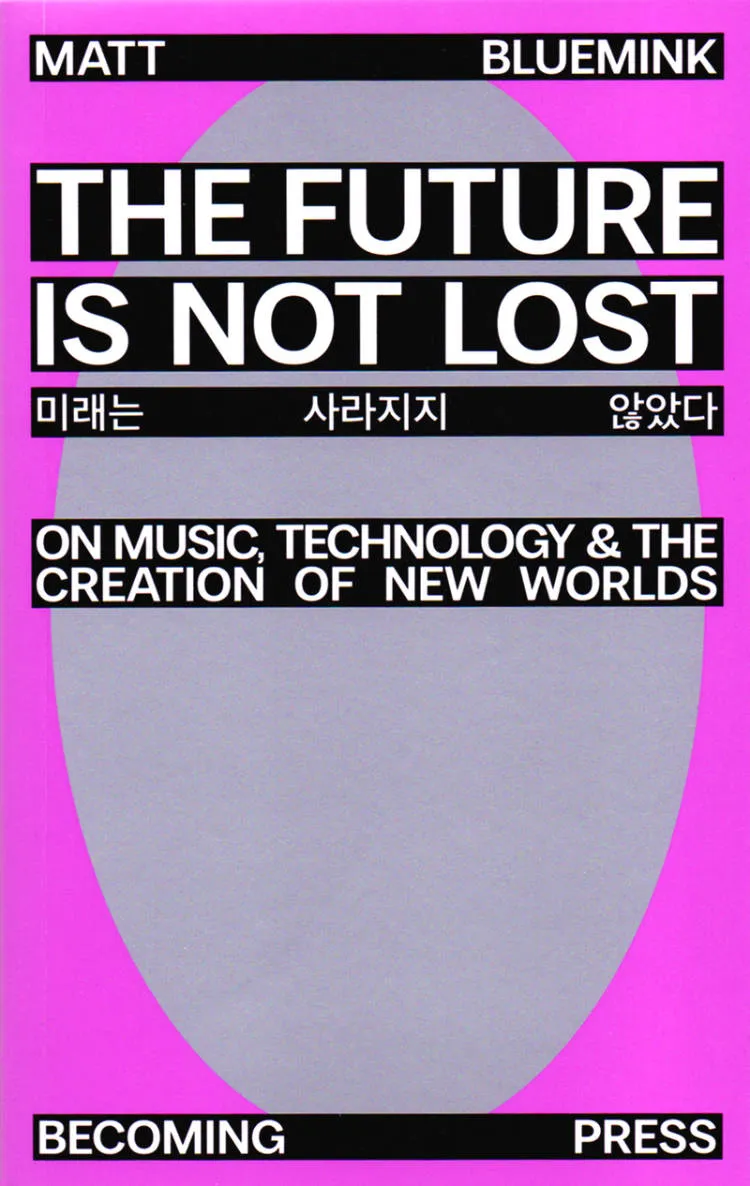
The Future is not Lost: On Music, Technology, and the Creation of New Worlds
Matt Bluemink, Alessandro Sbordoni
Mark Fisher taught a generation to hear the future's disappearance in contemporary music, as if the rhythm of the world was synchronised to the periodic flowering of new creative forms. His diagnosis was devastating: stagnation in music was akin to a venous insufficiency, or worse, some kind of nuclear winter that would ward off the spring for endless generations to come.
Drawing on musicians like SOPHIE, Arca and Iglooghost, Matt Bluemink declares that the future is not lost; it still speaks to us through music. If Fisher’s Hauntology — dwelling on ghosts of the past — is the logic of depression, then Bluemink’s Anti-Hauntology posits a logic of hope where voices from the future continue to guide the development of the present.
Island-hopping through Stiegler's philosophy of technics, Simondon's theory of individuation, and the spatial imaginaries of cyberpunk and solarpunk, Bluemink builds a theoretical framework equal to the times — one that takes seriously our capacity to, not only diagnose the world, but remake it. In order to create a new future we must re-imagine our relationship with music, with technology, and with culture. The world of tomorrow is a blank canvas; an open book. New beginnings are always possible.
Matt Bluemink is the founder and editor-in-chief of Blue Labyrinths online magazine. His research is focused on the relationship between the philosophy of technology, media theory and urbanism. He also writes on contemporary music, literature, and digital culture.

The Lesbian Avenger Handbook
Launched in New York City, in 1992, the Lesbian Avengers rejected the picket line and ordinary demo for media-savvy, nonviolent direct action.
They were superheroes arriving "to make the world safe for baby dykes everywhere;" warriors with capes and shields doing a line dance; dykes "Lusting for Power," pushing a giant bed float down Sixth Avenue in New York (with lesbians on it); nationally-ambitious Avengers eating fire in front of a hostile White House; lovers reuniting a statue of Alice B. Toklas with Gertrude Stein, then waltzing in the snow in Bryant Park. And homos who shamelessly chanted, "Ten percent is not enough, recruit, recruit, recruit."
Originally published in 1993, Homocom edition 2021

Country Lesbians
A bootleg of the first edition of Country Lesbians, published by WomanShare Books in 1976. It was printed in the context of a 2024 exhibition at Shmorévaz, a Paris-based independent art space, dedicated to the WomanShare collective, taking the book as its starting point, and borrowing its title.
WomanShare Collective is Sue Deevy, Billie Miracle, Nelly Kaufer, Carol Newhouse and Dian Wagner.
Co-published by Ness Books and Shmooks
Graphic design: Espace Ness

Conflict Is Not Abuse
From intimate relationships to global politics, Sarah Schulman observes a continuum: that inflated accusations of harm are used to avoid accountability. Illuminating the difference between Conflict and Abuse, Schulman directly addresses our contemporary culture of scapegoating. This deep, brave, and bold work reveals how punishment replaces personal and collective self-criticism, and shows why difference is so often used to justify cruelty and shunning. Rooting the problem of escalation in negative group relationships, Schulman illuminates the ways in which cliques, communities, families, and religious, racial, and national groups bond through the refusal to change their self-concept. She illustrates how Supremacy behaviour and Traumatized behaviour resemble each other, through a shared inability to tolerate difference.
This important and sure to be controversial book brings insight into contemporary and historical issues of personal, racial and geo-political difference, as tools of escalation towards injustice, exclusion and punishment, whether the objects of dehumanization are other individuals in our families or communities, African Americans at the hands of police, people with HIV, and Palestinians. Conflict Is Not Abuse is a searing rejection of the cultural phenomenon of blame, cruelty, and scapegoating, revealing how those in positions of power exacerbate and manipulate fear of the "other" to avoid facing themselves.

Foam
I am still transitioning, but I am unsure into what.
Who are all these Evas? They puncture and disrupt the domestic space and equilibrium of the narrator, who alternately relies upon them or administers their care. Foam is the latest boundary-blurring, genre-resistant, strange and speculative new fiction from Kate Zambreno, the inimitable and relentless literary stylist and conceptualist. Inspired by the absurdities of Eva Hesse and other soft sculpture, these are speculative art essays and textures, a document of precarity and slippery time—mischievous, moody, estranged—a masterwork of tone and atmosphere.

The Carrier Bag Theory of Fiction
In The Carrier Bag Theory of Fiction, visionary author Ursula K. Le Guin tells the story of human origin by redefining technology as a cultural carrier bag rather than a weapon of domination.
Hacking the linear, progressive mode of the Techno-Heroic, the Carrier Bag Theory of human evolution proposes: ‘before the tool that forces energy outward, we made the tool that brings energy home.’ Prior to the preeminence of sticks, swords and the Hero’s killing tools, our ancestors’ greatest invention was the container: the basket of wild oats, the medicine bundle, the net made of your own hair, the home, the shrine, the place that contains whatever is sacred. The recipient, the holder, the story. The bag of stars.
This influential essay opens a portal to terra ignota, where the possibilities of human experience and knowledge can be discovered anew.

The Tenant
The Tenant is a monographic critical essay by Marie Canet. It is the first text to directly address the connections between McKenzie’s work, pornography, and special effects. The title refers to the way the artist moves through different periods and aesthetic spaces, appropriating their codes in order to construct new visual fictions. The book is infused with post-#MeToo feminist thinking, alternative uses of biography, reflections on the art world, and contemporary debates surrounding appropriation, embodiment, and the status of the artwork.
McKenzie and Canet worked with each other for over eight years, on projects like Atelier E.B: Passer-by catalogue, published on the occasion of the Fondation Galeries Lafayette exhibition, or the book Pervert or Detective, a conversation between Lucy McKenzie and artist Reba Maybury. This collaboration now culminated in an exhibition and a book: Plastic Newspaper (presented at CRAC Sète in March 2026) and Lucy McKenzie, The Tenant.
Texts by Marie Canet and Lucy McKenzie
Translations: Catherine Petit & Paul Buck (Marie Canet), Juliette Desorgues (Lucy McKenzie)
Published in connection with the exhibition Lucy McKenzie, Plastic Newspaper, at Crac Occitanie, Centre régional d‘art contemporain Occitanie/Pyrénées-Méditerranée à Sète, 21.03.-06.09.26

Jeu des Arbres
Op 28 mei 2025 tekenden 500 mensen hun favoriete boom in het Josaphatpark in Brussel. Deze 52 uitgelote tekeningen vormen nu samen een kaartspel.
Le 28 mai 2025, 500 personnes ont dessiné leur arbre préféré dans le parc Josaphat à Bruxelles. Ces 52 dessins tirés au sort constituent désormais un jeu de cartes.
Découvrir la collection complet:
https://een-twee.be/tous-les-arbres-1

Notes of a Crocodile
Set in the post-martial-law era of late-1980s Taipei, Notes of a Crocodile is a coming-of-age story of queer misfits discovering love, friendship, and artistic affinity while hardly studying at Taiwan’s most prestigious university. Told through the eyes of an anonymous lesbian narrator nicknamed Lazi, this cult classic is a postmodern pastiche of diaries, vignettes, mash notes, aphorisms, exegesis, and satire by an incisive prose stylist and major countercultural figure.
Afflicted by her fatalistic attraction to Shui Ling, an older woman, Lazi turns for support to a circle of friends that includes a rich kid turned criminal and his troubled, self-destructive gay lover, as well as a bored, mischievous overachiever and her alluring slacker artist girlfriend.
Illustrating a process of liberation from the strictures of gender through radical self-inquiry, Notes of a Crocodile is a poignant masterpiece of social defiance by a singular voice in contemporary Chinese literature.
Winner of the 2018 Lucien Stryk Asian Translation Prize.

The Forgetting of Dreams Selected Oneiric Residues
We process our lives through riddles, mysteries, ciphers, and enigmas - but we hesitate to share these with friends and family. In times gone by, as for Freud, dreams were considered a key to cosmic secrets. Today, in all sorts of ways – both subtle and not – we are discouraged from sharing the content of our dreams, unless we happen to be indulging in that most anachronistic ritual: lying prostrate on the psychoanalyst’s couch. Anywhere else, an anecdote that begins, “Last night I dreamed . . .” is usually met with a sigh and a defensive glazing of the eyes. In our over-burdened world, any sharing of dreams is always already perceived as over-sharing. Contrary to this, Pettman argues - the more we share tales of our isolated nocturnal journeys, the better chance we have to understand the topography of our collective conundrum.

A Series Of Attempts #3: Loving Women aka Le Poney
"We didn’t have anything & we hadn’t seen much. So, naturally we understood less & felt owed something. We weren’t entirely wrong, though. It was 2011."
Part archival remix, part recruitment manual, this pamphlet’s cast of BAD HORSEY GIRLS will teach you how to neigh, dance and flirt until the vampires come home. A Series of Attempts #3 opens with Jordan/_Hell’s new manifesto ☆ LOVING WOMEN ★, that takes the Nomadic Sisters 1976 publication by the same name as a departure point. From here, ★ LE PONEY ☆ then follows a string of lesbian ponies through a dimensional split. A dimensional split that looks suspiciously like the L.A./Parisian+ queer scene… (͠≖~≖ ͡ )
About the author:
Jordan/_ Hell is a Black trans(2s) artist, writer, & scholar. Hell is the author of CONSTANT VIOLINS (Arcadia Missa, 2021) & AUTOLINGO DIDACTICA (Monitor Press, 2023), amount others. Hell’s writing has been internationally published in multiple languages in press, interdisciplinary projects, & exhibitions by Kunstverein Grafschaft Bentheim (DE), Arcadia Missa Gallery & Publishing (UK), Monitor Books (UK), Real Review (UK), Soft Opening (UK), Mousse Magazine (DE), 032c (DE), Rosie’s Disobedient Press (UK), Sticky Fingers Publishing (UK), The Bittersweet Review (UK), Pratt Institute’s The Felt (US), & others. Hell studied at Hochschule für Bildende Künste–Städelschule (DE) & Cooper Union School of Art (US). Currently, Hell is a doctoral candidate in the School of the Arts at Queen Mary University of London.

F.R. David - what I mean is—
F.R.DAVID is a typographical journal, dealing with the organisation of reading and writing in contemporary art practises. “what I mean is—” the 16th issue, edited by Will Holder.

Hyperpolitics: Extreme Politicization without Political Consequences
What happens when politics is everywhere, yet nothing seems to change? From the abandoned dance floors of Thatcher’s London to the mass mobilizations of Black Lives Matter, Anton Jäger traces how public life has become infused with protest, spectacle, and moral urgency — while the old infrastructure of parties, unions, and civic solidarity has been hollowed out.
Hyperpolitics revisits the illusions of the “end of history” and dissects the strange energies that replaced them: viral outrage, endless culture wars, and the digital rush of causes that flare and vanish overnight. Jäger shows how the promises of post–Cold War liberalism gave way to a restless, unsteady public sphere where private passions overflow into politics but rarely build enduring power.
Ranging from Guy Debord and Wolfgang Tillmans to Houellebecq’s disenchanted fictions, Hyperpolitics makes sense of a world in which collective action remains fragmented and the social fabric thinner than ever. For anyone trying to grasp why our age feels so charged yet so inconsequential, this book offers a vital map through the new contradictions of our hyperpolitical moment.

Lentil Space – Recipes from Artists' Homes
A compilation of recipes from the Arab world that were presented by artists for Mophradat's online cooking show Lentil Space.
Adapted from its namesake online program produced by Mophradat, co-curated by Mai Abu ElDahab and Reem Shilleh, from 2021 to 2023, this book is a celebration of the varied cuisine of the Arab world and its relationship with inherited food practices and the cultures of cooking and talking about food.
With contributions by Adam HajYahia and Haitham Haddad, Deena Abdelwahed, Laila Hida with Amine Lahrach, Mohamed Abdelkarim with Abla elBahrawy, Nadah El Shazly, amongst many others, this cookbook includes recipes chosen and prepared by the artists in an intimate setting coupled with stories both personal and about their art practice.

Practicing Dying
Practicing Dying is a literary anti-memoir documenting life in a Zen Buddhist monastery in rural France where the protagonist, a woman in her late twenties, attempts to overcome chronic drug addiction and mental illness.
Broken and severely unwell, our protagonist arrives at the monastery from London: starving, drug-addicted and disillusioned, having exhausted every conventional treatment route available to her. The book examines how, habituated to a life of benefits assessments, petty-crime and sex work, she struggles to adjust to the rules, discipline and religious life of the monastery—at times to devastating and comedic effect.
As the story unfolds, she reflects on her addictions and past experiences, raising critical questions about what it means to be "an addict" and why there may be vested corporate and societal interests in maintaining a narrow, individualistic understanding of addiction.
Anarchic and provocative, tender and self-deprecating, Practicing Dying differs from other contemporary memoirs in the genre of addiction-recovery by simultaneously challenging the dominant narratives surrounding mental health while proposing an alternative approach to treating the “sickness of self” from which we all increasingly suffer.
‘Practicing Dying is brilliant, rewarding and difficult. Northall offers the most brazen and shocking account of addiction I’ve ever read. Committing herself to the practice of Mahayana Buddhism, she eventually finds a way out, but only on the most rambling, circuitious path. Her account of addiction and loss, displacement and grief is profound and it proves that nothing is ever one thing.’ — Chris Kraus, author of The Four Spent The Day Together
Charlotte Northall is a London-based writer. Her debut, Practicing Dying, blends autobiography and cultural criticism to explore addiction, capitalism, and spiritual practice. She works with rough sleepers, supporting those living with addiction and complex mental health needs.

Solidarité, entre fantasme et nécessité
Sarah Schulman, fervente militante pour les droits humains, livre dans cet essai une brillante analyse des défis sociaux et psychologiques inhérents à tout mouvement de solidarité. En prenant appui sur plusieurs exemples historiques (lutte pour le droit à l’avortement dans l’Espagne postfranquiste, lutte contre le VIH/sida dans le New York des années 1990, mobilisation contre le génocide à Gaza…) ainsi que sur sa propre expérience de femme queer et juive, l’autrice décortique les rouages de la solidarité et entreprend de questionner les fantasmes qui y sont traditionnellement associés.
En filigrane, cet ouvrage pose une question fondamentale : quelle place pouvons-nous prendre dans un monde de plus en plus polarisé, et comment agir en solidarité avec les populations opprimées à l’échelle mondiale, locale ou individuelle ? L’autrice analyse les conditions nécessaires à tout mouvement de solidarité et montre l’importance de l’écoute active, la nécessité d’intervenir lorsque l’on est confronté à une injustice, la capacité à tolérer l’imperfection, ou encore la reconnaissance du coût moral et social inhérent à toute mobilisation.
En dressant des parallèles entre différents mouvements sociaux, Sarah Schulman met en lumière certaines dynamiques transversales à tout acte de solidarité et montre l’importance de la convergence des luttes dans un contexte mondialisé. Ode à la libération des populations opprimées, cet ouvrage apparaît aujourd’hui indispensable pour quiconque souhaite oeuvrer à la construction d’un monde plus juste.

Anarchitecture After Everything: A Trans Manifesto
A revolutionary way of seeing bodies and built environment that unites radical politics and trans aesthetics.
From a leading author and queer theorist known for reframing many of the most pressing questions about counter-intuitive ways of being.
Anarchitecture, a radical aesthetic practice of unmaking the built environment, staged a vigorous confrontation with urban renewal and gentrification projects in the 1970s. In Anarchitecture After Everything, Jack Halberstam identifies a powerful lexicon of transformation within anarchitecture, joining the movement’s practices of cutting and splitting with the destabilizing power of transness to detonate acts of formal violence in our time.
Anarchitecture describes the aesthetic practice of splitting and cutting, dismantling and undoing, unmaking, unbuilding, and ultimately unworlding. The trans body splits bodily coherence, dismantles the gender binary, and unbuilds bodily meaning. In these chapters, Gordon Matta-Clark’s cuts, along with Alvin Baltrop’s 1970s images of collapsing warehouses and Beverly Buchanan’s post-demolition fragmentary sculptures, return with a vengeance through the contemporary aesthetic gestures of Yve Laris Cohen, Jesse Darling, Nicole Eisenman, Kiyan Williams, Cassils, boychild, and Every Ocean Hughes. Anarchitecture unmakes space and offers a new rhetoric for emptiness. In its conclusion, the book explores this rhetoric through Renee Gladman’s anarchitectural experiments with language.
By reading anarchitecture through transness and transness through anarchitecture, Halberstam helps us see the trans body as a space of radical unmaking and as a portal to new lexicons for transformation.

Post-Europe
Today, we increasingly live in a state of becoming-homeless, while our homelessness also produces a desire for some form of homecoming, as is evident in the rise of conservative and neoreactionary movements worldwide.
With the unstoppable advance of global capitalism, the Heimatlosigkeit (homelessness) which twentieth-century European philosophers spoke of, and which Heidegger declared had become the ‘destiny of the world’, is set to become ever more pathological in its consequences. But rather than dreaming of an impossible return to Heimat, Yuk Hui argues that today thinking must start out from the standpoint of becoming-homeless—which also implies thinking a Post-Europe condition.
Europe may now be only one region among others, but to imagine that its decline simply marks a shifting of the locus of ‘world history’ to the East is to remain within the sphere of European techno-logocentrism. The planetary spread of technology may have released modern science and technology from being exclusively European assets, but it has also propagated a set of cognitive models that bar us from thinking otherwise, and put in place a global axis of time through which European modernity becomes the synchronising metric of all civilisations.
Following Novalis’s suggestion that philosophy is a form of homesickness, Jacques Derrida’s claim that philosophy is intrinsically European, and Bernard Stiegler’s insistence that philosophy’s logos is inextricable from the techne of technology, in Post-Europe Yuk Hui envisions a project of a post-European thinking. If Asia and Europe are to devise new modes of confronting capitalism, technology, and planetarisation, this must take place neither through a neutralisation of differences nor a return to tradition, but through a new individuation of thinking between East and West.
Drawing on the philosophies of Gilbert Simondon, Jacques Derrida, Bernard Stiegler, and Jan Patočka alongside the thought of Kitaro Nishida, Keiji Nishitani, Yoshimi Takeuchi, and Mou Zongsan among others, this examination of the relation between philosophy, technology, and the decline of European hegemony is also a reflection on the author’s own trajectory as a wanderer and an immigrant, and the complicit relation established between corporeal memory, linguistic plasticity, and Heimat via the tongue, that most neglected of technical organs.
Yuk Hui is the author of several titles including On the Existence of Digital Objects (University of Minnesota Press, 2016), The Question Concerning Technology in China: An Essay in Cosmotechnics (Urbanomic, 2016), Recursivity and Contingency (Rowman & Littlefield, 2019), Art and Cosmotechnics (e-flux/University of Minnesota Press, 2021), and Machine and Sovereignty: For a Planetary Thinking (University of Minnesota Press, 2024). He is currently Professor of Philosophy at Erasmus University Rotterdam.

Tricyclist
The love child of The L Word and Brontez Purnell’s 100 Boyfriends, with a disaffected flair all its own.
It’s San Francisco in the early aughts, and Howie Song is floundering. His failed projects—as a professional ballet dancer, as a boyfriend, as a friend—have left him forever the “third wheel.” But maybe he likes it that way? Leaping wildly between lovers, centuries, and an ever-changing cultural landscape, Howie might just feel most himself in the fracture.
Delicious, poetic, and delightfully pornographic, Tricyclist is an ode to the “abnormal angles” of people and art. As Howie overcomes his own ambivalences—in large part thanks to two suitors, and a circle of supporters who happen to be lesbians—Joon Oluchi Lee portrays, with his signature flamboyance, all of life’s joys, pitfalls, and pirouettes.
Joon Oluchi Lee is one of my favorite writers. A quick-change artist with a blazing intellect, he startles with his wicked wit and mix of rawness and sophistication. In Tricyclist, vexed, sexed, and indexed types orbit the narrator Howie Song, offering all kinds of distractions and attractions. Identity is a flipbook of possibilities, malleable in a way that excites and also threatens dissolution (which is maybe a relief). Raunch, philosophical asides, and a scavenger hunt for connection and love are all propelled by Lee’s masterful maverick style and brilliant humor. - Nate Lippens
Across lush hangouts with friends and hookups with lovers, Joon Oluchi Lee’s Tricyclist paints shimmering portraits of the most beautiful blouses and bars and bodies laid bare alongside our hopelessly alluring narrator. Through Howie’s careening sex drives and death drives, sensuality is everything, and with Lee’s keen attunement to life’s viscera, Tricyclist aches gorgeously. What a rhapsodic balm to my 2026. - Benedict Nguyễn
Tricyclist is a sex-forward, strikingly original story of queer life in San Francisco that feels so fresh it left my fingers wet. Joon Oluchi Lee’s eye is as sharp as his prose, rendering characters and scenarios with gossipy frankness. Kinetic and true and hyper-alive. - Michelle Tea