Books
Books
back in stock

A Garden Manifesto
What do gardens mean and how can they change the world? A Garden Manifesto gathers radical visions rooted in the earth from artists, writers, gardeners and activists, among them Lubaina Himid, Derek Jarman, Jamaica Kincaid, Ana Mendieta, Dan Pearson and Wolfgang Tillmans. It’s a seed box for an uncertain future, packed with anarchic dreams of Eden-making and humming with resistance to the colonial project of homogenisation and destruction.
Featuring William Blake, Joe Brainard, Jonny Bruce, John Clare, Gerry Dalton, Ellen Dillon, Baha Ebdeir, Alys Fowler, Magdalena Suarez Frimkess, Gaylene Gould, Green Guerillas, Joy Gregory, Fritz Haeg, Lubaina Himid, Philip Hoare, Rosie Hudson, Derek Jarman, Chantal Joffe, Laura Joy, Jamaica Kincaid, Elisabeth Kley, Olivia Laing, Jeremy Lee, Siobhan Liddell, Alison Lloyd, Hilary Lloyd, Jo McKerr, Lee Mary Manning, Ana Mendieta, Bernadette Mayer, Rosemary Mayer, Huw Morgan, Eileen Myles, Hussein Omar, Palestinian Heirloom Seed Library, Ian Patterson, Dan Pearson, Jean Perréal, Charlie Porter, Pat Porter, J. H. Prynne, Claire Ratinon, Jamie Reid, Lisa Robertson, Kuba Ryniewicz, Saadi, Sui Searle, Sei Shōnagon, Colin Stewart, Tabboo!, Edward Thomasson, Wolfgang Tillmans, Scott Treleaven, John Wieners, David Wojnarowicz, Matt Wolf and Sarah Wood

Prayers Manifestos Bravery
First published in 2018, Prayers Manifestos Bravery is a collection of Verity Spott’s “Trans* Manifestos”. Written from 2011 and originally published on her blog, the book’s content ranges from concrete poetry to long-form dispatches, confessions and manifestos touching on questions of identity, gender, justice and society.
“This is a collection of attempted manifestos whose composition began in 2011. It does not pretend to be completed and any life it has is in its capacity for change, movement and instability. These manifestos are described as such because at the time of their composition they felt like attempts of preservation; of life and of the capacity to struggle against life. They are all improvisations. They have not been heavily edited, and they are untidy. We're unsure what we are." — preface by the author
Verity Spott is a poet, teacher and care worker from Brighton, England. She is the author of the books Gideon, Click Away Close Door Say, We Will Bury You, The Mutiny Aboard the RV Felicity, Prayers Manifestos Bravery, Poems of Sappho (in translation), Hopelessness, Coronelles Set 1 and 70 Sonnets. Verity's poetry has appeared in The New York Times and has been translated into French, German and Greek.

Last Night A Beef Jerk Saved My Life
'Mortimer is one of the most talented writers of our generation and their debut collection proves this. Part essay, part poem, part memoir and part SOS, Last Night a Beef Jerk Saved My Life navigates its thematic scope—ranging from transness, queerness and naming to loving and losing—with sensitivity, insight, humour and bravado. Best thing I read this year.' - Isabel Waidner
'Last Night a Beef Jerk Saved My Life is a wonderful and thoughtful reflection on love and beauty and bodies and music and memories, and on the constellations of small things that make up modern queer life.' - Huw Lemmey
D Mortimer is a writer from London focussed on trans crip narratives. Their work (essays, poetry, prose, creative-criticism) has appeared in Granta and been performed at the Institute of Contemporary Art in London (Queers Read This, The Kathy Acker Reading Group). Their short story ‘Supermarket Revelations’ was published in Liberating the Canon: An Anthology of Innovative Fiction (ed. Waidner, Dostoyevsky Wannabe: 2018) and a poem-essay, 'How To Draw Hands', was published by Warm Yourself by My Trash Fire in 2020.

A Book of Music (1958)
A new edition of the posthumously published collection 'A Book of Music' by the American poet Jack Spicer (1925-1965).
While little known outside a circle of friends and poets in his lifetime, Spicer is widely considered one of the major figures of twentieth century American poetry.
After being removed from a teaching position at Berkeley in 1950 for refusing to pledge allegiance to the United States, he became a founder of the radical and counter-cultural San Francisco Renaissance movement of poets in an age when homosexuality was illegal.
He believed that the poet was a “radio” able to collect transmissions from an “invisible world,” as opposed to the idea that poetry was driven by a poet’s voice and will. In this sense he believed that his poems were dictated from a spirit world and saw poetry as a form of magic, most potent when spoken aloud.
He died at the age of 40 in the poverty ward of San Francisco General Hospital, from acute alcohol poisoning. One of his last coherent sentences was, “My vocabulary did this to me.”
This new edition of A Book of Music, published 65 years after its original was composed, is risograph printed on Munken Lynx paper and saddle-stitched by Earthbound Press.
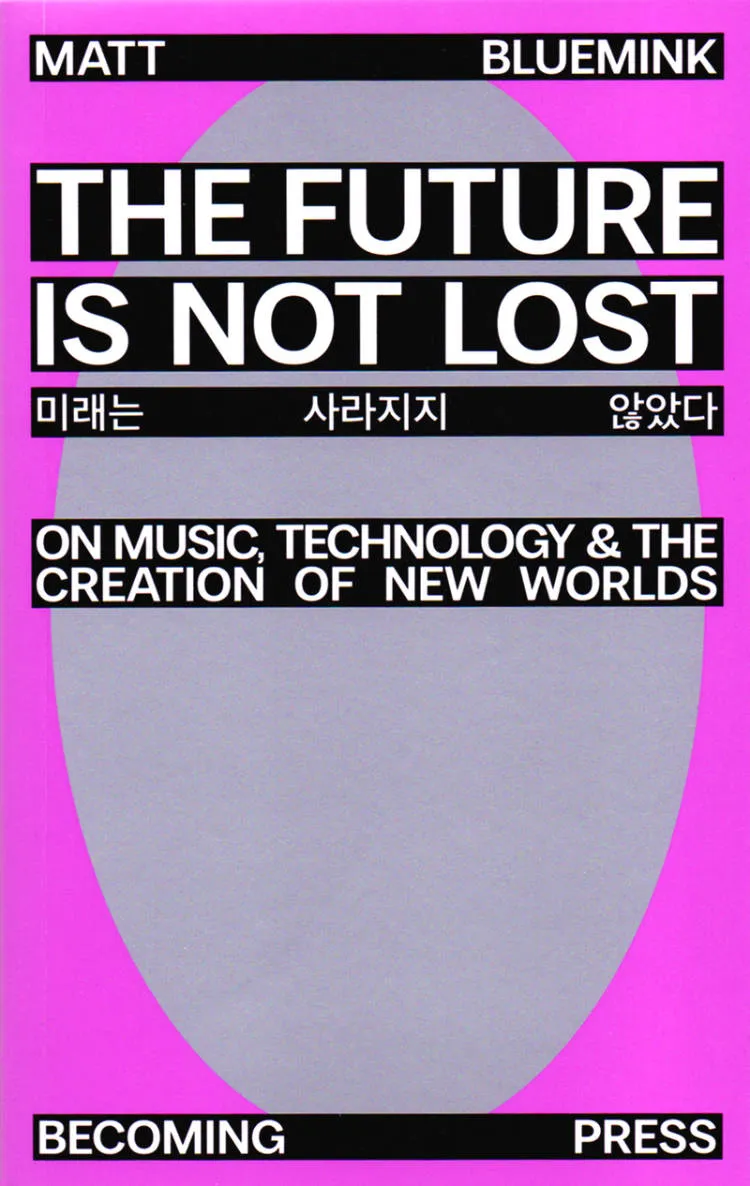
The Future is not Lost: On Music, Technology, and the Creation of New Worlds
Matt Bluemink, Alessandro Sbordoni
Mark Fisher taught a generation to hear the future's disappearance in contemporary music, as if the rhythm of the world was synchronised to the periodic flowering of new creative forms. His diagnosis was devastating: stagnation in music was akin to a venous insufficiency, or worse, some kind of nuclear winter that would ward off the spring for endless generations to come.
Drawing on musicians like SOPHIE, Arca and Iglooghost, Matt Bluemink declares that the future is not lost; it still speaks to us through music. If Fisher’s Hauntology — dwelling on ghosts of the past — is the logic of depression, then Bluemink’s Anti-Hauntology posits a logic of hope where voices from the future continue to guide the development of the present.
Island-hopping through Stiegler's philosophy of technics, Simondon's theory of individuation, and the spatial imaginaries of cyberpunk and solarpunk, Bluemink builds a theoretical framework equal to the times — one that takes seriously our capacity to, not only diagnose the world, but remake it. In order to create a new future we must re-imagine our relationship with music, with technology, and with culture. The world of tomorrow is a blank canvas; an open book. New beginnings are always possible.
Matt Bluemink is the founder and editor-in-chief of Blue Labyrinths online magazine. His research is focused on the relationship between the philosophy of technology, media theory and urbanism. He also writes on contemporary music, literature, and digital culture.

Semiotics of the End: Essays on Capitalism and the Apocalypse
The apocalypse as such will not take place, as it is already finished. Today, there is no longer any difference between the end of the world and capitalism itself: from Britney Spears’ Till the World Ends to The Caretaker’s Everywhere at the End of Time, from Avenger’s Endgame to Donnie Darko, and all the way down to the internet’s Backrooms, the world never ends but is reproduced again and again according to the semio-logic of capital.
In contrast with Mark Fisher’s Capitalist Realism, Semiotics of the End is a manifesto for the imagination of another relationship with the end. If it is easier to imagine the end of the world than the end of capitalism, as Slavoj Žižek, Fredric Jameson, and Mark Fisher put it, it is only because we have not imagined anything yet. The end is just the beginning.
With an Afterword by Matt Bluemink

A Nice Well-Behaved Fucked-Up Person
In a single seventeen-page paragraph, Jill Johnston describes an odyssey in and out of a not-yet-described identity in this excerpt from her 1973 bestseller, "Lesbian Nation".

Expropriating Appropriators
An excerpt of images collected over 20 years from popular fashion magazines offers expression to the artist's queer and feminist desires.

Letters from NYC
A diptych of transcribed letters, extracted from two films taking place in 1970s New York, made by Jacques Scandelari and Chantal Akerman.

Play It As It Lays
Essay #15
Editor: M. Sullivan
Design in collaboration with S. De Bondt

Drive It All Over Me
Paige Bradley’s Drive It All Over Me was commissioned by the artists Jay Chung and Q Takeki Maeda and concerns their work Bad Driver, 2023, Jack Goldstein’s Selected Writings, and Vanessa Place’s Gone with the Wind and concerns broad themes of subtextual narrative, authorship, and identity in text-based visual artworks while also touching upon allegory, elaborately subtle jokes, and writing as a sculptural material.

Relational Gym - metabolic edition
This deck is a ritual technology for metabolizing what is happening in the world — and the world is burning, flooding, choking, grieving, starving, birthing, emerging.
Here, metabolism is not just digestion. It’s a political act. A refusal. A prayer. A practice of remembering that every breath, every bite, every boundary, every breakdown is a site of relation — and that relation is never neutral.
This deck does not offer escape. It offers entanglement. It offers deep compost. It offers the sacred mess of staying with the trouble in a world that teaches us to numb, sever, consume, and forget.
It asks: What are we absorbing? What are we excreting? What are we ready to transform — personally, collectively, cosmically?
Use it when you feel cracked open. Use it when you feel sealed shut. Use it as ceremony, as salve, as companion, as agitation. Draw a card. Let the questions move you. Let the images sit on your mucosa. Let the reflections metabolize slowly — in the gut, in the fascia, in the field.
Each card invites you to remember that your body is not separate from Earth’s body. That your breath is not yours alone. That healing is not a return to purity, but a layered, leaking, entangled becoming. There is no clean air. No clean grief. No clean soil and no clean politics. Only deeper sensing, slower noticing, more compassionate worlding and a thousand and one chances to recommit to aliveness — again and again. Let rot what needs rotting. Let feed what needs feeding.
A 39-card oracle deck + 52-page booklet.

A4 review N°4
Gorge Bataille, Marc Buchy and 2 more
Founded in 2023, A4 is a poetry review which showcases and explores contemporary writings practices. Run by Littérature Supersport collective, the object is seen as the extension of their events. The review takes the form of 4 postcards which, when placed side-by-side, form an A4-sheet. A light (even precarious) format for literature that slips into the back pocket of pants and hangs on fridge doors. Each issue features unpublished texts by 4 authors.
This issue presents texts by: Gorge Bataille, Marc Buchy, Samy Manga, Elke de Rijcke.

Tongue Ring: Issue 01
Aodhan Madden, Claire Star Finch
Oh oh this is the first issue of Tongue Ring, a journal of experimental writing in English & French, with original contributions and translations of texts* by Ariana Reines*, CAConrad*, Camille Kingué, Kaur Alia Ahmed*, Rafael Moreno, Taos Bertrand, and Théo Robine-Langlois*.
Vous voyez, c’est ça mon genre. Je ne sais pas ce que c’est.
Mais c’est mon genre. J’ai cet esprit en moi—qui est très ému
par la féminité. Je pourrais me mettre à pleurer. Je veux poser
mon manteau par terre pour la laisser marcher dessus
—Ariana Reines
Premier numéro de la nouvelle revue fantastique et bilingue (FR + EN) d’écriture expérimentale Tongue Ring, avec des contributions originales ainsi que des traductions* de textes de Ariana Reines*, CAConrad*, Camille Kingué, Kaur Alia Ahmed*, Rafael Moreno, Taos Bertrand, and Théo Robine-Langlois*.

OEI #90/91 Sickle of Syntax & Hammer of Tautology
Tobi Maier, Cecilia Grönberg and 1 more
OEI # 90-91: Sickle of Syntax & Hammer of Tautology offers the first English language overview of the history of concrete and visual poetry production in socialist Yugoslavia between 1968 and 1983.
By focusing on mass-produced examples of concrete poetry, this publication presents these poetic experiments as organically linked to social movements, critical theories, and youth cultural revolutions. In his extensive introduction, Sezgin Boynik, the guest editor of this special issue of OEI, discusses concrete and visual poetry in socialist Yugo-slavia as an uneven and combined development, and emphasizes its confrontational and organizational aspects.
By means of interviews, translations, reproductions, and theoretical and historical statements, OEI # 90-91 offers a picture of a very lively scene of concrete and visual poetry in Yugoslavia, which unfortunately is not as recognized interna-tionally as it would deserve.
Hoping that OEI # 90-91 could contribute to this task in a substantial way, we present episodes from the early years of OHO formation and its complex theories of words and things; an interview with Rastko Močnik on programmed art and political formalism; militant polemics of Goran Babić; Signalist contradictions; subjective structural devices of Judita Šalgo; zaum experiments of Vojislav Despotov; detective meta-texts of Slavoj Žižek; poetic self-management studies of Vujica Rešin Tucić; a feminist historicisation of Ažin school for experimental poetry; democratisation of visual poetry by Westeast; selections from special issues of the journals Pitanja, Problemi, Ulaznica, Dometi, Delo, Koraci, Vidik, Pegaz, and many other materials translated here for the first time and presented in one publication.

OEI #92-93 Lettrist Corpus: The Complete Magazines (1946–2016)
Frédéric Acquaviva, Jonas J. Magnusson and 1 more
“Un livre qui fera date. Deux ans de recherches, 512 pages, 1.361 illustrations en quadrichromie, 119 revues lettristes parues de 1946 à 2016 pour un total de 1.200 ouvrages décrits (avec la couverture et le sommaire de chaque numéro). Qui d’autre que les éditeurs suédois de OEI (Jonas J. Magnusson et Cecilia Gronberg) aurait pu sortir ce travail anthologique? Personne!” — www.mauricelemaitre.org
“The ‘unreasonable’ idea for this ‘catalogue raisonné’ came to me as an attemps to draw up a complete inventory of all the journals and periodicals of the Lettrist group, from its birth until today. Because the lifespan of the Lettrist movement has exceeded that of all the other avant-garde movements, we are undoubtedly in front of the most immense corpus ever produced in terms of magazines, coverin a period from 1946 to 2016. It presents more than a hundred different titles with more than one thousand items and hundreds of authors. . . . I hope that this comprehensive work will give the reader an opportunity to understand the different paths of the Lettrist groups and the many areas addressed, if not shaken, beyond the books of Isidore Isou and Maurice Lemaître. Since other Lettrists have published relatively few monographic books, and very little outside their own magazines, OEI #92-93 is a unique database for most of the Lettrist texts that we can access, also making it possible for new readers to come across Lettrism.”
— from Frédéric Acquaviva’s introduction
Design by Fält

Parable of the Sower
When global climate change and economic crises lead to social chaos in the early 2020s, California becomes full of dangers, from pervasive water shortage to masses of vagabonds who will do anything to live to see another day. Fifteen-year-old Lauren Olamina lives inside a gated community with her preacher father, family, and neighbors, sheltered from the surrounding anarchy. In a society where any vulnerability is a risk, she suffers from hyperempathy, a debilitating sensitivity to others' emotions. Precocious and clear-eyed, Lauren must make her voice heard in order to protect her loved ones from the imminent disasters her small community stubbornly ignores. But what begins as a fight for survival soon leads to something much more: the birth of a new faith . . . and a startling vision of human destiny.
Includes a foreword by LeVar Burton and an afterword by N. K. Jemisin.

Feminist Fatwas
Feminist Fatwas traces how Muslim feminists are resisting misogynistic interpretations of the Quran (like the verse male clerics have used to condone wife-beating).
For centuries, the translators and interpreters of the Holy Quran have been men. This is changing now as more and more Muslim feminists cast their eye on the patriarchal contexts of these interpretations. Feminist Fatwas tells the story of Verse 34 in Chapter 4 which has been interpreted by male clerics as condoning a husband beating his wife. This essay traces the groundbreaking work of knocking down this misogynist Quranic interpretations. The story of how Muslim feminists are doing this work is a chronicle of the slow and quiet feminist revolution taking place within Islam as women take on significant and powerful roles.
Rafia Zakaria is a Pakistani-American attorney, feminist, journalist, and author. She has written for The Nation, Guardian Books, The New Republic, The Baffler, Boston Review, and Al Jazeera. In 2021, she published Against White Feminism, in which she critiques the emphasis that conventional feminist thought places on the experiences of white women while excluding women of color

The Psychoanalyst And The Artist
In these essays, New York psychoanalyst and author Jamieson Webster considers the relationship between the studio and the psychoanalyst's couch. From the scopophilic instinct of the viewer and the artist's anticipation of it to the pursuit of perfection and it's connection to the girl-child's curiosity about her mother's body, she asks us to think about art and analysis as connected practices. Focusing on Carroll Dunham and Louise Bourgeois, she argues for an embrace of our wildest symptoms in theory and in art.

Your Life Is Not A (Fucking) Story
In this new collected edition of his recent articles, Simon Critchley - one of the most important living philosophers - takes us through his reflections on death, questions of doubt and reason, the legacy of David Bowie, the nature of fear and empathy in a broken society and a critique of narrative identity - among other things. YOUR LIFE IS NOT A STORY explores the contemporary world and its psychological impact on us, offering us a way to see our situation different and resist its tricks and contrivances.

Small Press, or else...
“You run a WHAT?” A small press. Yes, this is the dream of those who don’t give a damn about mainstream literature, major presses and millionfold print runs. It is the nirvana to everyone interested in a mindful and loving acquaintance with books.
“Start out small. Continue smaller if needed. Never end. Dream big. Continue dreaming bigger if needed. Make sure to keep being considered small.”
This is not a basic guide, it is a fun and inspiring glance at the inner depth of a small press. With enthusiasm and distinctness the publisher gives advice on everything from networking to handling the scripts to creating and selling a book.
Kristian Carlsson (b.1978) is published in a number of select small presses following his literary debut in 1996. For a decade he had been engaged as an occasional guest editor and project based publisher, when he in 2009 founded Smockadoll Förlag [Smockadoll Press] and decided to publish contemporary poetry. In 2012 Smockadoll was featured by the news agency TT/ Spektra as one of a handful of today’s unsurpassed Swedish small presses for translated literature. During the years Kristian Carlsson most certainly has had time to break each and every one of the small press guidelines issued in this volume.

overlove
After a moment of possible eye contact at a gig, my attraction to the band's drummer - Curt - snowballed into limerent obsession. The unsent letters documenting my crush form the basis of overlove: a non-fiction novella concerned with love, boundaries, leaky jars and the female gaze in today's context of digital communication, millennial malaise and searching online for something 'more'.
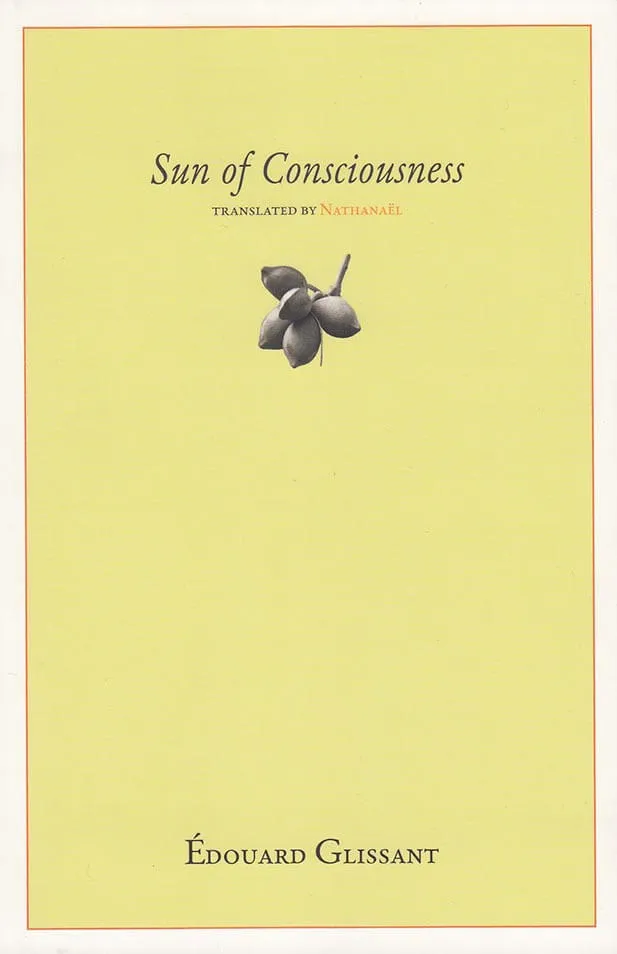
Sun of Consciousness
Soleil de la Conscience (Sun of Consciousness) was Martinican philosopher Édouard Glissant's first published work, and opened the Poétique (Poetics) strain of his oeuvre. This book-length essay, which is characterized by its exploratory, intimate character, announces Glissants concerns with créolisation (creolization), mondialité (worldliness, as against globalization), or opacité (opacity) and inscribes in this work a refusal of colonialism and of inverted exoticism. The sense of estrangement experienced by the author who arrives as a "foreigner" in a country to which he is bound by "the first page of his passport" is the author's principal preoccupation. By positioning himself as both different and same, Glissant opens a space for the writing of a(nother) history: that of the Caribbean.

An Apartment on Uranus
A “dissident of the gender-sex binary system” reflects on gender transitioning and political and cultural transitions in technoscientific capitalism.
Uranus, the frozen giant, is the coldest planet in the solar system as well as a deity in Greek mythology. It is also the inspiration for uranism, a concept coined by the writer Karl Heinrich Ulrich in 1864 to define the “third sex” and the rights of those who “love differently.” Following Ulrich, Paul B. Preciado dreams of an apartment on Uranus where he might live beyond existing power, gender and racial strictures invented by modernity. “My trans condition is a new form of uranism,” he writes. “I am not a man. I am not a woman. I am not heterosexual. I am not homosexual. I am not bisexual. I am a dissident of the gender-sex binary system. I am the multiplicity of the cosmos trapped in a binary political and epistemological system, shouting in front of you. I am a uranist confined inside the limits of technoscientific capitalism.”
This book recounts Preciado's transformation from Beatriz into Paul B., but it is not only an account of gender transitioning. Preciado also considers political, cultural, and sexual transition, reflecting on issues that range from the rise of neo-fascism in Europe to the technological appropriation of the uterus, from the harassment of trans children to the role museums might play in the cultural revolution to come.