Books
Books
back in stock

Godlike
New York poet Paul Vaughn has a trick for enjoying poetry readings: He simply imagines the reader died a long time ago. Paul is twenty-seven, married, and an admired poet himself. R. T. Wode’s mission is to give offense. He’s also a poet, freshly landed in the city, and, at age sixteen, unknown.
Paul worships T. They embark on a tempestuous affair, dropping acid and crashing parties and perambulating the grit and grime of New York City circa 1972. Paul is in love with T., but T. is in love with experience. Their relationship disintegrates.
A novel of compelling originality and transcendent beauty by legendary musician and poet Richard Hell, Godlike transposes the notorious romance of Paul Verlaine and Arthur Rimbaud to the East Village in its squalid, glorious ’70s heyday. The book comprises a version of Paul’s 1997 hospital notebooks: diaries amidst poems and essays, along with, most pertinently, the poet’s third-person memoir-novelette of his youthful time with the now-famous T. Godlike is infused as well with evocations—and sometimes actual poems—of many New York poets of the era, from Ted Berrigan and Ron Padgett to Edwin Denby and James Schuyler. It achieves a lyricism both profane and profound as it conjures the frenetic vitality as well as the existential malaise of an era. It’s a searching meditation on art, life, love, and the impossibility of everything.

Loving Corrections
Ethical, pondering, and wondrous, adrienne maree brown’s Loving Corrections is a collection of love-based adjustments and reframes to grow our movements for liberation while navigating a society deeply fractured by greed, racism, and war. In this landmark book, brown invigorates her influential writing on belonging and accountability into the framework of “loving corrections”; a generative space where rehearsals for the revolution become the everyday norm in relating to one another.
Filled with practical wisdom on how to be a trustworthy communicator while providing bold visions for a shared future, Loving Corrections can speak to everyone caught in the crossroads of our political challenges and potential. No matter how new to the struggle, or how numerous our failures, brown’s indispensable writing is an invitation to us all. Includes an afterword by Janine de Novais.

Radical Intimacy
An impassioned discussion about the alternative ways to form relationships and resist capitalism.
Capitalist ideology wants us to believe that there is an optimal way to live. 'Making connections' means networking for work. Our emotional needs are to be fulfilled by a single romantic partner, and self-care equates to taking personal responsibility for our suffering. We must be productive and heterosexual, we must have babies and buy a house. But the kicker is most people cannot and do not want to achieve all, or any of these life goals. Instead we are left feeling atomised, exhausted and disempowered.
Radical Intimacy shows that it doesn't need to be this way. A punchy and impassioned account of inspiring ideas about alternative ways to live, Sophie K Rosa demands we use our radical imagination to discover a new form of intimacy and to transform our personal lives and in turn society as a whole.
Including critiques of the 'wellness' industry that ignores rising poverty rates, the mental health crisis and racist and misogynist state violence; transcending love and sex under capitalism to move towards feminist, decolonial and queer thinking; asking whether we should abolish the family; interrogating the framing of ageing and death and much more, Radical Intimacy is the compassionate antidote to a callous society.

Airless Spaces
Shulamith Firestone was twenty-five years old when she published The Dialectic of Sex, her classic and groundbreaking manifesto of radical feminism, in 1970. Disillusioned and burned out by the fragmented infighting within the New York City radical feminist groups she’d helped to found, when her book hit the bestseller lists, Firestone decided against pursuing a career as a “professional feminist.” Instead, she returned to making visual art, the profession that she’d trained for. She wouldn’t publish anything again until Airless Spaces, in 1998.
Long before her first hospitalization for paranoid schizophrenia in 1987, Firestone had fallen off the grid and into precarity and poverty. For the next decade, she would move in and out of public psychiatric wards and institutions. Conceived as a series of vignettes about institutions and identity, Airless Spaces is a subtle and deeply literary work. Embedded as a participant-observer, Firestone moves beyond the spectacular and frightening surfaces of institutional life to record individual lives and acts of cruelty and kindness. The existence that she depicts is a microcosm of the world beyond.
After they raised her dose to 42 mg. of Trilafon, Lucy very nearly fainted. She felt a rush of bad sensation comparable to her mental telepathy when her grandmother died. ... But there was a good aspect to fainting too. As she was about to lose consciousness, she felt an overwhelming relief. The black velvety edges of the swoon. If only she could faint all the way, black out, and never wake up again ...
Introduction by Chris Kraus
Afterword by Susan Faludi

Otherhow: Essays and Documents on Art and Disability 1985–2024
Otherhow brings together four decades of writings, lectures, interviews, and documentation of work by the artist Joseph Grigely. Deaf since the age of ten, his art and writing have long questioned and made use of various modes of communication—photographs, handwritten notes, lipreading, newspaper headlines, paintings, and TV captions—to examine and scrutinize the ableism embedded in cultural and media production. From his brilliant series of postcards addressed to Sophie Calle, where he began to formulate a theory on the intersection of disability and art, to his epic lecture “On Failure,” which brings together the poet Keats, “the first woman of fly tying” Helen Shaw, and the filmmaker Andrei Tarkovsky to the same table for a conversation on beauty, Grigely’s writing is erudite, but clear; righteous with fury, but dryly humorous.
An underlying theme throughout are modes of access and how issues of accessibility and their resolution provide a benefit to everyone, not just the disabled. Chapters devoted to art, access, and advocacy underpin the interconnected nature of these issues in a maddening, but ultimately enlightening manner. Letters of complaint, faxes and emails, unpublished op-eds, exhibition proposals, statements on equality and access; each provide a glimpse into how Grigely’s work has been shaped by—or constructed from—the “tangled process” of opening access.
Joseph Grigely, artist, educator, and activist, is currently a Professor of Visual and Critical Studies at the School of the Art Institute of Chicago. He holds a Doctorate in Philosophy from Oxford in English literature and has taught at Gallaudet University, Stanford University, and the University of Michigan. Exhibiting widely in the US and Europe, his most recent show In What Way Wham? was presented at MASS MoCA in 2023–24. His work is in the collections of the Museum of Modern Art (NY), the Whitney Museum of American Art, the Tate Modern, and the Stedelijk Museum, among others.

Stay away from nothing
Stay away from nothing shines a spotlight on the deep relationship between Paul Thek and Peter Hujar through the artists’ letters and photographs. Beginning in 1956 and spanning two decades, the publication opens a window into their intimate, complex, and beautiful lives, starting with a sequence of images by Hujar that showcases the two of them in innocent moments of pensive and haunting play in Coral Gables and beyond.
These early portraits of their budding relationship are followed by several playful postcards from Thek in 1960 and his first letter to Hujar in 1962, written while the artist is in the Philadelphia harbor aboard a containership bound for Europe. In the letter, Thek is brimming with joy and new discoveries and exclaims that the world “seems bigger and more gloriously strange than ever before in my entire life.” The two eventually meet in Rome, where they both begin to evolve into the icons we know them as today, and the remaining letters trace Thek’s travels and adventures, romantic dalliances, work, and financial ups and downs through 1975. More than fifty letters and postcards, along with drawings and other ephemera, are reproduced in Stay away from nothing and their poetic, quotidian, and melancholic tone provide a rare glimpse into Thek and Hujar’s relationship as it wavers with seduction, glamor, tumult, and mischievousness.
Throughout this period, Hujar was photographing Thek in his now-iconic style, capturing him in Italy, in various studios, and on the beaches of Fire Island. Included are the artist’s classic images of Thek in the catacombs in Palermo, as well as his studio portraits of the artist creating The Tomb. Among these well-known works are dozens of other photographs, many unpublished until now, including candid portraits of Thek, as well as images of the two artists goofing around or posing for passport photos. Collectively, these images demonstrate not only the complex emotional interiority of Thek but the tender, dark, and hopeful connection between the two artists, lovers, and friends.
An afterword is provided by Andrew Durbin, author of The Wonderful World That Almost Was, a biography of Peter Hujar and Paul Thek. Edited by Francis Schichtel.
Paul Thek is among the most legendary and elusive artists of the post-1960s generation. He burst onto the New York scene with his Technological Reliquaries series, then known as “meat pieces,” which challenged Pop and Minimalism with an idiosyncratic approach that merged earnest posthuman embodiment and a critique of contemporary art trends. In Europe in the 1970s, he created new modes of exhibition-making that involved the creation of elaborate, ephemeral installations composed of sand, candles, newspaper, chicken-wire, Polaroids, and discarded furniture. Upon returning to New York in the later years of his career, he produced his deliberately “bad paintings” while continuing his longest-running series of paintings executed on newspaper, works that poignantly underscore his sustained engagement with themes of ephemerality and the passage of time. Thek died of AIDS in 1988.
Peter Hujar died of AIDS in 1987, leaving behind a complex and profound body of photographs. Hujar was a leading figure in the group of artists, musicians, writers, and performers at the forefront of the cultural scene in downtown New York in the 1970s and early 80s, and he was enormously admired for his completely uncompromising attitude towards work and life. He was a consummate technician, and his portraits of people, animals, and landscapes, with their exquisite black-and-white tonalities, were extremely influential. Highly emotional yet stripped of excess, Hujar’s photographs are always beautiful, although rarely in a conventional way. His extraordinary first book, Portraits in Life and Death, with an introduction by Susan Sontag, was published in 1976, but his “difficult” personality and refusal to pander to the marketplace ensured that it was one of the last publications during his lifetime.
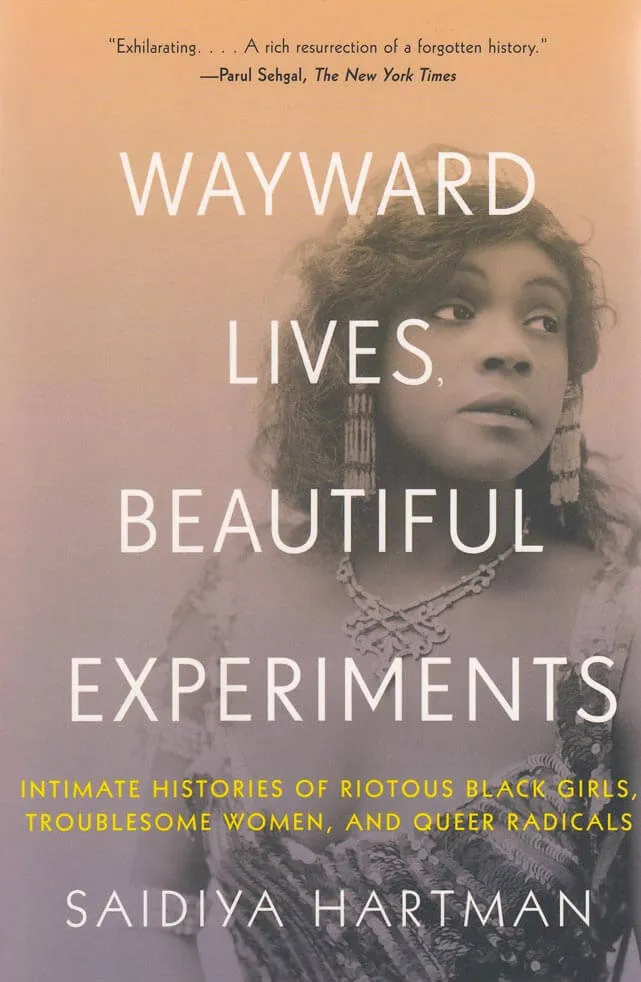
Wayward Lives, Beautiful Experiments
Wayward Lives, Beautiful Experiments examines the revolution of black intimate life that unfolded in Philadelphia and New York at the beginning of the twentieth century. In wrestling with the question of what a free life is, many young black women created forms of intimacy and kinship indifferent to the dictates of respectability and outside the bounds of law. They cleaved to and cast off lovers, exchanged sex to subsist, and revised the meaning of marriage. Longing and desire fueled their experiments in how to live. They refused to labor like slaves or to accept degrading conditions of work. Here, for the first time, these women are credited with shaping a cultural movement that transformed the urban landscape. Through a melding of history and literary imagination, Wayward Lives, Beautiful Experiments recovers these women's radical aspirations and insurgent desires.

Socialist Realism
When Trisha Low moves West, her journey is motivated by the need to arrive “somewhere better”—someplace utopian, like revolution; or safe, like home; or even clarifying, like identity. Instead, she faces the end of her relationships, a family whose values she has difficulty sharing, and America’s casual racism, sexism, and homophobia.
In this book-length essay, the problem of how to account for one’s life comes to the fore—sliding unpredictably between memory, speculation, self-criticism, and art criticism, Low seeks answers that she knows she won’t find. Attempting to reconcile her desires with her radical politics, she asks: do our quests to fulfill our deepest wishes propel us forward, or keep us trapped in the rubble of our deteriorating world?
Winner of the 2020 Lambda Literary Award for Bisexual Nonfiction.

Leash
Leash extends the logic of S&M to its inexorable and startling conclusion, darkly and hilariously revealing the masochistic impulse as the urge to disappear from the chores, obligations, and emotional vacuity of daily life.
No more jobs, no more taxes, no more checkbook, no more bills, no more credit cards, no more credit, no more money, no more mortgages, no more rent, no more savings, no more junk mail, no more junk, no more mail, no more phones, no more faxes, no more busy signals, no more computers, no more cars, no more drivers' licenses, no more traffic lights, no more airports, no more flying, no more tickets, no more packing, no more luggage, no more supermarkets, no more health clubs... While her current spends the summer researching public housing in Stockholm, a moderately wealthy, object-oppressed, and terminally hip New York female of a certain age seeks adventure in the sedate dyke bars of lower Manhattan. Finding none, she answers a personal ad. She is ordered to put on a blindfold before the first meeting with the woman she knows only as Sir. Not knowing what someone looks like turns out to be freeing, as do the escalating constraints that alienate her not just from her former life, but from her very conception of who she is. Part Georges Bataille, part Fran Leibowitz, this is the Story of O told with a self-referentially perverse sense of humor.

Margery Kempe
First published in 1994, Robert Glück’s Margery Kempe is one of the most provocative, poignant, and inventive American novels of the last quarter century.
The book tells two stories of romantic obsession. One, based on the first autobiography in English, the medieval Book of Margery Kempe, is about a fifteenth-century woman from East Anglia, a visionary, a troublemaker, a pilgrim to the Holy Land, and an aspiring saint, and her love affair with Jesus. It is complicated. The other is about the author’s own love for an alluring and elusive young American, L. It is complicated. Between these two Margery Kempe, the novel, emerges as an unprecedented exploration of desire, devotion, abjection, and sexual obsession in the form of a novel like no other novel.
Robert Glück’s masterpiece bears comparison with the finest work of such writers as Kathy Acker and Chris Kraus. This edition includes an essay by Glück about the creation of the book titled "My Margery, Margery's Bob."

The Pain Journal
"The Pain Journal" is the last finished work by Los Angeles writer and artist Bob Flanagan and is the extraordinary chronicle of the final year of his life before his death from cystic fibrosis at the age of 43. Flanagan created performances with Sheree Rose that shocked and inspired audiences as he combined text, video, and live performance to create a highly personal exploration of childhood, sex, illness, and mortality.

Walking Through Clear Water in a Pool Painted Black, New Edition: Collected Stories
The first collected edition of legendary writer, actress, and adventurer Cookie Mueller's stories, featuring the entire contents of her 1990 book Walking through Clear Water in a Pool Painted Black, alongside more than two dozen others, some previously unpublished.
Legendary as an underground actress, female adventurer, and East Village raconteur, Cookie Mueller's first calling was to the written word: I started writing when I was six and have never stopped completely, she once confessed. Muellerís 1990 Walking through Clear Water in a Pool Painted Black, the first volume of the Semiotext(e) Native Agents series, was the largest collection of stories she compiled during her life. But it presented only a slice of Mueller's prolific work as a writer. This new, landmark volume collects all of Mueller's stories: from the original contents of Clear Water, to additional stories discovered by Amy Scholder for the posthumous anthology Ask Dr. Mueller, to selections from Mueller's art and advice columns for Details and the East Village Eye, to still new stories collected and published here for the first time. Olivia Laing's new introduction situates Mueller's writing within the context of her life—and our times.
Thanks to recent documentaries like Mallory Curley's A Cookie Mueller Encyclopedia and Chloé Griffin's oral biography Edgewise, Mueller's life and work have been discovered by a new generation of readers. Walking through Clear Water in a Pool Painted Black: Collected Stories returns essential source material to these readers, the archive of Mueller's writing itself. Mueller's many mise en scènes—the Baltimore of John Waters, post-Stonewall Provincetown, avant-garde Italy, 1980s New York, an America enduring Reagan and AIDS—patches together a singular personal history and a primer for others. As Laing writes in her introduction, Collected Stories amounts to a how-to manual for a life ricocheting joyously off the rails, a live corrective to conformity, conservatism, and cruelty.

Do Everything in the Dark (2023)
Faced with photos of a once-tumultuous New York art world, the narrator's mind in this scathing, darkly funny novel begins to erupt. Memories jostle for center stage, just as those that they are about always did. These brilliant but broken survivors of the '80s and '90s have now reached the brink of middle age and are facing the challenge of continuing to feel authentic. Luminous with imagery, cackling with bitter humor, and with a new foreword by the author, this roman a cle spares no one.
First published in 2003, Gary Indiana's turn-of-the-millennium novel traces the lives of a loosely connected group of New York artists and the dissolution of their scene.
During the summer of 2001, the narrator of Do Everything in the Dark, a gallery curator, receives intermittent dispatches from his far-flung friends, many of whom resemble well-known figures in the art and intellectual worlds, who are spread out across the globe, from Istanbul to Provincetown to Santa Fe. Seeking various reprieves from a changed New York, the long-festering, glossed-over incompatibilities of these aging bohemians blossom into exotic and unbearable relief. Beneath the contemporary excesses Indiana chronicles, we can see the outlines of the earlier New York bohemia captured by Dawn Powell.
Arguably Indiana's most intimate, internal, and compassionate work to date, Do Everything in the Dark is a chilling chronicle of madness and failure, success and disappointment, and the many ways love dies in a world people find increasingly unlivable.

Aster of Ceremonies: Poems
Aster of Ceremonies asks what rites we need now and how poetry, astir in the asters, can help them along. What is the relationship between fleeing and feeling? How can the voices of those who came before—and the stutters that leaven those voices—carry into our present moment, mingling with our own? When Ellis writes, "Bring me the stolen will / Bring me the stolen well," his voice is a conduit, his "me" is many. Through the grateful invocations of ancestors, Hannah, Mariah, Kit, Jan, and others, and their songs, he rewrites history, creating a world that blooms backward, reimagining what it means for Black and disabled people to have taken, and to continue to take, their freedom.
A polyphonic new entry in Multiverse—a literary series written and curated by the neurodivergent—JJJJJerome Ellis's Aster of Ceremonies beautifully extends the vision of his debut book and album, The Clearing, a "lyrical celebration of and inquiry into the intersections of blackness, music, and disabled speech" (Claudia Rankine).
JJJJJerome Ellis is the author of Aster of Ceremonies. He is an animal, stutterer, and artist. He is also the author and composer of The Clearing, an audio-textual project that investigates how stuttering, blackness, and music can be practices of refusal against hegemonic governance of time, speech, and encounter. His work has been presented by the Lincoln Center, the Poetry Project, MASS MoCA, REDCAT, Arraymusic, and the Center for African American Poetry and Poetics, among others. He lives in Tidewater, Virginia, where he was raised by Jamaican and Grenadian immigrants.

Arts of Living on a Damaged Planet: Ghosts and Monsters of the Anthropocene
Nils Bubandt, Elaine Gan and 2 more
As human-induced environmental change threatens multispecies livability, Arts of Living on a Damaged Planet puts forward a bold proposal: entangled histories, situated narratives, and thick descriptions offer urgent “arts of living.” Included are essays by scholars in anthropology, ecology, science studies, art, literature, and bioinformatics who posit critical and creative tools for collaborative survival in a more-than-human Anthropocene.
Anna Lowenhaupt Tsing is professor of anthropology at the University of California, Santa Cruz, and a Niels Bohr Professor at Aarhus University in Denmark, where she codirects Aarhus University Research on the Anthropocene (AURA).
Heather Swanson is assistant professor of anthropology at Aarhus University.
Elaine Gan is art director of AURA and postdoctoral fellow at Aarhus University.
Nils Bubandt is professor of anthropology at Aarhus University, where he codirects AURA.

Running
In Running, former NCAA Division I track athlete Lindsey A. Freeman presents the feminist and queer handbook of running that she always wanted but could never find. For Freeman, running is full of joy, desire, and indulgence in the pleasure and weirdness of having a body. It allows for a space of freedom—to move and be moved. Through tender storytelling of a lifetime wearing running shoes, Freeman considers injury and recovery, what it means to run as a visibly queer person, and how the release found in running comes from a desire to touch something that cannot be accessed when still. Running invites us to run through life, legging it out the best we can with heart and style.

The Hearing Trumpet
An old woman enters into a fantastical world of dreams and nightmares in this surrealist classic admired by Björk and Luis Buñuel.
Leonora Carrington, painter, playwright, and novelist, was a surrealist trickster par excellence, and The Hearing Trumpet is the witty, celebratory key to her anarchic and allusive body of work. The novel begins in the bourgeois comfort of a residential corner of a Mexican city and ends with a man-made apocalypse that promises to usher in the earth's rebirth. In between we are swept off to a most curious old-age home run by a self-improvement cult and drawn several centuries back in time with a cross-dressing Abbess who is on a quest to restore the Holy Grail to its rightful owner, the Goddess Venus. Guiding us is one of the most unexpected heroines in twentieth-century literature, a nonagenarian vegetarian named Marian Leatherby, who, as Olga Tokarczuk writes in her afterword, is "hard of hearing" but "full of life."

Eros the Bittersweet: An Essay
Anne Carson's remarkable first book about the paradoxical nature of romantic love. Since it was first published, Eros the Bittersweet, Anne Carson's lyrical meditation on love in ancient Greek literature and philosophy, has established itself as a favorite among an unusually broad audience, including classicists, essayists, poets, and general readers.
Beginning with the poet Sappho's invention of the word "bittersweet" to describe Eros, Carson's original and beautifully written book is a wide-ranging reflection on the conflicted nature of romantic love, which is both "miserable" and "one of the greatest pleasures we have."

The Hormone of Darkness: A Playlist
In Tilsa Otta’s The Hormone of Darkness, we find a queer, Latinx person who has lived through iterations of authoritarian rule, and who answers these conditions by creating poetry that doubles down on a life force that precedes and exceeds received notions of the poetic. Here poetry is bawdy, fabulist, and spiritual—in short, it is alive. Otta has created a heaven where readers can go after they die.
Drawing from four volumes spanning Otta’s career, translator-poet Farid Matuk has curated a playlist we can dance and dream to, one that honors Otta’s drive toward liberation through both perreo in the club and transdimensional wandering among the stars.
We can go on like that forever
building paradise from our urges
out of our fetishes our loves our vices
How lucky
We’ll wait for you then
Don’t be too long
Bookmark the page
We’ll be Here
—From “The New Heaven”
Translated from the Spanish by Farid Matuk.

Silence Is My Mother Tongue
On a hill overlooking a refugee camp in Sudan, a young man strings up bedsheets that, in an act of imaginative resilience, will serve as a screen in his silent cinema. From the cinema he can see all the comings and goings in the camp, especially those of two new arrivals: a girl named Saba, and her mute brother, Hagos.
For these siblings, adapting to life in the camp is not easy. Saba mourns the future she lost when she was forced to abandon school, while Hagos, scorned for his inability to speak, must live vicariously through his sister. Both resist societal expectations by seeking to redefine love, sex, and gender roles in their lives, and when a businessman opens a shop and befriends Hagos, they cast off those pressures and make an unconventional choice.
With this cast of complex, beautifully drawn characters, Sulaiman Addonia details the textures and rhythms of everyday life in a refugee camp, and questions what it means to be an individual when one has lost all that makes a home or a future. Intimate and subversive, Silence Is My Mother Tongue dissects the ways society wages war on women and explores the stories we must tell to survive in a broken, inhospitable environment.

Wrong Norma
Published here in a stunning edition with images created by Carson, several of the twenty-five startling poetic prose pieces have appeared in magazines and journals like The New Yorker and The Paris Review.
As Carson writes: “Wrong Norma is a collection of writings about different things, like Joseph Conrad, Guantánamo, Flaubert, snow, poverty, Roget’s Thesaurus, my Dad, Saturday night. The pieces are not linked. That’s why I’ve called them ‘wrong.’”

The Albertine Workout
The Albertine Workout contains fifty-nine paragraphs, with appendices, summarizing Anne Carson's research on Albertine, the principal love interest of Marcel in Proust's Á la recherche du temps perdu.

Teddy Sandoval and the Butch Gardens School of Art
C. Ondine Chavoya, David Evans Frantz
Published to accompany the artist’s first retrospective exhibition, Teddy Sandoval and the Butch Gardens School of Art examines the work of the inventive yet overlooked Teddy Sandoval, a central figure in Los Angeles’s queer and Chicanx artistic circles. Sandoval was known for producing subversive and playful artworks in a range of media that explored the codes of gender and sexuality, particularly conceptions of masculinity.
This publication surveys Sandoval’s work alongside other queer, Latinx, and Latin American artists whose practices profoundly resonate. This expansive catalogue features essays by C. Ondine Chavoya, David Evans Frantz, Raquel Gutiérrez, and Mari Rodríguez Binnie, as well as biographical entries on other artists featured in the exhibition, including Félix Ángel, Myrna Báez, Álvaro Barrios, Ester Hernández, Hudinilson Jr., Antonio Lopez, María Martínez-Cañas, Marisol, and Joey Terrill.
Design by Content Object
Co-published by Inventory Press, Williams College Museum of Art, Vincent Price Art Museum, and Independent Curators International

Love in a F*cked-Up World
Around the globe, people are faced with a spiraling succession of crises, from the pandemic and climate change-induced disasters to the ongoing horrors of mass incarceration, racist policing, endemic gender violence, and severe wealth inequality. Many of us feel mobilized to organize and collectively combat these issues on both a personal and political level, often dedicating our lives to the forwarding of progressive ideas and the daunting goal of trying to bend the world toward justice.
But even those of us who long for change seem to have trouble when it comes to interpersonal relationships. Too often we think of our political values as outward-facing positions again dominant systems of power. Rarely, if ever, do we pursue the same kind of justice close to home, in our personal connections. Many activist projects and resistance groups fall apart because people treat each other poorly, trying desperately to live out the cultural myths about dating and relationships that we are fed from an early age.
How do we divest from the idea that one romantic partner will be the solution to all our problems? How do we separate our expectations of love from the troubling dynamics left to us by our parents? How do we bring our best thinking about freedom and justice into step with our desires for healing and connection?
Lifelong activist and educator Dean Spade dares us to decide that our interpersonal actions are not separate from our politics of liberation and resistance. Love in a F*cked-Up World is a resounding call to action and a practical manifesto for how to combat cultural scripts and take our relationships into our own hands, preparing us for the work of changing the world.