rile*books

Search books

Search books by title, author, publisher, keywords...

Cover of ztscript 30 : Zeitschrift

ztscript

ztscript 30 : Zeitschrift

ztscript

€5.00

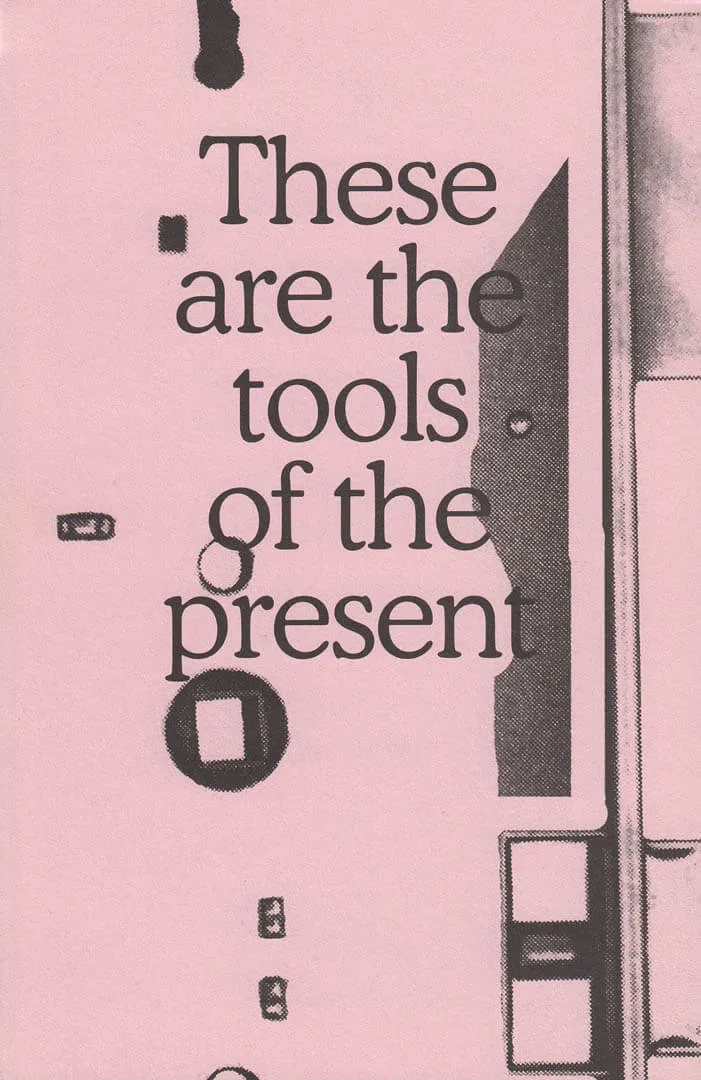
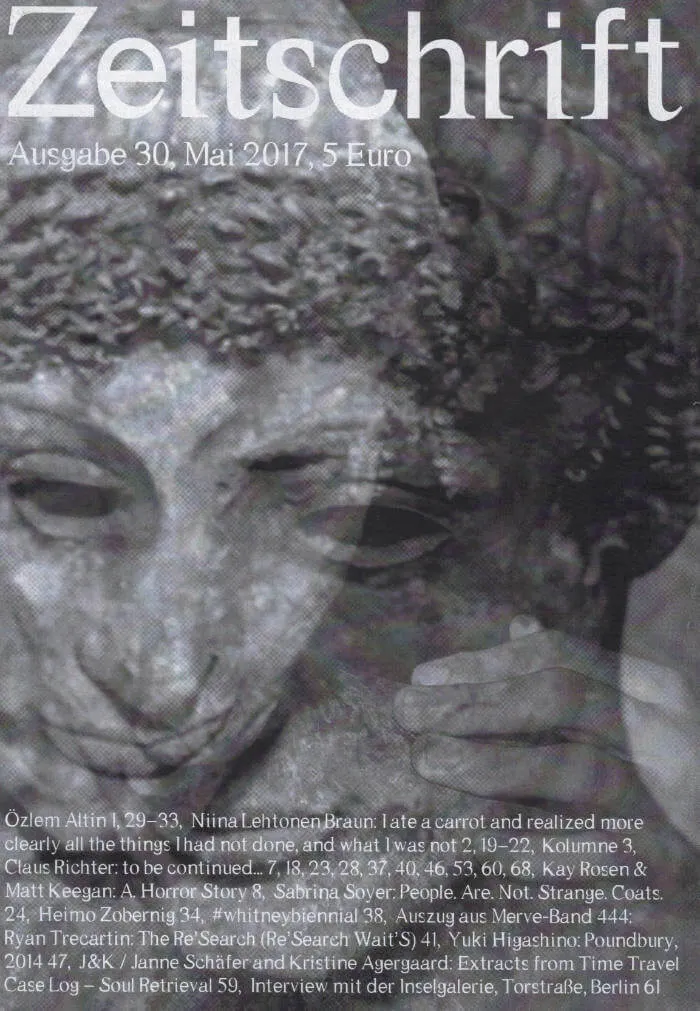
Jubilee Issue #30 in the magazine's 15th year. The font Zeitschrift (magazine in German) is especially designed for this issue by Alexander Wolff and is a merge of the fonts Helvetica and Times. Each issue has a paper streamer woven through several pages by Niina Lehtonen Braun. The cool black n white poster is made by Heimo Zobernig featuring a mesh up font of Helvetica and Courier, spelling the word SCHEITSCHRIFT.

Contributors: Özlem Altin, Nina Lehtonen Braun, Claus Richter, Kay Rosen, Matt Keegan, Sabrina Soyer, Heimo Zobernig, Ryan Trecartin, Yuki Higashino, Jane Schäfer, Krintine Agergard

Language: English
recommendations

Cover of ztscript 33 : Lisa Fittko

ztscript

ztscript 33 : Lisa Fittko

ztscript

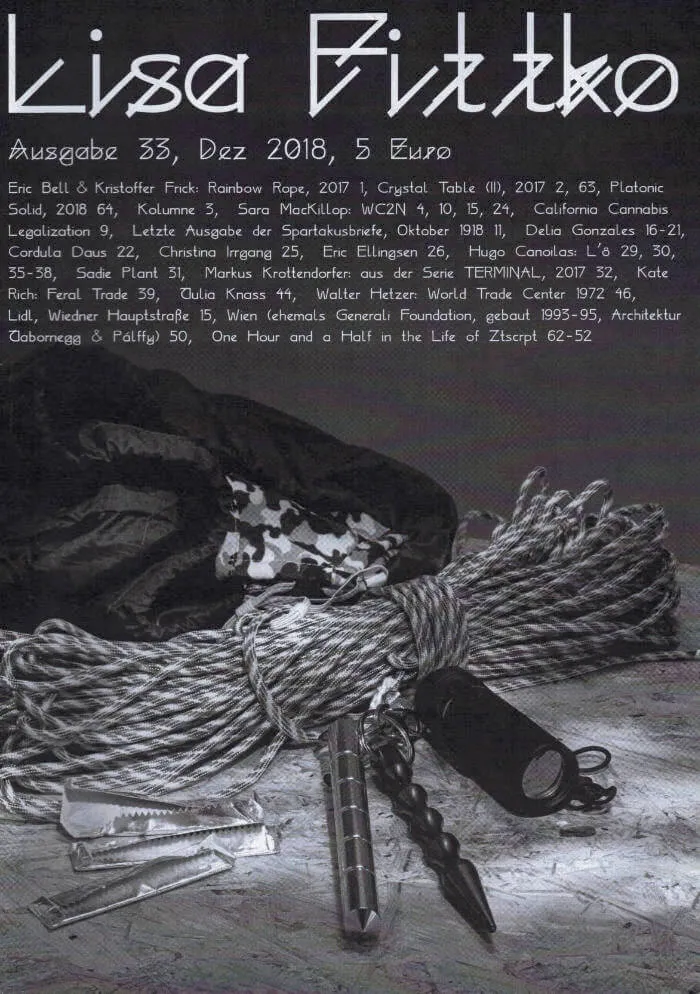
Typeface by Bea Schlingelhoff, from the Project "Women against Hitler"

Eric Bell & Kristoffer Frick: Rainbow Rope, 2017 1, Crystal Table (II), 2017 2, 63, Platonic Solid, 2018 64, Kolumne 3, Sara MacKillop: WC2N 4, 10, 15, 24, California Cannabis Legalization 9, Letzte Ausgabe der Spartakusbriefe, Oktober 1918 11, Delia Gonzales 16-21, Cordula Daus 22, Christina Irrgang 25, Eric Ellingsen 26, Hugo Canoilas: L’ô 29, 30, 35-38, Sadie Plant 31, Markus Krottendorfer: aus der Serie TERMINAL, 2017 32, Kate Rich: Feral Trade 39, Julia Knass 44, Walter Hetzer: World Trade Center 1972 46, Lidl, Wiedner Hauptstraße 15, Wien (ehemals Generali Foundation, gebaut 1993-95, Architektur Jabornegg & Pálffy) 50, One Hour and a Half in the Life of Ztscrpt 62-52

Cover of ztscript  29 : Spiegel

ztscript

ztscript 29 : Spiegel

ztscript

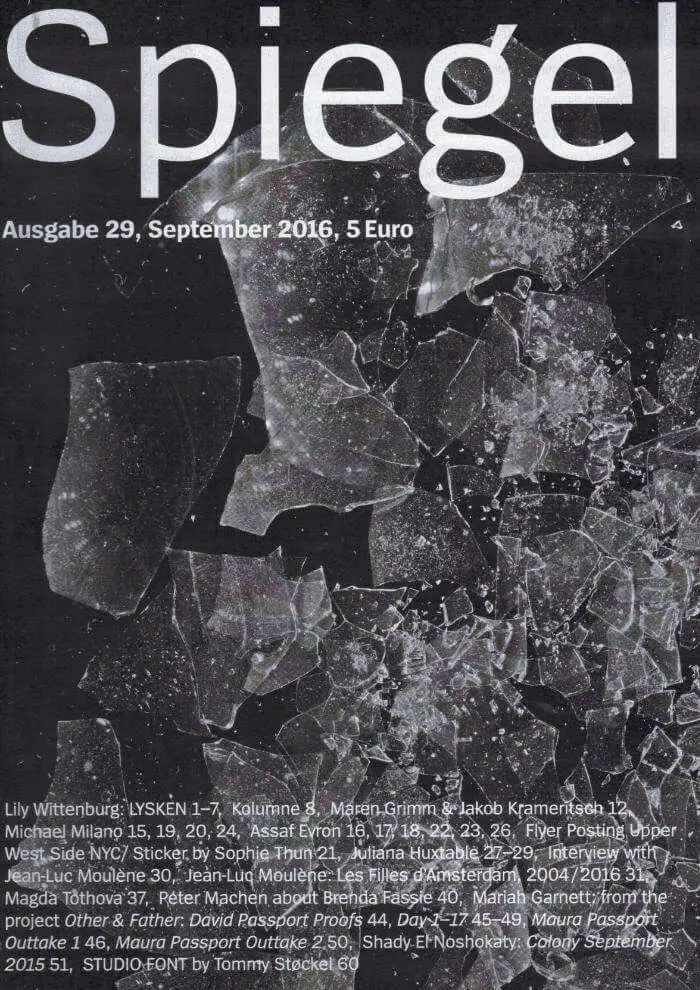
This issue uses the font designed for german news magazine Spiegel by amazing Lucas de Groot. The color poster is part of the full print of the series “Les Filles d’Amsterdam” by photographer Jean-Luc Moulène. It is the first time this series is printed in book form and in an exclusive interview the artist tells the story of that work.

Contributors: Lily Wittenburg, Maren Grimm & Jakob Krameritsch, Michael Milano, Assaf-Evron, Sophie Thun, Juliana Huxtable, Interview with Jean-Luc Moulène, poster by Jean-Luc Moulène, Magda Tóthová, Peter Machen on Brenda Fassie, Mariah Garnett, Shady El NoshokatyTommy Støckel

Cover of Untitled

Capricious

Untitled

Sasha Phyars-Burgess

Monograph €40.00

Sasha Phyars-Burgess’ first monograph, Untitled. Spanning three bodies of work, this 200-plus page monograph includes poems by Ser Alida and Aurora Masum-Javed, a conversation between Sasha Phyars-Burgess, Juliana Huxtable and Carolyn Lazard, and essay by Bill Gaskins. Designed by Studio Lin.

As recipient of the second annual Capricious Photo Award, Sasha is a vital, emerging voice in contemporary photography, engaging the charged line between documentary and fine art. Her work ranges from affecting studies on diaspora, family and place to revolving social phenomenons in which energy, beauty and power meet.

The second annual jury panel was helmed by Capricious Founder and Publisher Sophie Mörner and Associate Publisher Anika Sabin alongside Lauren Cornell, Katherine Hubbard, JOFF, Matt Keegan, Guadalupe Rosales, Ka-Man Tse, and Lyndsy Welgos.

Cover of == #2 (edition)

Capricious

== #2 (edition)

Matt Keegan

First launched in 2012, and published by mfc michèle didier (micheledidier.com), == is a small-run arts publication, edited by Matt Keegan. ==#2, 2015, is designed by Su Barber and published in an edition of 500 by Capricious Publishing. Barber and Keegan worked together on North Drive Press (northdrivepress.com) between 2005-2010, and this publication shares a variety of traits with NDP.

==#2 is a non-thematic arts publication contained in a box with a 96-page bound volume featuring artist-to-artist interviews, texts, and transcriptions. Six loose multiples are also included.

Contributors include: Sam Anderson, Uri Aran, Fia Backström, Darren Bader, Judith Barry, Stefania Bortolami, Daniel Bozhkov, Milano Chow, Anna Craycroft, Lucky DeBellevue, Cristina Delgado, Haytham El-Wardany, Jake Ewert, Vincent Fecteau, Corrine Fitzpatrick, Harrell Fletcher, Rachel Foullon, Aurélien Froment, Kenny Greenberg, Calla Henkel, Leslie Hewitt, Jaya Howey, Adelita Husni-Bey, Iman Issa, Ruba Katrib, Jill Magid, Jo Nigoghossian, Aaron Peck, Max Pitegoff, David Placek, Olivia Plender, Lisa Robertson, Andrew Russeth, Amy Sillman, Diane Simpson, Greg Parma Smith, Jessica Stockholder, Martine Syms, and Anicka Yi.

Cover of sawing a plank is like going for a walk

Posture Editions

sawing a plank is like going for a walk

Kato Six

With texts by Phillip Van den Bossche, Filarowska and a conversation between Eva Wittocx and the artist (NL/EN)


Nº 48 / October 2022

sawing a plank is like going for a walk by Kato Six (b. 1986) is published on the occasion of Kato’s solo exhibition at M Leuven this autumn. This book encapsulates 10 years of her quest as an artist.


The work of Kato Six (b. 1986) balances between abstract and figurative art. She works on different themes which she develops into series or ensembles. Architecture, design, domesticity and utensils all act as important references. Starting there, she uses recognisable and everyday materials such as MDF, stone, plastic or textiles.
Kato wants to question certain affinities and let the viewer look at familiar objects or images from a different perspective. As a viewer, you feel connected to the object or image but the actual meaning or function no longer applies.

Some of my works refer to the domestic, especially the most recent ones, such as ‘Carpet Beater Carpet’ and ‘Striped Knitwear’. The invisible work done by “housewives”, but also by workers or maintenance staff, is certainly one of the themes addressed in ‘Carpet Beater Carpet’. The above works are textile works, created with so-called “soft skills”. In the arts, these “soft skills” are often attributed to female artists — women often being assigned a certain medium.
Kato Six in conversation with Eva Wittocx in “sawing a plank is like going for a walk”

Cover of HOOT nr. 5 — Grégoire Devidal

GUFO

HOOT nr. 5 — Grégoire Devidal

Rozenn Voyer, Clément Faydit and 1 more

Cet été j’ai rappelé un ami, Grégoire Devidal, pour lui demander de ses nouvelles depuis que nous sommes chacun·e parti·e d’Amsterdam où nous y avons partagé quelques années. Il m’a parlé d’un projet de podcasts avec Agathe Boulanger et Gwendal Raymond.

Ayant partagé des moments de vie, de création, de tension, de doutes et beaucoup de moments de travail, il m’est apparu comme une nécessité de proposer ce nouveau numéro de HOOT à ces trois artistes. La parole et l’écriture sont au centre de leur pratique et de leurs recherches. Je leur ai alors confié mon questionnaire habituel pour m’effacer de la trame de ces conversations et laisser place à une nouvelle forme de dialogue : celui qu'iels se partagent sans que je ne les écoute, sans que je n'intervienne. Iels parlent entre-elleux, se questionnent et se meuvent comme autant d’échos infinis sur des parois fluides. Leurs échanges m’ont évoqué ceux des personnages des Vagues de Virginia Woolf dans la manière dont ils s'interpénètrent, dont l’identité des orateur·rice·s valse et les échanges se relaient plutôt que se répondent.

Cover of Revue Phylactere n°2 - Oh là là !

immixition books

Revue Phylactere n°2 - Oh là là !

Roxanne Maillet, Auriane Preud'homme

Periodicals €25.00

Phylactère est une revue annuelle à voix multiples, née du désir d’explorer l’écriture de l’oralité et les possibilités de retranscription de performance, à travers des visions authentiques, subjectives et spontanées. Donnant la parole à des amateur·ice·s, artiste·s, designer·s et penseur·se·s, la revue Phylactère regroupe des écrits de transition, assumant tous les glissements entre un script, l’action réalisée et sa traduction, avec une attention extrême et aventureuse pour la manière dont les contextes, gestes, émotions et espaces sont mis en jeu lors de cette retranscription.

Initiée par Roxanne Maillet et Auriane Preud’homme à l’invitation de Camille Videcoq lors de la résidence Entrée Principale (Marseille), Phylactère conjugue pratique graphique et éditoriale et démarche curatoriale en intégrant au processus de publication l’organisation de différents événements. 

Pour son deuxième numéro, Phylactère prend pour titre l’onomatopée Oh là là !

Avec les contributions de : Anne Lise Le Gac, Benoît Le Boulicaut, Camille Videcoq, Cecil Serres, Claudia Pagès, Considered to be Allies (Margaux Parillaud & Mie Frederikke Fischer Christensen), Ghita Skali, Giuliana Zefferi, Lauren Tortil, Loreto Martínez Troncoso, Louise Hervé & Clovis Maillet, Mona Gérardin-Laverge, Nygel Panasco, pauline l. boulba, Sarah Browne, Susie Green (with Kim Coleman, Simon Bayliss & Rory Pilgrim), Tahnee, L’autre and Tiziana La Melia.

Conception graphique : Auriane Preud'homme et Roxanne Maillet.

Cover of  Viscose 08: SOUND

JEUG

Viscose 08: SOUND

Jeppe Ugelvig, Bill Kouligas and 2 more

Periodicals €30.00

The eighth issue of Viscose examines the myriad of music and sound cultures of fashion. Entirely untethered from materiality and image, sound is the proof that fashion operates just as vividly in the purely atmospheric. From the artfully curated musical narratives of the runway to the ambient sonic environment of shops, fashion both emits sounds and seeks to associate itself with it for its own advancement. 

Music in particular asserts fashion’s existential relationship to time: it aesthetically time-keeps fashion media and confirms sartorial novelty by mirroring it rhythmically. To a public consciousness, the intimate relationship between fashion and music is obvious and at times even understood as one and the same. Sound glues material such as clothes to wider zeitgeists and mediated lifestyles, and as such, to cultural memory itself. As Mary E. Davis has illuminated, the alliance is profoundly historic: as far back as 1672, fashion periodicals have covered clothes and music as equally essential components of an elegant, fashionable lifestyle. 

Music, in fact, surrounds fashion: it enwraps makers, mediators, and consumers alike in ephemeral, yet intensely meaningful, signifiers of taste. Countless designers have come to fashion through musical subcultures, and labors in ateliers to particular playlists. Indeed, style most often has a soundtrack of its own, or dances to a specific tune.  Fashion emits sounds before and after the musical. The clicking of heels, the rustling of a sweater, the hissing of a zipper. The ambient humming of a sewing machine; the conclusive “beep” from a store cashier. 

For the 8th issue of Viscose, we set out to examine the sonic landscapes of fashion in a most expansive manner. In billing our issue “sound” we seek to gesture to more visually obscure and materially ephemeral interplays between fashion and the auditory—in wardrobes and shops, on the body and in the nightclub. With music culture at the center of our inquiry, we hope to seek beyond and towards the more ephemeral sounds the clothing and fashion emits, records, and appropriates. We are pursuing the possibility of rendering fashion in entirely sonic terms, and how this translates into written words, in a print magazine.