rile*books

Search books

Search books by title, author, publisher, keywords...

Cover of The Complete Works of Pat Parker

Sinister Wisdom

The Complete Works of Pat Parker

Julie R. Enszer ed., Pat Parker ed.

€23.00

A Midsummer Night’s Press and Sinister Wisdom are pleased to announce the publication of Sinister Wisdom 102: The Complete Works of Pat Parker with a new introduction by poet and scholar Judy Grahn; an afterword by volume editor Julie R. Enszer, with extensive notes on the poems; photographs of Parker and a bibliography.

'In The Complete Works of Pat Parker, we have a trove of her artistic and political engagements-poetry and stories and plays and speeches; these are not separate realities. They intertwine in her now classic works, Movement in Black (1978), Womanslaughter (1978), and Jonestown & Other Madness (1985). But here too are less celebrated and uncollected works, plays especially, that show off Parker’s willingness to experiment, to push us towards more politicized realities.' - Alexis de Veaux

Included in Sinister Wisdom 102: The Complete Works of Pat Parker are Parker’s masterwork, Movement in Black, as well as Jonestown & other madness. Parker’s prose writing is collected in The Complete Works along with two unpublished plays and a number of previously uncollected poems. Editor Julie R. Enszer notes, “The breadth of creative output collected here demonstrates the seriousness of Parker’s overall work as a writer. Beginning in 1963, when she was nineteen years old, and continuing until she died in 1989, Parker took her work as a writer seriously. Gathering as much of it as possible into a single volume invites readers to take it seriously as well.”

Language: English

recommendations

Cover of Celebrating the Michigan Womyn's Music Festival

Sinister Wisdom

Celebrating the Michigan Womyn's Music Festival

Sinister Wisdom

Sinister Wisdom 103: Celebrating the Michigan Womyn's Music Festival honors the forty-year legacy of the Michigan Womyn’s Music Festival (1976–2015). Sinister Wisdom 103: Celebrating the Michigan Womyn's Music Festival celebrates this embodiment of radical feminist separatist collaboration, transformational self-defined autonomous spaces, a commitment to sisterhood and matriarchal culture, and a musical city sprung from the earth for one week in the woods.

A collective of five womyn each with a deep connection to Fest operated by consensus to create this issue. Striving to represent a range of womyn’s voices, values, traditions, and experiences of Fest, the collective highlighted what Fest has meant to generations of womyn, documented its chronology, and bore witness to the power of this community. Sinister Wisdom 103: Celebrating the Michigan Womyn's Music Festival includes womyn from multiple races, geographies, sexualities, generations, and gender and other social identities. Just as Fest brought together womyn from various backgrounds, our collection includes a range of artistic experience, from seasoned authors and photographers to those womyn new to publishing.
Sinister Wisdom 103: Celebrating the Michigan Womyn's Music Festival remembers the transformations, possibilities, and hopes for spaces cultivating the ongoing empowerment of womyn.

Cover of Lost & Found: The CUNY Poetics Document Initiative, Series VI

CUNY Center for the Humanities

Lost & Found: The CUNY Poetics Document Initiative, Series VI

CUNY

Lost & Found: The CUNY Poetics Document Initiative publishes unexpected, genre-bending works by important 20th century writers. Unearthed from personal and institutional archives in the United States and abroad, these materials are edited by doctoral students at the Graduate Center, CUNY.

LOST & FOUND SERIES VI presents work by Gregory Corso, Judy Grahn, Bobbie Louise Hawkins, and Ted Joans. While the styles and experiences of these writers are radically different, each project presented here enacts a commitment to the exploration of knowledge unbound by disciplinary constraints.

Gregory Corso: Naropa Lectures 1981, introduced by Anne Waldman, includes two transcribed and annotated lectures that illustrate Corso's vast storehouse of cultural knowledge, animating his poetics both on the page and in the classroom.

Bobbie Louise Hawkins: The Sounding Word presents two very different lectures from the Jack Kerouac School of Disembodied Poetics, and a new interview with the author. Whether looking at iconic French novelist Colette or examining the poetics of prose, The Sounding Word describes an unflinching empirical approach to knowledge and its transmission through direct experience.

Judy Grahn: Selections from Blood, Bread, and Roses explores mythic, societal, and personal relationships to menstruation throughout time, and is accompanied by a recent interview with the legendary poet, teacher, scholar, and activist.

Ted Joans: Poet Painter / Former Villager Now / World Traveller, introduced by Diane di Prima, presents an array of previously unpublished texts on jazz, surrealism, travel guides to Africa and Paris, his inimitable Negative Cowboy, and photographs from his life and times. As writers, each considers and refigures the malleable conditions of historical truth and the pursuit of knowledge as part of their creative process. And as readers, we are encouraged to do the same.

SERIES VI includes:

Gregory Corso: Naropa Lectures 1981 (Part I & II) (ed. William Camponovo, Mary Catherine Kinniburgh, Öykü Tekten)

Bobbie Louise Hawkins: The Sounding Word (ed. Iris Cushing)

Judy Grahn: Selections from Blood, Bread, and Roses (ed. Iemanjá Brown & Iris Cushing)

Ted Joans: Poet Painter / Former Villager Now / World Traveller (Part I & II) (ed. Wendy Tronrud & Ammiel Alcalay)

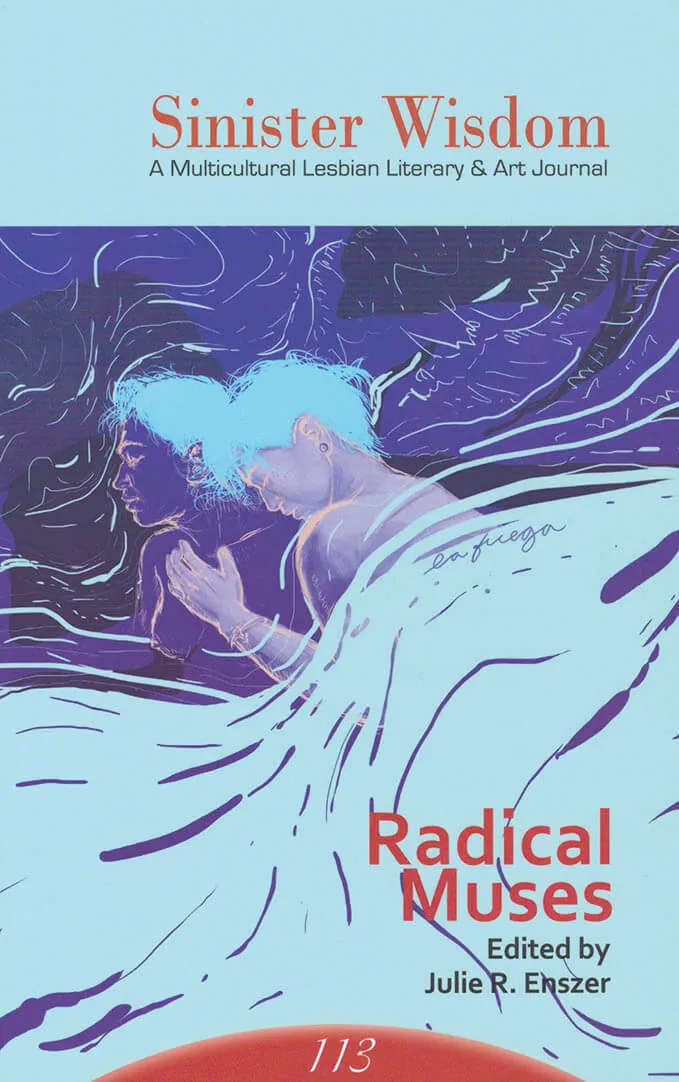
Cover of Radical Muses (Sinister Wisdom nr. 113)

Sinister Wisdom

Radical Muses (Sinister Wisdom nr. 113)

Julie R. Enszer

Sinister Wisdom 113: Radical Muses features an eclectic array of contemporary poetry, prose, and art by lesbians from around the world, including new work by: Andrea Assaf, Tara Shea Burke, Cheryl Clarke, Marina Chirkova, Estela González, Barbara Haas, Nancy E. Lake, Vi Khi Nao, H. Ní Aódagaín and much more!

Cover of The Letters of Audre Lorde and Pat Parker 1974-1989

the87press

The Letters of Audre Lorde and Pat Parker 1974-1989

Julie R. Enszer

Poets Audre Lorde and Pat Parker first met in 1969; they began exchanging letters regularly five years later. Over the next fifteen years, Lorde and Parker shared ideas, advice, and confidence through the mail. They sent each other handwritten and typewritten letters and postcards often with inserted items including articles, money, and videotapes.

The Letters of Audre Lorde and Pat Parker 1974-1989 gathers this unique correspondence in which Lorde and Parker discuss their work as writers as well as the intimate details of their lives, including periods when each lived with cancer. These letters are a rare opportunity to glimpse inside the minds and friendship of two great twentieth century poets.

Introduction by Mecca Jamilah Sullivan.

Cover of Love Belongs to Those Who Do the Feeling: New & Selected Poems (1966-2006)

Red Hen Press

Love Belongs to Those Who Do the Feeling: New & Selected Poems (1966-2006)

Judy Grahn

Poetry €22.00

An exciting collection of new and selected poetry by Judy Grahn. The book contains selections from Judy's entire body of poetic work from The Work of a Common Woman, The Queen of Wands and The Queen of Swords, to new poems written between 1997 and 2008.

Judy's poetry is rangy and provocative. It has been written at the heart of so many of the important social movements of the last forty years that the proper word is foundational.

Cover of Audible Heat

Tenement Press

Audible Heat

Milo Thesiger-Meacham

Ecology €25.00

A manuscript shortlisted for the inaugural edition of the Prototype Prize, 2024, a eulogy to the sonic influence and cultural inferences of the sound of the cicada. A train of thought on the multiform significations and significance of the cicada’s buzz and hum; a dissection and deconstruction of the insect as emblem; a wild and associative suite of fragments on the evocations of background noise when brought to the fore.

Milo Thesiger Meacham’s Audible Heat is a rich, meditative ecotone of ideas; a nimble and associative work of essayism that aims to map a reticulated cultural biography of the sound of the cicada. Equal parts academic argument, travelogue, and critical collage, this synthesis of ideas pulls upon a wide-ranging bibliography of materials to examine the omnipresent sound of the cicada as ‘audible heat’ throughout human history and culture. Herein, this climatic sound acts as a conduit between ecology, identity and mortality, and the cicada’s sonic inference emerges as a codification of the unknown and unfamiliar—as a spiritual weathervane in desert settings—and as a means of teasing out the sensorial limits of human understanding.

Thesiger-Meacham sits himself in a field of enquiry and in dialogue with voices various, ancient, and modern, such as Douglas Yanega of the University of California, folk musician Matthias Loibner, and Gene Kritsky, developer of Cicada Safari, a public app which tracks the mass emergence of periodical cicadas across North America, in a transversal network of interlinked, informational nodes.

Herein, we’ve the sonic-induced anxieties of 17th, 18th and 19th-century colonists in Northeastern America—notably the largely unknown career of entomologist Margaretta Morris—and the apocalyptic premonitions of the indigenous Wampanoag; Greek tongue twisters; the poetry of Ibn Quzmān and Harry Crosby; African American mathematician Benjamin Banneker’s lost wooden clock; Socrates' fear of dehydration; the geopolitical tensions embedded in Southern Spain as Al-Andalus (سُلَدْنَألا); Plato’s Phaedrus; a history of the hurdy-gurdy; Geronimo’s hatred of telegraphy; contemporary and historical entomologies; the slurred, slow body language of Clint Eastwood; insects on the film sets of Sergio Leone's Spanish Westerns; squinting; tanning; metamorphosis; acts of violence in Once Upon a Time in the West (1968); military reenactments of the Battle of Marathon (490 BCE); the botanist Donald C. Peattie’s existential dread; ancient cooking implements; riverside trees hills, and their symmetric reflections in still water…

All ideas emanating from the acoustical atmospherics inherent to the cicada’s song.

Cover of How to disappear

Kayfa ta

How to disappear

Haytham El-Wardany

Essays €10.00

This publication proposes a set of aural exercises that show readers how to disappear, reappear, join a group, or leave a group. Its annex is a lexicon of some of the sounds that dwell in or are banished from the middle-class household. 

Text: Haytham El-Wardany
Editors: Maha Maamoun and Ala Younis
Translated from Arabic by Jennifer Peterson (Preliminary Exercises) and Robin Moger (Sounds of the Middle Classes)

Cover of Tripwire 23 - Work/Anti-work

Tripwire Journal

Tripwire 23 - Work/Anti-work

David Buuck

Periodicals €18.00

Work/Anti-work issue with writing by Nat Raha /. lisa minerva luxx /Ghayath Almadhoun, trans. Catherine Cobham / Jacqui Germain / Jazra Khaleed, trans. Peter Constantine / Finn Finneran / Cait O’Kane / Rebecca Kosick / Lara Durback Skye /Lotta Thießen / William Rowe / Danny Hayward / Rona Lorimer / Zoe Beloff / Jike Ayou, trans. Yě Yě / Miguel de Vallester, trans. Erasmo Pantoja / Lucas Martínez / ko ko thett / Hung Q. Tu / Raymond de Borja / etaïnn zwer, trans. Ilan A.L.S. Erikson Weisbrod / Annie Raab on Taylor Portela / Rachael Guynn Wilson on Lyn Hejinian / Will Rowe on Danny Hayward / Chloe Watlington on Joshua Clover