rile*books

Search books

Search books by title, author, publisher, keywords...

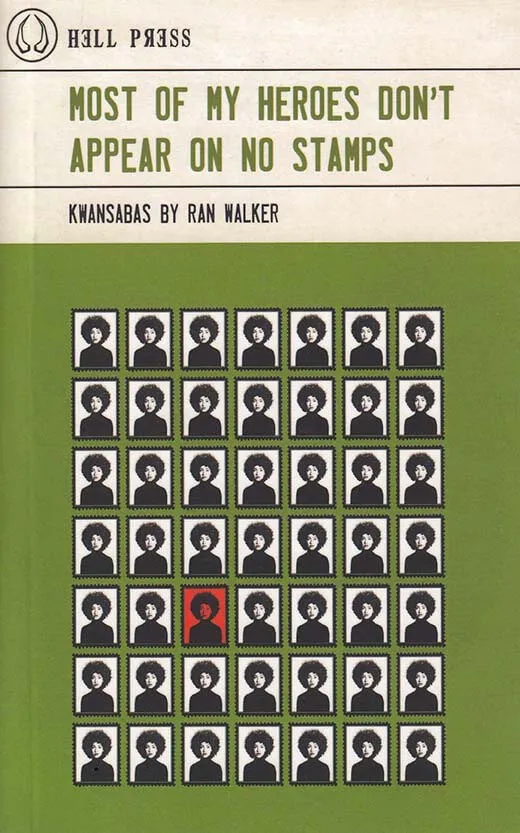
Cover of Most of my heroes don't appear on no stamps

University of Hell Press

Most of my heroes don't appear on no stamps

Ran Walker

€15.00

The poems in Ran Walker's collection use an African-American poetic form called the Kwansaba, which was created in 1995 by Dr. Eugene Redmond. The poems follow a seven-line, seven-words per line pattern with no word more than seven letters (save proper nouns and foreign terms). All language within the form speaks to aspects of African-American history and culture. With these forty-nine poems, each chapter of forty-nine lines, Walker offers profound commentary on a wide variety of topics ranging from interrogations of celebrity culture to issues that speak directly to the Black Lives Matter movement.

Published in 2019 ┊ 92 pages ┊ Language: English

recommendations

Cover of Lola the Interpreter

Wesleyan

Lola the Interpreter

Lyn Hejinian

Poetry €19.00

The final book by the award-winning and celebrated writer Lyn Hejinian. 

Lyn Hejinian's Lola the Interpreter is a prose poem in which an 'I' and a series of quasi-characters (including Lola) interpret one another, their quotidian lives, and the terms, categories, and presuppositions that allow fragments of experience to be extracted from the flux of perception and framed as objects of analysis. This work stands as a culmination of Hejinian's lifelong exploration of thought's infrastructure, threading through her oeuvre from A Thought is the Bride of What Thinking to My Life and A Border Comedy, to this, her last book. What perhaps marks Lola as a work of late style, of new experimentalism even at the twilight of Hejinian's life, is the extent to which the interpretation that at first seems to be generated out of discrete events transcends its ostensible occasion and becomes philosophy more broadly, a philosophy poised between a necessary skepticism toward the given or imposed and a life-affirming commitment to the emergent possibilities within the ever-shifting and uncertain domain of daily existence. 

Cover of Document

World Poetry Books

Document

Amelia Rosselli, Roberta Antognini and 1 more

Poetry €24.00

The pivotal 1976 work of one of Italy's most significant post-war voices asks how poetry can document lived experience while dialoguing with the Petrarchan sonnet tradition. Long fascinated by the classical sonnet as an ideal model, Rosselli took on the Petrarchan structure of a canzoniere—a text in which meaning is generated by sequence—to contain the flood of 175 poems for her third collection. Speaking of Document, Rosselli said: “It was hard work; those who do not write poetry cannot imagine to what lengths poets go in order to compose, even if they barely scrape by, and even if it’s still the case that poetry is either inspired or worthless.” This “hard work” conveyed the pain, intensity, and turmoil of her existence and of our own violent chaotic times. Originally published in 1976, Document is the last of her major collections to be translated into English.

I think the great anti-fascist poet Amelia Rosselli has always been in a "lockdown" mode of existence. Document documents Rosselli's internal well, an echo chamber-she orchestrates the signals of global turmoil of war, violence, class struggle, religion, consumerism, financial capitalism. Nothing goes amiss inside her chamber. Rosselli’s oblique, taut, and mocking entries pile up relentlessly—they make up an anti-fascist soliloquy that also echoes the "lockdown" of our current troubled era. — DON MEE CHOI

Amelia Rosselli is one of the towering poets of the twentieth century, so we owe immense gratitude to Roberta Antognini & Deborah Woodard for bringing Documento, Rosselli’s third book, to an anglophone public in full for the first time, in a sharp translation with helpful notes. Less overtly biting and difficult than Rosselli’s previous work-at least at first-these barbed lyrics will initiate new readers into her mind-bending oeuvre. As she writes at the start, "in the end I wrote beautiful things, all of them / for you." Yes: that means you. — BARRY SCHWABSKY

Cover of Negativity

Atelos

Negativity

Joceylyn Saidenberg

Poetry €16.00

Jocelyn Saidenberg's third book of poetry begins in a "dusky" wood, but instead of descending to hell she journeys through the negativity of earthly relations. We hear of friends, lovers, and a declining country—all filtered by a consciousness equally troubled by its own suffering and the suffering of others. Saidenberg has written some of the most accomplished, grounded and reflective poetry of the last decade. She is previously the author of CUSP (2001) and MORTAL CITY (1998), and the founder and publisher of Krupskaya Books.

Cover of A Catalogue of Risk

Wendy's Subway

A Catalogue of Risk

Alisha Mascarenhas

Poetry €18.00

Alisha Mascarenhas’s A Catalogue of Risk is a volte-face of the neoliberal market economy’s construction of isolated, individual safety. In her debut book of poems, Mascarenhas lingers in the question of risk as it arises in daily life and intimacy. Through a close study and partial translation of philosopher-psychoanalyst Anne Dufourmantelle’s Éloge du risque (2011), her poems posit risk as a fissure, through which we might imagine yet-unknown futures.

Alisha Mascarenhas’s A Catalogue of Risk is the recipient of the 2022 Carolyn Bush Award.

Alisha Mascarenhas (b. 1989) is a poet and translator and the author, most recently, of the chaplet Contagion Fields (Belladonna* 2021). She has contributed writing to Pamenar Press, The Poetry Project Newsletter, The Recluse, Peripheral Review, and The Felt, among others. Alisha was a 2023 resident at La Baldi Artist’s Residency in Montegiovi, Italy. She holds an MFA in Writing from Pratt Institute in Brooklyn, where she now lives.

There is a body lying across Alisha Mascarenhas’s A Catalogue of Risk. Here is a book of generosity and perdition, that could not anticipate the death of its author, the one these works are addressed to, written for, dreamt by, in a stream of proximities. A strange dismantling of time occurs as a result of quiet reversals in which light is diffracted across belated syntaxes, reaching past life to the living. Though A Catalogue of Risk is “running past the flowers,” it is a slow text that grieves the day’s illuminations. It is a lesson in transmission in which we, readers, are the apprentices of grace, at the edge also of drowning. Here is a book that has been “hungering to be emptied.” So, too, is it a book of promise.
Nathanaël

A Catalogue of Risk is a book of luminous attention. Alisha Mascarenhas gives us the language of a mind tracking both internal and external weathers, tuning and returning herself to beauty, fear, grief and desire. Attending a cascade of emotions, the poet dwells in questions, knowing that to keep open to difficult questions is to keep open to desire. That she risks such openness, thinking always with others, through pain and love, is an astonishment. 
— Madhu Kaza

A Catalogue of Risk poses an evocative challenge, one of prismatic nuance: to pursue multiple angles of intimacy along the life-death continuum of how risk holds, unfolds, and makes one whole. “The definition” of what risk is “is shaded in questions” and runs a gamut of desires and sensations at once libidinal and cerebral. Alisha Mascarenhas risks risk itself with this generous offering of exquisite phenomenology and experiential trace in the form of a full-saturation poetics glowing in amplitude and intensity.
— Brenda Iijima

Cover of Positions of the Sun

Belladonna* Collaborative

Positions of the Sun

Lyn Hejinian

Poetry €18.00

The second work in Belladonna* Collaborative’s Germinal Texts series, Lyn Hejinian’s Positions of the Sun is a book of twenty-six interlocking “essays with characters” that explores the mid-2000s financial “crisis” through the movements and daily lives of a wide-ranging cast of characters located in the Bay Area.

In Positions, Hejinian plays the bricoleur, bringing together whatever’s needed in her to approach to the subject—whether the paratactic tactics of poetry, scholarship’s critical patchwork, or dramatis personae set in time that evokes but frustrates narrative.

Earlier iterations of essays 4, 14, and 17 appeared in Belladonna*’s Elders Series #5, edited by Jennifer Scappettone with work by Etel Adnan, Lyn Hejinian, and Jennifer Scappettone.