rile*books

Search books

Search books by title, author, publisher, keywords...

Explore

Categories
Visit
Collections
Publishers
Back in stock
Any books
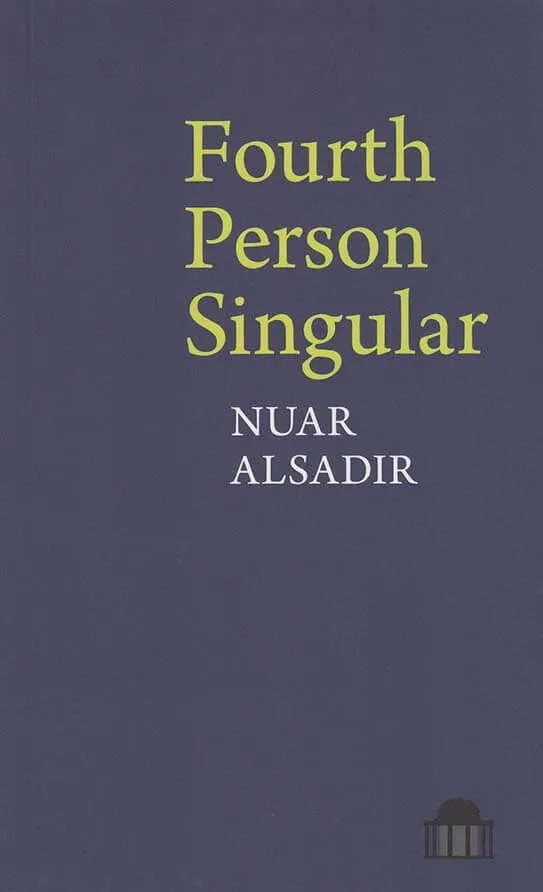
Cover of Fourth Person Singular

Liverpool University Press

Fourth Person Singular

Nuar Alsadir

€20.00

Fourth Person Singular sets open the relationship between self and world in a working through of lyric shame, bending poetic form through fragment, lyric essay, aphorisms mined from the unconscious, and pop-up associations, to explore the complexities, congruities, disturbances - as well as the beauty - involved in self-representation in language.

Language: English

recommendations

Cover of How To Wash A Heart

Liverpool University Press

How To Wash A Heart

Bhanu Kapil

Poetry €20.00

How To Wash A Heart, Kapil's first full-length collection published in the U.K., depicts the complex relations that emerge between an immigrant guest and a citizen host. Drawn from a first performance at the ICA in London in 2019, and using poetry as a mode of interrogation that is both rigorous, compassionate, surreal, comic, painful and tender, by turn, Kapil begins to ask difficult and urgent questions about the limits of inclusion, hospitality and care.

Winner of the T.S. Eliot Prize 2020. 
Poetry Book Society Choice for Summer 2020.

Cover of Juvenilia #2

Tabloid Publications

Juvenilia #2

Willa Smart

Poetry €12.00

Ludi Juvenales (Latin for "juvenile games') is a poetry, art and games series interested in youth, childhood, play, and immaturity. 

Ludi Juvenales is edited by Elise Houcek & Zoe Darsee

www.ludijuvenales.com

Juvenilia #2 by Willa Smart.
Copyright C Willa Smart 2024. All rights reserved.
Cover art by K. Fabricant.
Design by Elise Houcek & Zoe Darsee.
Risograph printed with BearBear in Milwaukee, Wisconsin.
Edition of 50.

Cover of The Hungering Years

Host Publications

The Hungering Years

Summer Farah

Poetry €20.00

Utterly magnetic, Summer Farah’s debut poetry collection The Hungering Years is a rush of breathless song, voicing confessions so often left unsung amidst personal and collective crisis. “I am afraid of asking the right questions,” Farah admits. But through intimate conversations with fellow Arab-American writer and literary ancestor Etel Adnan, this work finds the courage to ask: What is art? An escape? A reflection? Another unhealthy attachment? Though the answers are elusive, what steps into the light is a collective of friends whose genuine care and companionship anchor these poems through their spiraling search. 

“I am always looking for Palestine, and yes, I am always looking for love,” these poems croon, holding so much of the world even as they trace an inheritance of displacement. The Hungering Years conjures startling landscapes where we may also experience what it is to be consumed by obsession, echoing with songs by Mitski, iconic scenes from Supernatural, and the sound of the Mediterranean Sea. But as Lena Khalaf Tuffaha writes in her introduction, Farah’s repetitions “are more than echo. They are a vernacular of this unspeakable era,” anchored in “questions that keep us reaching toward life,” and questions toward each other.

Building glass structures from her questions, Farah pushes their architecture almost to breaking. Then breaking, the spirit—luminous, actualized—reveals itself through the cracks. Through the landscapes of California, Palestine, and all of the distances in between, there emerges a new sense of devotion to what is possible which might thrust us, together, “off the edge, / in love, towards God.”

With an introduction by poet, essayist, and translator Lena Khalaf Tuffaha.

Summer Farah’s debut collection The Hungering Years bubbles with language, is desirous, sensitive, and hysterically (ferociously) human. “I” is I, is mother, is the guiding wisdom of Etel Adnan, is Palestine, is the work that writes Palestine into the future, is the epistolary thread of love that holds this daring young poet’s work together. “i am an enemy of dust i am an amalgamation of everyone i have ever loved …” writes Farah, enlisting us in this vital poetry against the death cult, lush with solidarity, teeming with the futurity we need. — Wendy Xu, author of The Past

What I most adore about Summer Farah's work, and what most comes alive in The Hungering Years is that there is no such thing as an unworthy affection, nothing unworthy of close and careful attention, nothing unworthy of being pressed up against the undeserving world and becoming something greater. This is a gift and a delight, and through that gift, these poems are richly and generously populated, and teeming with beauty. — Hanif Abdurraqib, author of There’s Always This Year

Summer Farah's words ease me, compel me, motivate me. Her work is agile and brilliant, her mind potent and illustrious—like air, a song, rhythmic and concise. These poems move me to my core, rupturing something deep inside of me about place, Palestine and Etel Adnan. "I memorize no language/but their voices," she writes as I memorize her words again and again, uttering gratitude that I get to be alive and read Summer's words. This book is both a spell and an oracle. — Fariha Róisín, author of Survival Takes a Wild Imagination

Cover of Negativity

Atelos

Negativity

Joceylyn Saidenberg

Poetry €16.00

Jocelyn Saidenberg's third book of poetry begins in a "dusky" wood, but instead of descending to hell she journeys through the negativity of earthly relations. We hear of friends, lovers, and a declining country—all filtered by a consciousness equally troubled by its own suffering and the suffering of others. Saidenberg has written some of the most accomplished, grounded and reflective poetry of the last decade. She is previously the author of CUSP (2001) and MORTAL CITY (1998), and the founder and publisher of Krupskaya Books.

Cover of Borderlands / La Frontera: The New Mestiza 5th Edition

aunt lute books

Borderlands / La Frontera: The New Mestiza 5th Edition

Gloria Anzaldua

Poetry €29.00

A new edition of Anzaldúa's classic text.

Borderlands/La Frontera: The New Mestiza is a 1987 semi-autobiographical work by Gloria E. Anzaldúa that examines the Chicano and Latino experience through the lens of issues such as gender, identity, race, and colonialism. Borderlands is considered to be Anzaldúa’s most well-known work and a pioneering piece of Chicana literature.

Rooted in Gloria Anzaldúa's experience as a Chicana, a lesbian, an activist, and a writer, the essays and poems in Borderlands/La Frontera: The New Mestiza profoundly challenged, and continue to challenge, how we think about identity. Borderlands/La Frontera remaps our understanding of what a border' is, presenting it not as a simple divide between here and there, us and them, but as a psychic, social, and cultural terrain that we inhabit, and that inhabits all of us.

Cover of Black Bedouin

1080 Press

Black Bedouin

Mohammed Zenia, Tenaya Nasser

Poetry €30.00

Black Bedouin, by Mohammed Zenia and Tenaya Nasser is a book of the IMMEDIATE — written immediately (in the span of five days, very literally at the printing press at 1080PRESS) in response to the current genocide against, and in solidarity with, the people of Sudan and in the context of immediate echoes in Palestine, Congo, Pakistan, and more — and throughout it all imbued with the immediacy that the global situation demands of us and our moral consciences. Black Bedouin rings in the creative immediacy of New York School all-night-writing-to-mimeograph-next-day with the political immediacy of a this-is-happening-right-now Crass single or Etel Adnan's incomparable (but here spiritually correlated) The Arab Apocalypse. In other words, Black Bedouin hits every star in a very cool and specific constellation. — Dave Morse