rile*books

Search books

Search books by title, author, publisher, keywords...

Explore

Categories
Visit
Collections
Publishers
Back in stock
Any books
Cover of A Mycological Foray: Variations on Mushrooms

Atelier Editions

A Mycological Foray: Variations on Mushrooms

John Cage

€50.00

[Slightly damaged cover. Reduced price from 60 euros.] Foraging for mushrooms with John Cage: writing, art, photography and ephemera from an idiosyncratic chapter in the composer's life

Imagined as an extended mushroom-foraging expedition, John Cage: A Mycological Foray gathers together Cage's mushroom-themed compositions, photographs, illustrations and ephemera. Indeterminacy Stories and other writings by Cage are interwoven throughout the first volume within a central essay examining Cage's enduring relationship with mycology. Also included is a transcript of Cage's 1983 performance, MUSHROOMS et Variationes. The second volume is the inaugural reproduction of Cage's 1972 portfolio, Mushroom Book, authored in collaboration with illustrator Lois Long and botanist Alexander H. Smith. Readers are thus drawn through the landscape of Cage's mycologically centred oeuvre and interests, discovering assorted works, images, compositions, philosophies and ephemera, as one might encounter assorted fungi and flora while foraging.

John Cage: A Mycological Foray constitutes a new, idiosyncratic chapter in Cage's oeuvre, a departure from the composer's more established narrative.

American composer and music theorist John Cage (1912-92) was a pioneer of indeterminacy in music, electroacoustic music and a leading figure of the postwar avant-garde. His influence extended to the realms of dance, poetry, performance and visual art.

Published in 2020 ┊ 224 pages ┊ Paperback ┊ Language: English

recommendations

Cover of Wistlin is did

Cordite Books

Wistlin is did

Chris Mann

Poetry €19.00

Chris Mann is an Australian-American composer, poet and performer specializing in compositional linguistics. Mann studied Chinese and linguistics at the University of Melbourne, and his interest in language, systems, and philosophy is evident in his work. Mann founded the New Music Centre in 1972 and taught at the State College of Victoria in the mid-1970s. Mann moved to New York in the 1980s and was an associate of American composers John Cage and Kenneth Gaburo. Mann has recorded with the ensemble Machine For Making Sense with Amanda Stewart and others, Chris Mann and the Impediments, and Chris Mann and The Use. Mann currently teaches in the Media Studies Graduate program at The New School.

Cover of Schizo-Culture: The Event, The Book

Semiotext(e)

Schizo-Culture: The Event, The Book

Sylvère Lotringer, David Morris

Philosophy €42.00

The legendary 1975 "Schizo-Culture" conference, conceived by the early Semiotext(e) collective, began as an attempt to introduce the then-unknown radical philosophies of post-'68 France to the American avant-garde. The event featured a series of seminal papers, from Deleuze's first presentation of the concept of the "rhizome" to Foucault's introduction of his History of Sexuality project. The conference was equally important on a political level, and brought together a diverse group of activists, thinkers, patients, and ex-cons in order to address the challenge of penal and psychiatric institutions. The combination proved to be explosive, but amid the fighting and confusion "Schizo-Culture" revealed deep ruptures in left politics, French thought, and American culture.

The "Schizo-Culture" issue of the Semiotext(e) journal came three years later. Designed by a group of artists and filmmakers including Kathryn Bigelow and Denise Green, it documented the chaotic creativity of an emerging downtown New York scene, and offered interviews with artists, theorists, writers, and No Wave and pre-punk musicians together with new texts from Deleuze, Foucault, R. D. Laing, and other conference participants.

This slip-cased edition includes The Book: 1978, a facsimile reproduction of the original Schizo-Culture publication; and The Event: 1975, a previously unpublished and comprehensive record of the conference that set it all off. It assembles many previously unpublished texts, including a detailed selection of interviews reconstructing the events, and features Félix Guattari, William Burroughs, Kathy Acker, Michel Foucault, Sylvère Lotringer, Guy Hocquenghem, Gilles Deleuze, John Rajchman, Robert Wilson, Joel Kovel, Jack Smith, Jean-François Lyotard, Ti-Grace Atkinson, François Peraldi, and John Cage.

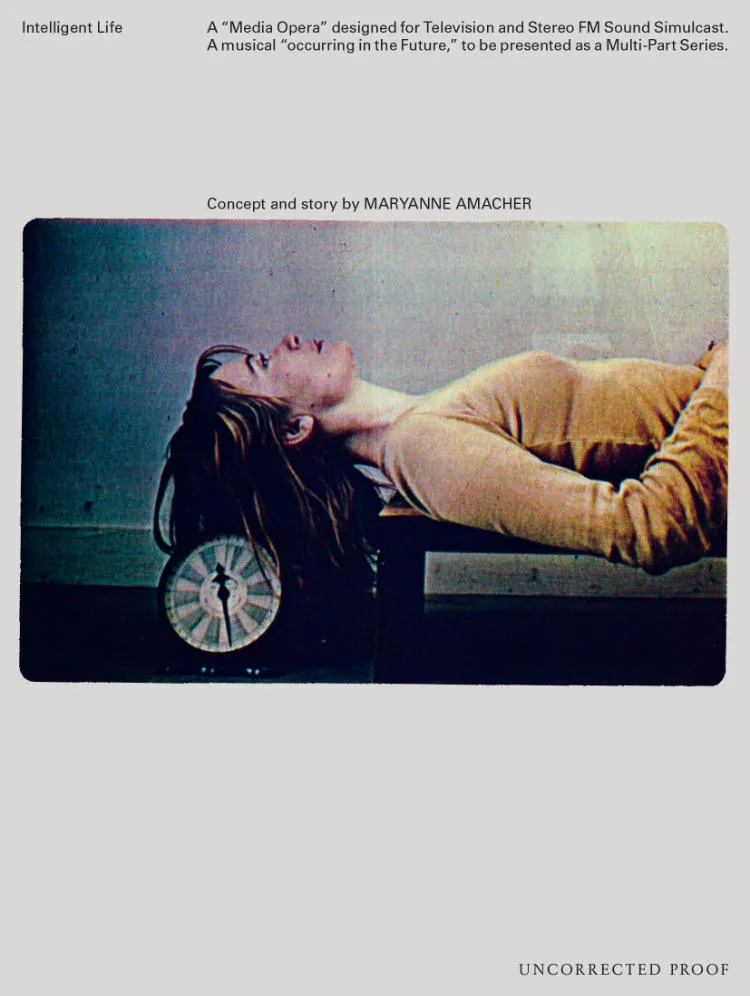
Cover of Intelligent Life

Blank Forms

Intelligent Life

Maryanne Amacher

Comprehensive and previously unpublished documentation on the American composer's unproduced magnum opus.

Had it been produced, Maryanne Amacher's media opera Intelligent Life would have represented the summation of the composer's concept to date. As she wrote to John Cage in the autumn of 1983, following the untimely deaths of the opera's patrons—Wies Smals, founder of De Appel, and curator Josine van Droffelaar, in a plane crash in the Swiss Alps—she would have at last had the support to "communicate the finest of my thought to others." Amacher's serial, intended for broadcast, sought to transmit her evolving ideas about perception, listening, and composition to a broader public—shifting music away from "nod and tap recognition" toward a transformative practice that could awaken intelligence to "unrecognized and new perceptual modes."

Set in the year 2021, Intelligent Life follows the employees of Supreme Connections LLC, a music entertainment corporation navigating a future in which artificial intelligence generates music faster than composers can. Anticipating an industry-wide downturn, Supreme Connections president Aplisa Kandel seeks advanced technologies that will revolutionize the act of listening and the future of music, including a bio-music script that lets the user hear Bach from the aural perspective of a reindeer and a wearable device that goes beyond replicating the mechanical tympanic resonances of the listening subject to produce the "listening mind" or the "sophisticated perceiver"—capturing and reproducing all the emotional and psychological associations unique to each individual.
Though Amacher could not realize Intelligent Life in any of its intended forms—she theorized its publication as a serialized radio broadcast and television simulcast, among other configurations—she continued designing "treatments" for the opera for much of her career. This volume makes the most complete of these working documents—including episodic scripts, notes on the use of LaserDisc, and an illustrated storyboard for the pilot—available to the public for the first time.

Maryanne Amacher (1938-2009) was a composer of large-scale fixed-duration sound installations and a highly original thinker in the areas of perception, sound spatialization, creative intelligence, and aural architecture. She is frequently cited as a pioneer of what has come to be called “sound art,” although her thought and creative practice consistently challenges key assumptions about the capacities and limitations of that genre. Often considered to be a part of a post-Cagean lineage, her work anticipates some of the most important developments in network culture, media arts, acoustic ecology, and sound studies.

Cover of Silence: Lectures and Writings

Wesleyan

Silence: Lectures and Writings

John Cage

Essays €27.00

Silence: Lectures and Writings is a book by American experimental composer John Cage (1912–1992), first published in 1961 by Wesleyan University Press. Silence is a collection of essays and lectures Cage wrote during the period from 1939 to 1961.

Most of the works are preceded by a short commentary on their origins, some have an afterword provided. Several works feature unorthodox methods of presentation and/or composition. "The Future of Music: Credo" juxtaposes paragraphs of two different texts. The text of the first part of "Composition as Process" is presented in four columns, the text of "Erik Satie" in two. "45' for a Speaker" is similar to Cage's "time length" compositions: it provides detailed instructions for the speaker as to exactly when a particular sentence or a phrase should be said. "Where Are We Going? and What Are We Doing?" is presented in several types of typeface to better reflect the concept of the lecture, which was originally presented as four tapes running simultaneously. "Indeterminacy" is a collection of various anecdotes and short stories taken from life or books Cage read: the concept is to tell one story per minute, and to achieve the speaker has to either speed up or slow down, depending on the length of the story.

Cover of Of Planters; an Herbarium

Birthday, Felony & Fuss

Of Planters; an Herbarium

COUR

Ecology €28.00

Published in tumult of “Planters, a garden show” by COUR: with Noëmi Orgaer, Orson Van Beek, Charlotte Bombel, Moreno Schweikle, Shun Yoon, Yen Proesmans, Benny Van den Meulengracht-Vrancx, HansWuyts, Malte van der Meyden, Fritz Adamski, Hannah Kuhlmann, Delphine Lejeune, Grażyna Mielech and Giseok Kim. 

Cover of Ductus

Self-Published

Ductus

Paul Abbot

Performance €10.00

DUCTUS is the latest solo project by Paul Abbott, featuring 51 minutes of audio, across 12 tracks, and a 42 page booklet featuring new writing. DUCTUS was written and recorded in Edinburgh and Porto in 2019. 

DUCTUS presents a playful weave of collapsing time through a number of speculative elements and fictional characters. Abbott feels his way through learning drums, rhythm and writing as fleshy research technologies. DUCTUS is the latest stage in a process considering sound, the body, imagination, and language through music. This features as part of ongoing investigations using real and imaginary drums, synthetic sounds, performance and writing.

Cover of Ironic Resonance, Anti-sound Design and Radical Cacophony in Jia Zhangke's Xiao Wu

Courtisane

Ironic Resonance, Anti-sound Design and Radical Cacophony in Jia Zhangke's Xiao Wu

Morgan Quaintance

Noise in Xiao Wu is not a negative presence. It reinforces the thereness of Zhangke’s Fenyang, the inner and outer lives of his characters. Noise is articulate, just as it is in the cacophonous zones of cities around the world. Who knows if it was modernity en masse that constituted the vulgar soundscape for RM Schafer when he was predicting sonic doom in 1977… But if modernity is vulgar, what then is refined? The absence of sound, one might guess: a library, a Buddhist temple, a suburb, death. Aesthetic value judgements and speculations aside silence is, well, silent. Noise on the other hand, is filled with information. Noise speaks, and in the Fenyang of Xiao Wu it never shuts up. Well then, let’s listen to what it is saying. 
— Morgan Quaintance

In the context of The Skin of the World program at Courtisane festival 2024, Morgan Quaintance was invited to reflect on the use of sound in Jia Zhangke’s Xiao Wu (Pickpocket).

2nd publication in the Echoes of Dissent series, devoted to the politics of the soundtrack. 

Cover of Livre d'images sans images (LP)

Varamo Press

Livre d'images sans images (LP)

Iben Edvardsen, Mette Edvardsen

Performance €23.00

Livre d’images sans images by Mette Edvardsen & Iben Edvardsen borrows its title from a book by H.C. Andersen, also referred to as The Moon Chronicler. The book follows a conversation between a painter and the Moon, where the Moon describes to the painter what she sees on her journey around the world every evening, telling the painter to paint what she describes. “This conversation, as in the now obsolete meaning of the word (‘a place where one lives or dwells’), was the starting point for our work. Using the weather report as dramaturgy, (‘the moon did not show up every evening, sometimes a cloud came in between’), we have created and collected materials from our conversations in the form of recordings, text, voice, drawings, references, found images, loose connections, inspirations and imaginations, in the order they came to us. They are at the same time sources and traces, material and support for new imaginations or events to come.” The work consists of three different media: vinyl, paper and live performance. 

Mette Edvardsen is a choreographer and performer eager to explore the performing arts as a practice and situation, also in relation to other media such as books and writing. This work is in collaboration with her daughter, Iben Edvardsen.

Published by Xing & Varamo Press
XONG collection – artist records XX10 (2023)
First edition, September 2023
Recorded and edited by Mette Edvardsen & Iben Edvardsen
Format white 12’ vinyl LP in cardboard sleeve
Released in a numbered edition of 300 copies, including collector’s edition of 25 copies, each accompanied by a unique poster hand drawn with black marker by Mette Edvardsen & Iben Edvardsen, 59,4 x 84 cm, folded, signed by the artists